
- Startseite

- Artikel
- The Visceral Self: Exploring Emotion & Identity in Expressionist Portraiture
The Visceral Self: Exploring Emotion & Identity in Expressionist Portraiture
Inhaltsverzeichnis
The Dawn of Inner Worlds: Contextualizing Expressionism
Expressionism is a modernist movement, initially in poetry and painting, originating in Northern Europe around the beginning of the 20th century. Its typical trait is to present the world solely from a subjective perspective, distorting it radically ...
The early decades of the 20th century were a crucible of change, a period marked by rapid industrialization, burgeoning psychoanalysis, and the looming shadow of global conflict. Traditional artistic conventions, focused on objective representation, began to feel inadequate in capturing the anxieties and complexities of modern existence. From this ferment arose Expressionism – not merely a style, but a profound shift in perspective. It wasn’t about depicting what things *looked* like, but rather how they *felt*. This movement, originating primarily in Germany and Austria, sought to convey subjective experience, often through jarring color, distorted forms, and emotionally charged brushwork. The world was no longer viewed as a stable reality to be passively observed, but as an internal landscape shaped by individual perception – and frequently, by profound unease.
While precursors existed in the works of artists like Edvard Munch—whose “The Scream” remains an iconic emblem of existential dread—and Vincent van Gogh’s intensely personal depictions of nature, Expressionism coalesced around a desire to break free from Impressionistic objectivity. Artists felt compelled to express not just what they saw, but what they *felt* about what they saw, and more importantly, what it meant to be alive in an increasingly fragmented world. The philosophical undercurrents of Friedrich Nietzsche’s critiques of morality and the burgeoning field of psychoanalysis, pioneered by Sigmund Freud, provided a theoretical framework for this inward turn.
Beyond Likeness: The Psychological Portrait in Focus
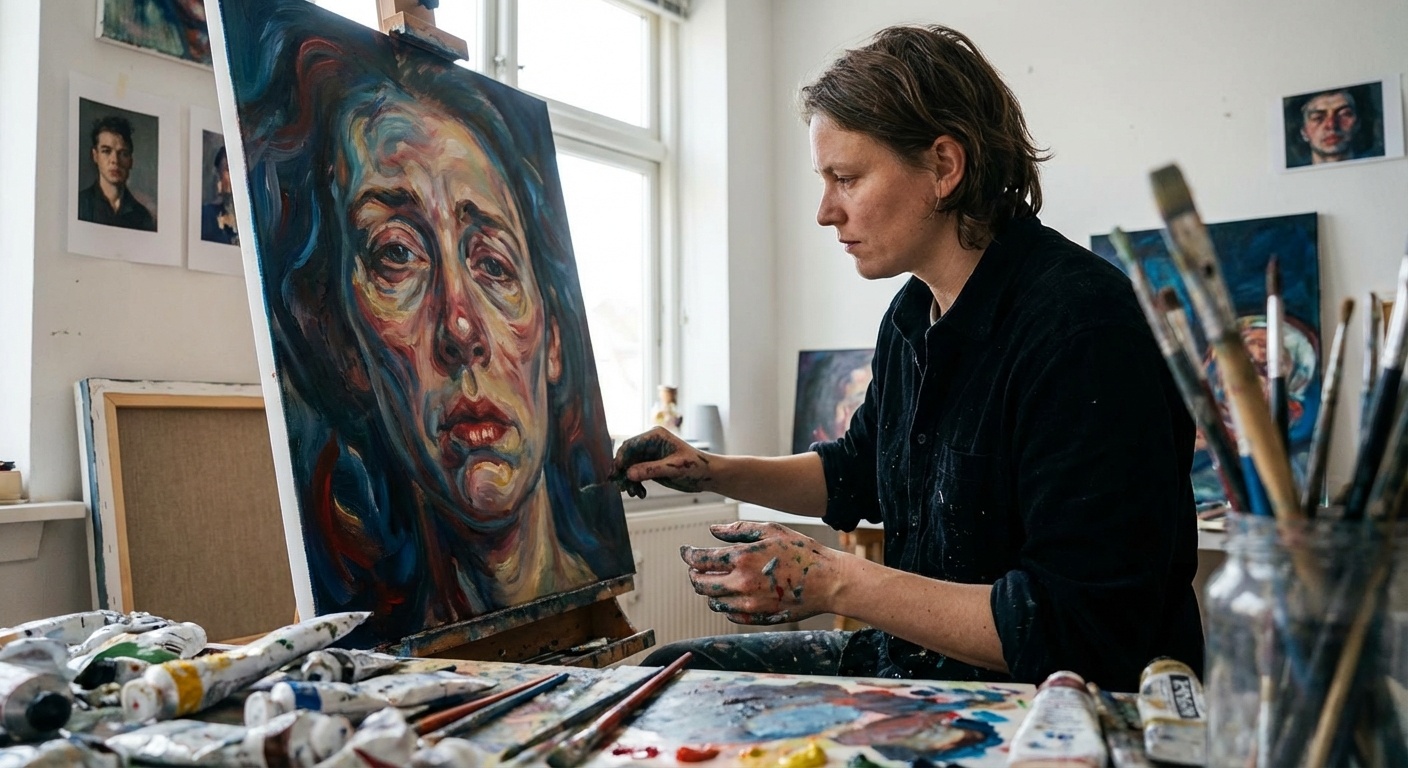
The portrait, historically a genre dedicated to capturing outward appearance and social status, became a vehicle for exploring the inner life. Expressionist artists weren’t interested in flattering their sitters or adhering to conventional standards of beauty. Instead, they sought to reveal psychological states – anxiety, alienation, despair, but also moments of intense introspection. This often involved a deliberate rejection of naturalistic representation. Features were exaggerated, colors were non-naturalistic, and backgrounds were simplified or distorted to amplify the emotional impact. The goal wasn’t to create a faithful likeness, but to communicate a sense of the sitter's inner turmoil.
The MoMA collection provides compelling examples of this shift. Expressionist portraits often feel unsettling precisely because they bypass superficiality and delve directly into the raw emotions beneath the surface. The gaze of the subject is rarely inviting; it’s frequently intense, probing, or even accusatory. This isn't about capturing a moment in time, but about revealing a fundamental truth about the human condition – a truth often obscured by social conventions.
Distortion & Color as Emotional Language
The techniques employed by Expressionist portraitists were deliberately provocative. Distortion wasn’t simply an aesthetic choice; it was a means of conveying emotional intensity. A stretched face, angular features, or disproportionate limbs could visually represent inner tension and psychological stress. Similarly, color became divorced from its descriptive function. Artists used bold, often clashing hues – jarring reds, sickly greens, and oppressive blues – to evoke specific moods and feelings. Complementary colors were frequently employed to create a sense of unease and visual dissonance.
Ernst Ludwig Kirchner’s work exemplifies this approach. His portraits are characterized by angular figures, flattened perspectives, and intense color palettes that reflect the alienation and anxiety of modern urban life. The use of non-naturalistic colors isn't arbitrary; it’s a deliberate attempt to bypass rational perception and tap into primal emotions. The brushstrokes themselves often contribute to this effect – they are frequently visible, energetic, and even violent, mirroring the emotional turmoil being depicted.
Key Figures and Their Intimate Visions: Kirchner, Dix, and Modersohn-Becker
Ernst Ludwig Kirchner, a founding member of Die Brücke (The Bridge), produced portraits that captured the frenetic energy and social alienation of Berlin. His “Self-Portrait as a Sick Man” (1917) is particularly poignant, reflecting his physical and psychological breakdown during World War I. The painting’s stark colors and distorted form convey a sense of profound despair and isolation.
Otto Dix, emerging after the war, adopted a more brutally realistic style known as Neue Sachlichkeit (New Objectivity). However, even in his unflinching depictions of post-war Germany, a strong emotional undercurrent persists. His portrait of “Mrs. Otto Mueller” is a striking example – a monochrome charcoal study that reveals both strength and vulnerability. The starkness of the image reflects the disillusionment and moral decay of Weimar society.
Paula Modersohn-Becker, often overlooked, was a pioneer of Expressionism whose intimate self-portraits explored themes of motherhood, identity, and female experience. Her work predates many of the better-known male artists associated with the movement, and her unflinching honesty paved the way for future generations of female artists. She used simplified forms and bold colors to convey a sense of inner strength and psychological depth.
The Enduring Legacy: Expressionism’s Influence on Contemporary Art
Expressionism didn't simply disappear with the rise of other artistic movements. Its influence can be seen in countless subsequent styles, from Abstract Expressionism to Neo-Expressionism. The emphasis on subjective experience, emotional intensity, and the rejection of traditional conventions continues to resonate with artists today. The willingness to confront difficult emotions and explore the darker aspects of human existence remains a powerful force in contemporary art.
Ludwig Meidner’s apocalyptic landscapes, anticipating the horrors of WWI, demonstrate how Expressionism could be used to express collective anxieties and premonitions. His work serves as a reminder that art can be more than just aesthetic pleasure; it can be a powerful tool for social commentary and psychological exploration.
Collecting the Visceral: Considerations for Building an Expressionist Portrait Collection
For collectors drawn to the emotional power of Expressionist portraiture, several factors should be considered. Authenticity is paramount – verifying provenance and seeking expert appraisal are crucial steps. The market for Expressionist works can be competitive, so thorough research is essential.
Beyond financial considerations, it’s important to consider your personal connection to the work. Do you respond emotionally to the artist's vision? Does the painting resonate with your own experiences or beliefs? Building a collection should be driven by passion and intellectual curiosity as much as investment potential. ArtsDot.com offers museum-quality reproductions of Expressionist masterpieces, allowing collectors to experience the power of these works firsthand. We also provide custom reproduction services, enabling you to transform personal photos into artworks in the style of your favorite Expressionist artists – a unique way to connect with this enduring legacy. For further guidance on art consultation or appraisal, please visit /en/orders/art-consultation/.
Ähnliche Artikel

Egon Schiele: Ausdrucksstil, Angst und die Moderne – Eine umfassende Betrachtung
Entdecken Sie die tiefgründige Welt von Egon Schiele! Unsere umfassende Analyse beleuchtet seinen expressiven Stil, die Darstellung von Angst und seinen Einfluss auf die Moderne. Jetzt lesen!

Figurative Expressionism: Emotional Intensity & Subjective Reality in 20th-Century Art
Explore the powerful world of Figurative Expressionism with ArtsDot. Discover key artists like Kirchner & Beckmann, understand its emotional depth, and learn how to collect this influential 20th-century art movement.

Deutsche Expressionismus Meisterwerke: Die 10 wichtigsten Kunstwerke für Ihr Zuhause
Entdecken Sie die 10 bedeutendsten Werke des Deutschen Expressionismus! Kirchner, Nolde & Co. – ihre Geschichten, Techniken und zeitlose Schönheit. Hochwertige Kunstdrucke auf ArtsDot.com kaufen und Ihr Zuhause mit emotionaler Kunst bereichern. Jetzt entdecken!

Oskar Kokoschka: Ein expressionistisches Leben zwischen Leidenschaft und Revolution
Entdecken Sie das turbulente Leben und die revolutionäre Kunst Oskar Kokoschkas! Erfahren Sie mehr über seine expressionistischen Meisterwerke, Einflüsse und sein Vermächtnis. Jetzt lesen!

