
- Startseite

- Artikel
- Beyond Reality's Grasp: Surrealism & Expressionism in 20th-Century Art
Beyond Reality's Grasp: Surrealism & Expressionism in 20th-Century Art
Inhaltsverzeichnis
The Dawn of Inner Worlds: Expressionism's Subjective Revolt
Expressionism is a modernist movement, initially in poetry and painting, originating in Northern Europe around the beginning of the 20th century. Its typical trait is to present the world solely from a subjective perspective, distorting it radically ...
The early decades of the 20th century witnessed a seismic shift in artistic perception, a turning away from the meticulous representation of the external world towards an exploration of the tumultuous landscape within. This was the birth of Expressionism – not merely a style, but a profound emotional upheaval rendered visible. Artists like Edvard Munch, with his iconic “The Scream,” weren’t interested in depicting *what* they saw, but rather *how* they felt about it. A sense of alienation, anxiety, and existential dread permeated their canvases, expressed through distorted forms, jarring colors, and often a deliberate crudeness of execution. This wasn't about beauty in the traditional sense; it was about authenticity – a raw, unfiltered outpouring of inner experience. The world had been irrevocably altered by industrialization, urbanization, and the looming threat of war, and Expressionism served as a visceral response to this new reality. It rejected academic conventions, favoring instead a subjective interpretation that prioritized emotional impact over objective accuracy.
Surrealism’s Unconscious Landscape: Automatism and Dream Logic
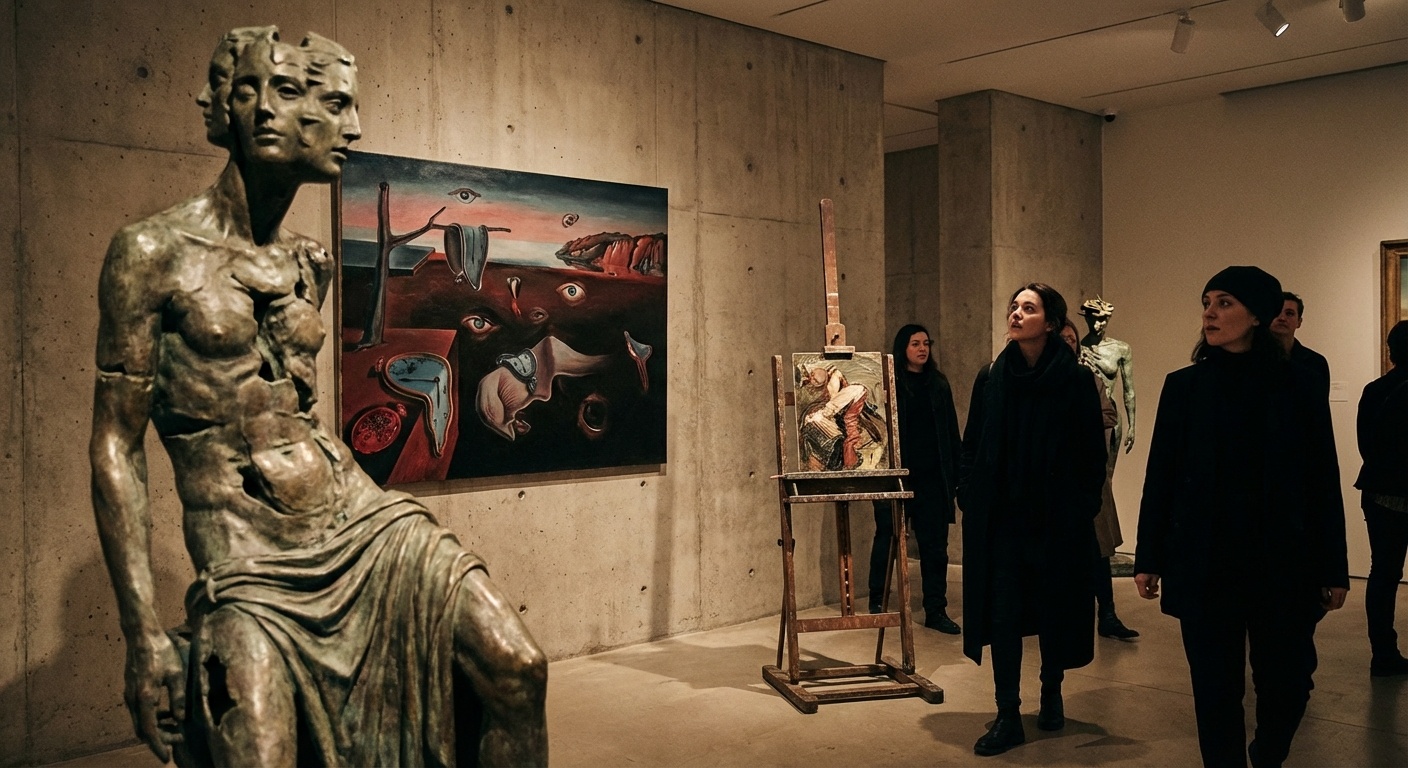
From the ashes of Dadaism emerged Surrealism, a movement equally rebellious but with a distinctly different focus. While Expressionism delved into conscious emotion, Surrealism sought to unlock the power of the unconscious mind – that realm of dreams, desires, and irrationality previously relegated to the shadows. Inspired by the psychoanalytic theories of Sigmund Freud, artists like André Breton championed “psychic automatism,” a method of bypassing rational control to access unfiltered creativity. This manifested in various techniques, including automatic writing and drawing, where the hand was allowed to move freely across the canvas or page without conscious direction. The resulting images were often bizarre, illogical, and deeply symbolic, reflecting the fragmented nature of dreams and the hidden depths of the psyche. The goal wasn’t simply to depict dreams, but to create a new reality – a “surreality” that transcended the boundaries of logic and reason. Collage became another key tool, juxtaposing disparate images in unexpected ways to disrupt conventional associations and provoke new interpretations.
Bridging the Gap: Shared Territories Between Surrealism & Expressionism
Despite their differing approaches, Surrealism and Expressionism were not entirely separate entities. Both movements shared a rejection of traditional artistic values and a fascination with the darker aspects of human experience. A common thread was the exploration of psychological states – anxiety, fear, desire – though expressed through different means. Many artists found themselves drawn to both worlds, blurring the lines between conscious emotion and unconscious impulse. The use of distortion, symbolism, and non-representational forms were prevalent in both styles, creating a sense of unease and ambiguity. Furthermore, both movements challenged the viewer’s perception of reality, forcing them to confront uncomfortable truths about themselves and the world around them. It's important to note that Expressionism laid some of the groundwork for Surrealism by dismantling traditional artistic norms and emphasizing subjective experience.
André Masson: A Pioneer Navigating the Intersection
 Leda
LedaExplore Masson's 'Leda,' a powerful 1947 Surrealist Expressionism masterpiece. Abstract lines & forms evoke desire, transformation & the myth of Leda and Zeus.
Few artists embody this intersection as powerfully as André Masson. Initially a figure within the Surrealist circle, Masson’s work consistently reveals an underlying emotional intensity that aligns him with Expressionist sensibilities. His 1947 masterpiece, “Leda,” exemplifies this duality. The abstract lines and forms evoke a sense of primal energy and desire, referencing the myth of Leda and Zeus but refusing any literal depiction. Masson’s technique – often involving automatic drawing and sand painting – allowed him to tap into his subconscious while simultaneously maintaining a powerful control over composition and form. Similarly, “Baudelaire” (1943) is a testament to his exploration of evocative themes through automatic processes. These works aren’t simply representations of the unconscious; they are visceral expressions of human passion and turmoil, imbued with a raw emotional power that transcends stylistic categorization. Masson wasn't merely *using* automatism; he was channeling it as a means of accessing deeply personal and often unsettling emotions.
Jackson Pollock and Stanley William Hayter: Evolving Abstraction from European Roots
 Stenographic Figure
Explore Jackson Pollock's 'Stenographic Figure' (1942), a dynamic oil painting blending surrealism and abstraction with horses, birds, and riders – a pivotal work in his evolution towards abstract expressionism.
The influence of Surrealism and Expressionism extended across the Atlantic, profoundly shaping the development of Abstract Expressionism in post-war America. Paul Jackson Pollock’s early work, such as “Stenographic Figure” (1942), demonstrates a clear debt to European automatism. The dynamic composition, featuring horses, birds, and riders rendered in swirling lines, reflects his experimentation with subconscious imagery and spontaneous gesture. However, Pollock’s evolution went beyond mere imitation; he developed his signature drip technique, creating large-scale canvases that were entirely devoid of representational form. Stanley William Hayter, though less widely known, played a crucial role in disseminating these ideas through Atelier 17, a workshop he founded in Paris and later New York. He pioneered viscosity printing techniques, encouraging artists to explore the possibilities of chance and abstraction. Both Pollock and Hayter, along with others, built upon the foundations laid by European pioneers, forging a uniquely American style that emphasized scale, gesture, and emotional intensity.
The Enduring Legacy: Influence on Contemporary Art
The impact of Surrealism and Expressionism continues to resonate in contemporary art. Their rejection of traditional norms paved the way for countless experimental approaches, from Abstract Expressionism to Neo-Expressionism and beyond. The emphasis on subjective experience, emotional authenticity, and the power of the unconscious remains a central theme for many artists today. The techniques pioneered by Masson, Pollock, and others – automatism, collage, distortion – continue to be explored and reinterpreted in new and innovative ways. Ultimately, these movements remind us that art is not simply about replicating reality; it’s about exploring the complexities of the human condition and expressing the often-unseen worlds within. At ArtsDot.com, we celebrate this legacy by offering high-quality reproductions of masterpieces from these pivotal movements, allowing you to bring the power and beauty of Surrealism and Expressionism into your own home.
Ähnliche Artikel
André Masson: Automatisme, Surrealismus und die expressive Kraft einer Künstlergeneration
Entdecken Sie das faszinierende Werk André Massons! Wir beleuchten seine Rolle im Surrealismus, die Technik des Automatismus und seinen Einfluss auf die moderne Kunstgeschichte. Expertenwissen & tiefe Einblicke.


The Resonance of Modernity: Exploring Emotional Tones in Contemporary Artwork
Explore the emotional depth of modern art with expert insights on abstract expressionism, Color Field painting & key artists like Rothko & Pollock. Discover investment potential and curated selections for discerning collectors.

Beyond Representation: Emotional Resonance & Formal Innovation in Abstract Painting
Explore the profound emotional depth & formal innovations of abstract painting. Discover key artists like Rothko & Kandinsky, understand art collecting insights, and elevate your space with timeless masterpieces. Expert analysis for discerning collectors.

The Raw Emotion of Expressionism: A Deep Dive into its History, Characteristics & Enduring Influence
Explore the raw emotion of Expressionism with ArtsDot. Discover its history, key artists like Kirchner & Munch, and lasting influence on modern art. Expert insights for collectors & enthusiasts.

Abstrakter Expressionismus: Die 10 Meisterwerke, die eine Kunstbewegung prägten |
Entdecken Sie die 10 Meisterwerke des Abstrakten Expressionismus! Von Jackson Pollock bis Mark Rothko – erfahren Sie die Geschichten hinter ikonischen Gemälde und finden Sie hochwertige Reproduktionen für Ihr Zuhause. Jetzt bei entdecken!

