


 Vorschau anzeigen
 Versenden
 Teilen
 Details anzeigen
 Leitfaden

 Herunterladen
 Ähnliche Objekte
 Röntgenaufnahme
 Diashow
 Q&A
Q&A Statistiken
unbetitelt (8195)


 Weiterlesen
Handgefertigte Ölreproduktion
Handgemaltes Ölgemälde auf Leinwand in Ihrer Wunschgröße und mit Rahmen, auf Bestellung von unseren Künstlern angefertigt. ( Zum Druck wechseln Zum digitalen Bild wechseln)




P118B €10

P118H €10

P118W €10

P438Z €10

P508JH €12

P508YH €12

P805H €10

P805Z €10

P919BZ €10

P919G €10

P919XJ €10

P959ZH €10

P968JZ €12

W106C €8

W218G €10

W218JH €8

W218Y €10

W307PJ €10

W316G €10

W316PJ €8

W316Y €10

W398PJ €8

W4111J €10

W500HY €15

W500JH €15

W692G €12

W849H €8

W940BG €15

W953PJ €8




Wählen Sie aus unseren vordefinierten Formaten, die den ursprünglichen Proportionen des Kunstwerks entsprechen.

Geben Sie die Breite und die Höhe an, die Sie für Ihren Rahmen oder Ihre Wand benötigen. Da dieses Werk handgemalt ist, kann der Künstler bei einer anderen Form etwas mehr um das Bild herum malen oder etwas abschneiden – Sie entscheiden. Wir senden Ihnen ein digitales Mockup zur Freigabe, bevor mit dem Malen begonnen wird. Das auf dieser Seite gezeigte Bild stellt nicht das tatsächliche Ergebnis dar – dies tut nur das Mockup.
Nach der Bestellung wird das ArtsDot.com-Team dem Kunden Anweisungen per E-Mail zusenden und eine Mockup-Vorschau bereitstellen.
Weltweiter Versand () in nur 3 bis 4 Wochen statt der üblichen 5 Wochen. (28 Oktober). Keine Kompromisse bei der Qualität.

Kostenloser weltweiter Expressversand

Hochwertige Leinenleinwand

Umfassender Versicherungsschutz beim Versand

Zollgebühren-Rückerstattungsgarantie

Garantie für exakte Farbtreue

100 Tage Rückgaberecht (nur bei Mängeln)

100% Geld-zurück-Garantie

Mengenrabatt verfügbar
 Die Glasoption ist nur für Größen unter 110 cm verfügbar.

unbetitelt (8195)
Art der Reproduktion
Format der Reproduktion
-


Endpreis
€ 232
Eine Vision ätherischer Anmut: Botticellis unbetitelter Tanz
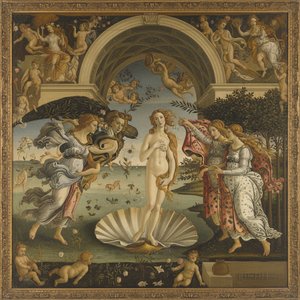
In den stillen Winkeln der Florentiner Renaissance existieren Werke, die die Grenzen von bloßer Farbe und Holz überschreiten und stattdessen in das Reich des reinen Mythos vordringen. Sandro Botticellis unbetitelt (8195) ist ein solches Meisterwerk – eine fesselnde Vision nackter Frauen, die inmitten einer üppigen, grünen Landschaft einen rhythmischen, anmutigen Tanz vollführen. Den Blick auf dieses Werk zu richten bedeutet, in eine Traumlandschaft einzutreten, in der die Grenzen zwischen der menschlichen Gestalt und der natürlichen Welt verschwimmen. Die Figuren bewegen sich mit müheloser Geschmeidigkeit, ihre Körper in einer zarten Choreografie angeordnet, die sowohl eine Feier des Lebens als auch ein zeitloses Ritual der Erneuerung suggeriert. Es ist ein Gemälde, das nicht bloß eine Szene darstellt; es lädt den Betrachter ein, an einem Moment des ewigen Frühlings teilzuhaben.
Die technische Meisterschaft hinter dieser Komposition offenbart Botticellis tiefgreifende Beherrschung des Tempera-Mediums. Durch die Verwendung dünner, transparenter Lasuren, die auf eine Holztafel aufgetragen wurden, erreichte der Künstler eine leuchtende Qualität, die aus dem Inneren der Figuren selbst zu strahlen scheint. Diese akribische Technik ermöglicht einen subtilen Einsatz von Chiaroscuro, wobei sanfte Abstufungen von Licht und Schatten die Kurven der Tänzerinnen modellieren und ihnen eine greifbare, skulpturale Präsenz verleihen. Jeder feine Pinselstrich dient dazu, die ätherische Atmosphäre zu verstärken und einzufangen, wie das Licht durch das umgebende Laub filtert, um die Haut der Tänzerinnen zu küssen. Für den anspruchsvollen Sammler oder Innenarchitekten bietet diese Luminosität die unvergleichliche Fähigkeit, jedem anspruchsvollen Raum Leben und Wärme einzuhauchen.
Symbolik und das Echo der Antike
Jenseits seines visuellen Glanzes ist das Gemälde tief in den humanistischen Idealen des späten 15. Jahrhunderts verwurzelt. In dieser Ära bot die Wiederentdeckung der klassischen Mythologie den Künstlern ein reiches Vokabular an Allegorie und Bedeutung. Die Figuren in diesem Tanz sind nicht einfach nur Frauen; sie sind Verkörperungen von Fruchtbarkeit, Anmut und der zyklischen Natur der Jahreszeiten. Es besteht hier eine tiefe Resonanz mit Botticellis berühmteren Werken wie der Primavera, da die Szene das Ankommen des Frühlings und das Aufblühen des Lebens heraufbeschwört. Die Anwesenheit einer Frau, die einen Apfel hält, führt eine subtile mythologische Ebene ein, die vielleicht auf Themen der Versuchung, der Schönheit oder den Mythos der Atalanta hindeutet und so eine intellektuelle Tiefe schafft, die eine lange Betrachtung belohnt.
Die emotionale Wirkung des Werkes liegt in seiner Fähigkeit, ein Gefühl von Frieden und Staunen zu erzeugen. Die Verbindung zwischen den Tänzerinnen und den üppigen Bäumen im Hintergrund schafft ein harmonisches Ökosystem der Schönheit, in dem Menschheit und Natur in perfektem Gleichgewicht existieren. Dieses Gefühl der Ruhe macht das Kunstwerk zu einer außergewöhnlichen Wahl, um einen Fokuspunkt in einem Raum zu schaffen, der für Reflexion oder Eleganz konzipiert ist. Ob als Herzstück in einer prachtvollen Galerie oder als subtiler Akzent in einem kuratierten Wohnraum – diese Reproduktion von Botticellis Vision dient als Fenster in eine Welt der Anmut und bietet eine zeitlose Erinnerung an die beständige Kraft der Schönheit und den ewigen Tanz des Daseins.
Fragen & Antworten
Ist "unbetitelt (8195)" ein berühmtes Werk der Renaissance-Humanismus-Epoche?
"unbetitelt (8195)" von Sandro Botticelli wird als Ikonisch klassifiziert und gehört zur Renaissance-Humanismus-Strömung.
Wie harmonisch sind die Farben von "unbetitelt (8195)" von Sandro Botticelli?
"unbetitelt (8195)" von Sandro Botticelli besticht durch eine Disharmonische Farbpalette Farbharmonie.
Was für ein Kunstwerk ist "unbetitelt (8195)"?
"unbetitelt (8195)" ist ein Werk der Gattung Wandkunst.
Ähnliche Kunstwerke


Künstlerbiografie
frühes Leben und Ausbildung
Sandro Botticelli, geboren Alessandro di Mariano di Vanni Filipepi um 1445, war eine zentrale Figur im frühen italienischen Frührenaissance der Malerei. Zunächst posthumig vernachlässigt, wurde Botticellis Werk im späten 19. Jahrhundert von den Präraffaeliten revitalisiert und führte zu einer Neubewertung seiner künstlerischen Beiträge. Botticelli wurde in Florenz, Italien, geboren und lebte sein ganzes Leben im selben Viertel. Seine Familie, darunter sein Vater Mariano di Vanni d’Amedeo Filipepi, war in verschiedene Berufe involviert, was sie mit Künstlern in Kontakt brachte. Giorgio Vasari berichtete, dass Botticelli zunächst als Goldschmied ausgebildet wurde.Künstlerischer Stil und bemerkenswerte Werke
Botticellis Werk ist durch elegante Linearität gekennzeichnet, die die Lücke zwischen der späten italienischen Gotik und dem frühen Frührenaissance schließt. Seine berühmtesten Werke, die Geburt des Venus und Primavera, werden in der Uffizialleerie in Florenz ausgestellt, die eine bedeutende Sammlung seiner Kunst beherbergt. * die Geburt des Venus (ansicht auf ArtsDot) * Primavera (Sandro Botticellis Kunst erkunden auf ArtsDot) * Mystische Geburt (Nationalgalerie, London), datiert 1501, ist das einzige Werk von Botticelli mit einem klaren Datum.Vermächtnis und Einfluss
Botticellis Stil entwickelte sich in den 1490er Jahren zu einem persönlicheren Ansatz und unterschied sich von Zeitgenossen wie Leonardo da Vinci und dem aufkommenden Hochrenaissance-Stil. Sein Werk wurde als bedeutende Beiträge zur italienischen Renaissance Kunstbewegung anerkannt. * Die italienische Renaissance Kunstbewegung * Sandro Botticelli auf Wikipedia- Bekannte Künstler der italienischen Renaissance umfassen Sandro Botticelli, Leonardo da Vinci, Michelangelo und Tizian.
- Die Uffizialleerie in Florenz beherbergt eine bedeutende Sammlung von Botticellis Kunst.
- Botticellis Werk wurde als eine zentrale Figur im frühen italienischen Frührenaissance der Malerei anerkannt.

Sandro Botticelli
1445 - 1510 , Italien
Kurzinfos
- Beeinflusste Künstler: ['Präraffaeliten']
- Bemerkenswerte Werke:
- Die Geburt der Venus
- Primavera
- Mystische Geburt
- Einflussreiche Künstler:
- Fra Angelico
- Paolo Uccello
- Geburtsdatum: ca. 1445
- Geburtsort: Florenz, Italien
- Künstlerische Bewegung: Frührenaissance
- Nationalität: Italienisch
- Sterbedatum: 1510
- Vollständiger Name: Sandro Botticelli
Ähnliche Artikel

Frührenaissance: Die 10 Meisterwerke, die eine Epoche prägten – Kunst für Ihr Zuhause
Entdecken Sie die 10 prägendsten Meisterwerke der Frührenaissance! Von Giotto bis Botticelli – erleben Sie Kunstgeschichte hautnah. Hochwertige Reproduktionen für Ihr Zuhause auf .
Sandro Botticelli: Die 25 Meisterwerke des Renaissance-Genies – Kunst für Ihr Zuhause
Entdecken Sie die 25 schönsten Meisterwerke von Sandro Botticelli! Erleben Sie die Renaissance-Kunst mit 'Geburt der Venus', 'Primavera' & mehr. Hochwertige Reproduktionen für Ihr Zuhause – jetzt auf ArtsDot.com!

Echoes of Olympus: Mythological Narratives in Western Art Through the Ages
Explore the captivating history of mythological narratives in Western art! From ancient Greece to modern masterpieces, discover iconic artworks & symbolism. Expert analysis and high-quality reproductions at ArtsDot.

Die 25 Meisterwerke der Uffizien: Kunstgeschichte für Ihr Zuhause | ArtsDot
Entdecken Sie die 25 berühmtesten Meisterwerke der Uffizien, Florenz! Von Botticelli bis Leonardo da Vinci – Kunstgeschichte erleben. Hochwertige Reproduktionen & Inspiration für Ihr Zuhause auf ArtsDot.com.

Meisterwerke der Temperamalerei: 10 Panelbilder, die Kunstgeschichte schrieben | ArtsDot
Entdecken Sie die 10 legendärsten Meisterwerke der Temperamalerei auf Holz! Von Giotto bis Botticelli – erfahren Sie die Geschichten hinter ikonischen Panelbildern und lassen Sie sich von Renaissance-Kunst inspirieren. Hochwertige Reproduktionen finden Sie auf ArtsDot.com.


