In echtem Maßstab anzeigen
 Versenden als Grußkarte
 Teilen
 Details anzeigen
 Leitfaden öffnen

 Herunterladen
 Ähnliche Objekte
 Röntgenaufnahme
 Diashow
 Besucherstatistiken
Stańczyk
 Oil On Canvas
- WallArt
- Romanticism
 1862
1862- 19th Century
 88.0 x 120.0 cm
 Muzeum Narodowe
 Mehr anzeigen
Handgefertigte Ölreproduktion
Handgemaltes Ölgemälde auf Leinwand in Ihrer Wunschgröße und mit Rahmen, auf Bestellung von unseren Künstlern angefertigt. ( Zum Druck wechseln Zum digitalen Bild wechseln)




P118B €10

P118H €10

P118W €10

P438Z €10

P508JH €12

P508YH €12

P805H €10

P805Z €10

P919BZ €10

P919G €10

P919XJ €10

P959ZH €10

P968JZ €12

W106C €8

W218G €10

W218JH €8

W218Y €10

W307PJ €10

W316G €10

W316PJ €8

W316Y €10

W398PJ €8

W4111J €10

W500HY €15

W500JH €15

W692G €12

W849H €8

W940BG €15

W953PJ €8




Wählen Sie aus unseren vordefinierten Formaten, die den ursprünglichen Proportionen des Kunstwerks entsprechen.

Sie können Ihre eigenen Maße eingeben, um einen bestimmten Rahmen oder Platz auszufüllen. Wenn die gewählte Größe nicht den Proportionen des Originalbildes entspricht, werden wir das Kunstwerk entweder beschneiden oder das Gemälde durch zusätzliche, handgemalte Elemente erweitern. Ein digitales Mockup wird Ihnen zur Genehmigung zugesandt, bevor die Produktion beginnt.
Bitte beachten Sie, dass die Bildschirmvorschau nicht die tatsächliche Beschneidung oder Erweiterung widerspiegelt. Nur das Mockup zeigt die endgültige Komposition exakt an.
Obwohl Sondermaße verfügbar sind, empfehlen wir, eine Größe aus der vordefinierten Liste zu wählen, um die ursprünglichen Proportionen beizubehalten.
Nach der Bestellung wird das ArtsDot.com-Team dem Kunden Anweisungen per E-Mail zusenden und eine Mockup-Vorschau bereitstellen.
Weltweiter Versand () in nur 3 bis 4 Wochen statt der üblichen 5 Wochen. (11 Oktober). Keine Kompromisse bei der Qualität.

Kostenloser weltweiter Expressversand

Hochwertige Leinenleinwand

Vollständiger Versicherungsschutz beim Versand

Zollgebühren-Rückerstattungsgarantie

Garantie für exakte Farbtreue

100-tägiges Rückgaberecht (nur bei Mängeln)

100% Geld-zurück-Garantie

Angebot für Mengenrabatt
 Die Glasoption ist nur für Größen unter 110 cm verfügbar.

Stańczyk
Reproduktionsmedium
Format der Reproduktion
-


Gesamtpreis
€ 226
A Portrait of Solitude and National Soul
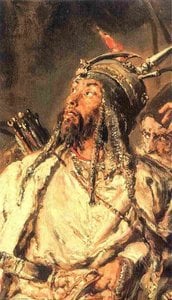
In the quiet, heavy atmosphere of Jan Matejko’s 1862 masterpiece, Stańczyk, one does not merely encounter a portrait, but a profound psychological landscape. The painting presents us with the legendary court jester, not in the midst of a comedic performance or a moment of levity, but captured in a state of deep, melancholic introspection. Seated alone amidst the opulence of a grand interior, his hands are tightly clasped, and his gaze wanders toward an unseen horizon, heavy with the weight of foreknowledge. This is not the face of a fool, but that of a visionary—a man who perceives the gathering shadows of political decline while those around him remain lost in the festivities of the moment.
The composition is a masterclass in Romantic Grandeur, where every element serves to heighten the emotional tension. Matejko utilizes a striking color palette dominated by the vibrant, commanding crimson of Stańczyk’s robe. This deep red acts as the visual heartbeat of the canvas, symbolizing both the resilience of the Polish spirit and the simmering passion of a man burdened by duty. The brilliance of this hue is set against a backdrop of somber, shadowy drapery and muted tones, creating a chiaroscuro effect that pulls the viewer’s eye directly into the sitter's contemplative expression. Through his expert use of impasto, Matejko breathes life into the fabric; the thick, textured layers of paint give the heavy velvet of the cloak a palpable weight, making the physical presence of the figure feel almost overwhelming.
Historical Echoes and Symbolic Depth
To understand Stańczyk is to understand the heartbeat of 19th-century Poland. Painted during a period of profound national mourning following the territorial losses of the Austro-Prussian War, the work serves as a silent, powerful protest. The setting—a scholarly and courtly environment suggested by the presence of manuscripts and fine furniture—contrasts sharply with the internal turmoil of the protagonist. While figures in the distant background appear engaged in the trivialities of social life, Stańczyk remains isolated by his wisdom. He embodies the "intellectual's burden," representing a nation that possesses the dignity and history to endure, yet faces an uncertain, fragmented future.
For the discerning collector or interior designer, this painting offers more than mere decoration; it provides a focal point of intellectual and emotional gravity. The meticulous attention to detail—from the intricate patterns on the floor to the subtle light reflecting off the scholarly documents—makes it an ideal centerpiece for spaces that demand character and narrative depth. Whether placed in a private library or a sophisticated contemporary salon, a high-quality reproduction of this work brings with it an aura of historical importance and a timeless conversation about resilience, wisdom, and the enduring strength of the human spirit.
Fragen & Antworten
Wer hat "Stańczyk" erschaffen?
"Stańczyk" wird Jan Matejko zugeschrieben.
Für welchen Raum wird "Stańczyk" von Jan Matejko aufgrund seiner Farben empfohlen?
Angesichts seiner Earthy Farben wird „Stańczyk“ für ein Living Room empfohlen.
Wer ist der Urheber von "Stańczyk" und aus welchem Jahr stammt das Werk?
Jan Matejko schuf „Stańczyk“ im Jahr 1862.
Wie alt war Jan Matejko, als „Stańczyk“ geschaffen wurde?
Als "Stańczyk" im Jahr 1862 entstand, war Jan Matejko – geboren 1838 – 24 Jahre alt.
Zeigt "Stańczyk" starke Hell-Dunkel-Kontraste?
"Stańczyk" von Jan Matejko zeigt einen Serene Kontrast zwischen seinen hellen und dunklen Bereichen.
Welche Stimmung und welche Emotionen vereinen sich in "Stańczyk"?
Die festgehaltene Stimmung von "Stańczyk" von Jan Matejko ist Romantic, und ihr emotionaler Tonfall ist Melancholic.
In welchem Jahr wurde "Stańczyk" geschaffen?
"Stańczyk" stammt aus dem Jahr 1862. Dieses Datum ordnet das Werk in die Schaffensperiode von Jan Matejko sowie in dessen Epoche ein.
Ähnliche Kunstwerke


Biografie des Künstlers
Frühes Leben und Ausbildung
Jan Alojzy Matejko, ein renommierter polnischer Maler, wurde am 24. Juni 1838 in Krakau, Polen, geboren. Sein Vater, Franciszek Ksawery Matejko, war ein tschechisch-stämmiger Tutor und Musiklehrer. Jans frühes Leben war geprägt von der Krakauer Revolution von 1846 und der Belagerung von Krakau durch die Österreicher im Jahr 1848 – Ereignisse, die später seine künstlerischen Themen beeinflussen sollten. Matejko besuchte das St.-Annen-Gymnasium, verließ es aber 1851 aufgrund schlechter Noten. Er zeigte jedoch schon in jungen Jahren außergewöhnliches Talent für Kunst. Von 1852 bis 1858 studierte er an der Kunstakademie in Krakau und spezialisierte sich unter der Anleitung von Wojciech Korneli Stattler und Władysław Łuszczkiewicz auf historische Malerei.Künstlerische Karriere
Matejkos erstes bedeutendes Werk, Zaren Schujiski vor Zygmunt III, wurde 1853 fertiggestellt. Er begann, seine historischen Gemälde ab 1855 bei der Gesellschaft der Freunde der Künste in Krakau auszustellen. Zu seinen bemerkenswertesten Werken gehören:- Rejtan (1866): Eine großformatige Öl-auf-Leinwand-Malerei, die einen entscheidenden Moment in der polnischen Geschichte darstellt.
- Union von Lublin (1869): Ein bedeutendes Werk, das Matejkos Fähigkeit zeigt, historische Ereignisse einzufangen.
- Schlacht von Grunwald (1878): Ein Meisterwerk, das seine Fähigkeit hervorhebt, die Intensität von Schlachtbildern darzustellen.
Einflüsse und Entwicklung
Matejko wurde stark von der polnischen Geschichte und dem Wunsch beeinflusst, diese für ein breites Publikum zugänglich zu machen. Er studierte sorgfältig historische Dokumente und recherchierte akribisch Details über Kleidung, Waffen und Architektur seiner Zeit. Sein Stil entwickelte sich im Laufe seiner Karriere hin zu einer realistischeren Darstellung, wobei er jedoch immer die dramatische Erzählung und die emotionale Wirkung in den Vordergrund stellte. Die Romantik des 19. Jahrhunderts prägte seine Werke, insbesondere durch die Betonung von Heldentum, Patriotismus und dem Kampf für nationale Unabhängigkeit.Museologische Beiträge und Vermächtnis
Matejko verbrachte den Großteil seines Lebens in Krakau und wurde schließlich Direktor an der Jan Matejko Akademie der Bildenden Künste, ehemals Krakauer Akademie der Bildenden Künste. Zu seinen Schülern gehörten bedeutende Maler wie Maurycy Gottlieb, Jacek Malczewski, Józef Mehoffer und Stanisław Wyspiański. Bemerkenswerte Werke auf ArtsDot:- Jan Matejko: Warna (Romantik)
- Jan Matejko: Stillleben (Romantik)
- Jan Matejko: Die Union von Lublin (298 x 512 cm, Romantik, Öl auf Leinwand)
Referenzen:
Entdeckung der Meisterwerke des Muzeum Narodowe in Krakau, Polen (wikipedia.org)
Jan Matejko
1838 - 1893 , Polen
Eckdaten zum Künstler
- Andere Namen: Jan Alojzy Matejko
- Beeinflusste Künstler:
- Maurycy Gottlieb
- Jacek Malczewski
- Stanisław Wyspiański
- Bemerkenswerte Werke:
- Rejtan (1866)
- Union of Lublin (1869)
- Schlacht von Grunwald (1878)
- Einflussreiche Künstler:
- Wojciech Korneli Stattler
- Władysław Łuszczkiewicz
- Geburtsdatum: 24. Juni 1838
- Geburtsort: Kraków, Polen
- Künstlerische Bewegung: Romantik
- Nationalität: Polnisch
- Sterbedatum: 1. November 1893
- Vollständiger Name: Jan Matejko
Verwandte Artikel

Jan Matejko: Nationales Narrativ und Identität im polnischen Gemälde des 19. Jahrhunderts
Entdecken Sie Jan Matejkos faszinierende Gemälde und ihren Einfluss auf die polnische nationale Identität im 19. Jahrhundert. Analysen, Schlüsselwerke & historischer Kontext – jetzt lesen!

Öl auf Leinwand: Eine historische und technische Erkundung eines zeitlosen künstlerischen Mediums
Entdecken Sie die faszinierende Welt der Ölmalerei! Von historischen Techniken bis zur modernen Anwendung – wir bieten Expertenwissen, Restaurierungstipps und hochwertige Reproduktionen. Jetzt informieren!

Crimson Threads of Narrative: Exploring Symbolism & Representation in Artworks Featuring the Red Dress
Explore the rich symbolism of the red dress in art history! From ancient power displays to iconic portraits like Cézanne’s 'Madame Cezanne', discover the cultural and artistic significance behind this captivating color. Expert analysis & insights.

The Enduring Power of Painting: A Historical & Contemporary Exploration of Form and Emotion
Explore the rich history & enduring techniques of oil painting with ArtsDot. Discover masterpieces, learn about art collecting, and find authentic handmade reproductions crafted by skilled artists.

The Enduring Legacy of Oil on Canvas: Technique, History & Aesthetic Impact
Explore the rich history & techniques of oil painting – from Renaissance masters to Impressionism. Discover pigments, layering methods, and why this timeless medium endures. Expert insights for artists & art enthusiasts.