A Vision of Imperial Serenity
Semyon Fyodorovich Shchedrin stands as a profound chronicler of the Russian landscape, a painter whose brush captured the quietude and grandeur of late eighteenth-century Imperial Russia. Born in St. Petersburg into the family of a life guard, his journey was one of academic excellence and international exploration. After entering the Academy of Arts in St. Petersburg in 1759, he distinguished himself early, graduating in 1765 with a gold medal and prestigious grants that allowed him to venture across Europe. His travels through Paris and Rome were transformative; in Paris, he immersed himself in the works of both contemporary and old masters, while in Rome, the disciplined principles of classicism took hold, teaching him to seek beauty in the echoes of antiquity.
The artist's development was deeply shaped by the shifting intellectual tides of his era. Under the influence of Jean-Jacques Rousseau’s philosophy—which posited that true beauty resides within everyday life and the natural world—Shchedrin embraced plein-air techniques, painting directly from outdoor environments to capture the authentic essence of nature. This delicate balance between the spontaneous vitality of the outdoors and the structured elegance of classical composition became a hallmark of his style. Upon returning to St. Petersburg in 1776, he transitioned from student to mentor, serving as a professor of landscape painting at the Academy of Arts and guiding the next generation of Russian artists, including his nephew, Sylvester Shchedrin.
The Landscapes of Majesty and Order
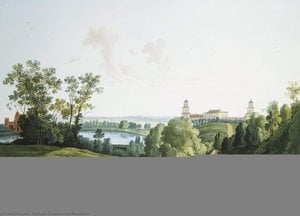
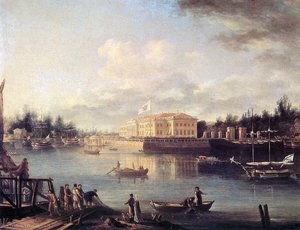
Shchedrin’s most enduring legacy lies in his meticulous documentation of the imperial estates, particularly those commissioned by Catherine the Great. His works serve as more than mere topographical records; they are carefully orchestrated visual narratives that reflect the idealized harmony sought by the Russian Imperial court. Through his eyes, we witness the meticulously designed worlds of Tsarskoye Selo, Gatchina, and Petergof—places where nature was sculpted to mirror notions of order, refined taste, and aristocratic leisure.
His technical mastery is evident in several key thematic areas:
- The Harmony of Architecture and Nature: In masterpieces such as Stone Bridge in Gatchina near Constable Square, Shchedrin demonstrates a command over light and composition, where man-made stone structures exist in perfect neoclassical equilibrium with lush, verdant environments.
- A Restrained Palette: Moving away from the flamboyant ornamentation of the Rococo period, he embraced a more grounded, neoclassical palette consisting of earthy browns, muted greens, and deep ochres to cultivate an atmosphere of profound stillness.
- The Capture of Light: His ability to render the soft, diffused light of approaching dusk or the tranquil reflections on a pond creates a sense of permanence and peace within his landscapes.
Beyond his role as a landscape painter, Shchedrin contributed significantly to the preservation of art itself, participating in the restoration of paintings within the Hermitage. His career reached its zenith during the 1790s, a period marked by iconic views of palaces and parks that remain vital windows into a bygone era. Through his dedication to both the creation and the care of art, Semyon Fyodorovich Shchedrin ensured that the serene beauty of the Russian landscape would endure long after the empire he so beautifully depicted had passed into history.
Otázky a odpovědi
Mohu si prohlédnout díla umělce Semyon Fyodorovich Shchedrin podle barevného spektra?
Stránka Spektrální index organizuje díla umělce Semyon Fyodorovich Shchedrin podle barvy.
V jakém městě a z jaké země pochází Semyon Fyodorovich Shchedrin?
Semyon Fyodorovich Shchedrin se narodil(a) ve městě Saint Petersburg v zemi Russia.
Kde mohu vidět všechna umělecká díla autora Semyon Fyodorovich Shchedrin?
Veškerá díla umělce Semyon Fyodorovich Shchedrin na tento web lze prohlédnout na jeho stránce Všechna umělecká díla.