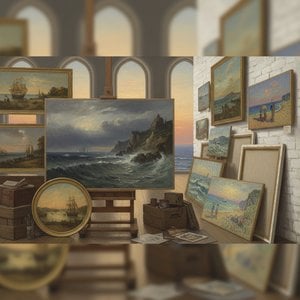
Paul Jean Clays – Život Embracing the Sea
Paul Jean Clays, born in Bruges, Belgium, in 1819 and passing in Brussels in 1900, was a painter who dedicated his life to capturing the subtle poetry of marine landscapes. He wasn’t drawn to the dramatic storms or shipwrecks favored by earlier Romantic artists; instead, he sought to portray the tranquil beauty of coastal scenes, the gentle sway of rivers, and the quiet dignity of harbors. His work represents a pivotal shift in marine painting—a move away from theatrical spectacle towards a more naturalistic observation of light, atmosphere, and the very essence of water itself. Clays’s path to becoming a celebrated artist was anything but conventional, beginning with an adventurous spirit that led him far from the classroom and directly into the heart of his future inspiration: the sea. As a young boy, he famously ran away from school to work as a cabin boy, experiencing firsthand the maritime world that would so profoundly shape his artistic vision. This early immersion instilled in him not only a deep appreciation for seafaring life but also an invaluable understanding of its nuances—the play of light on waves, the weight of water, and the subtle shifts in atmosphere. It was a formative experience, etching itself into his very sensibility and providing a wellspring of authenticity that would define his artistic career.Early Life and Influences
Paul Jean Clays’s fascination with the sea began at an early age. Born to a tax collector father, he displayed an exceptional curiosity about the natural world from childhood. He abandoned formal schooling shortly after commencing it, embarking on a journey of self-discovery that would ultimately lead him to his artistic vocation. Recognizing the importance of practical experience, he secured employment as a cabin boy aboard ships—a decision that profoundly impacted his worldview and instilled in him an intimate knowledge of maritime life. This formative period wasn’t merely about gaining seafaring skills; it was about immersing himself in the sensory world of the ocean—observing the shifting hues of sky and sea, feeling the movement of waves beneath his feet, and absorbing the rhythms of daily life at sea. These experiences fueled his artistic imagination and instilled a deep appreciation for nature's subtleties—qualities that would become central to his distinctive style. Notably, Clays’s artistic sensibilities were shaped by the burgeoning Barbizon school movement in France, which championed *plein air* painting—working outdoors directly from nature—and a commitment to realistic representation. Artists of this era sought to capture the essence of landscapes with uncompromising honesty and sensitivity, rejecting academic conventions that prioritized idealized forms over accurate observation. Clays embraced this approach wholeheartedly, recognizing its power to convey the beauty and grandeur of the natural world.Formal Artistic Training and Parisian Engagement
Despite his early immersion in seafaring life, Clays understood the necessity of formal artistic training. He traveled to Paris—a vibrant hub for artists during the 19th century—where he studied under Horace Vernet, a renowned military painter known for his dramatic depictions of battle scenes. However, Clays soon discerned that Vernet’s style didn't align with his own artistic inclinations. Vernet’s focus on historical narratives and heroic figures felt restrictive to Clays, whose heart resided in the observation of nature’s quieter moments—moments imbued with subtle beauty and atmospheric depth. Recognizing this divergence, he sought alternative avenues for artistic development, enrolling at the Atelier Suisse—a prestigious institution that fostered a disciplined approach to drawing and painting. At the atelier Suisse, Clays honed his technical skills while simultaneously exploring new stylistic horizons. He diligently practiced figure drawing, mastering anatomical precision and capturing expressive gestures with remarkable accuracy. Simultaneously, he experimented with landscape compositions, striving to emulate the techniques of Barbizon painters—artists who prioritized direct observation and tonal harmony. This dual focus ensured that Clays cultivated both foundational artistic skills and a distinctive visual language—a combination that would prove crucial to his subsequent success as a marine painter.A Distinctive Style: Naturalism and Color Harmony
Paul Jean Clays’s artistic style is characterized by its naturalism—a sincere effort to depict the world as it appeared before his eyes. He broke away from Romantic conventions, eschewing dramatic storms and shipwrecks in favor of calm waters, reflective skies, and tranquil harbors. His paintings aren't about grand narratives or heroic struggles; they are about capturing a fleeting moment of beauty, a sense of peace, and the subtle interplay of light and atmosphere. He possessed an exceptional ability to convey what he described as “the limpid salt atmosphere, the weight of waters, the transparence of moist horizons, the gem-like sparkle of the sky.” This was achieved through meticulous observation and a masterful use of color—a hallmark of his artistic vision. Unlike many of his contemporaries who favored muted tones, Clays employed a vibrant palette with clean, strong hues that contributed to the luminosity and freshness of his seascapes. His attention to detail, particularly in the depiction of vessels—often rendered with painstaking accuracy—also reflects an influence from 17th-century Dutch naval painting—a tradition known for its precision and realism. Works such as *The Beach at Ault*, *Boats in a Dutch Port*, and *Dutch Boats in Flushing Roads* exemplify this meticulous approach, showcasing his ability to render both the grandeur of the sea and the intricate details of maritime life with equal skill.Legacy and Recognition
Throughout his prolific artistic career, Paul Jean Clays actively participated in numerous exhibitions across Europe—including the prestigious Paris Salon and the Exposition Universelle of 1867—garnering critical acclaim for his innovative style and unwavering commitment to naturalistic representation. His paintings were celebrated for their luminous color harmonies and evocative depictions of coastal landscapes—qualities that resonated deeply with audiences of the time. Clays’s work gained considerable renown, securing a prominent place in public galleries and establishing him as one of Belgium's most respected artists. He was awarded membership in several Academies—both Belgian and foreign—and honored by the Order of Leopold and Legion of Honor—recognizing his contributions to artistic excellence. His enduring legacy lies not only in his beautiful paintings but also in his pioneering role as a champion of naturalistic marine art—a movement that profoundly influenced subsequent generations of artists. Clays stands as a testament to the transformative power of observation, the beauty of tranquility, and the timeless allure of the sea.Otázky a odpovědi
Kolik děl umělce Paul Jean Clays je možné si prohlédnout?
V katalogu si můžete prohlédnout 66 děl děl autora Paul Jean Clays na stránce Všechna umělecká díla.
Jak najdu díla umělce Paul Jean Clays na konkrétní téma?
Chcete-li najít díla umělce Paul Jean Clays na konkrétní téma, využijte stránku Podle klíčových slov, která seskupuje umělecká díla podle klíčových slov.
Odkud pochází Paul Jean Clays?
Paul Jean Clays se narodil(a) v zemi Belgie.