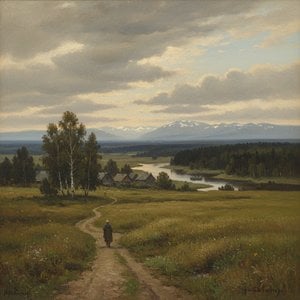
The Alpine Visionary: The Life and Art of Otto von Kameke
Born into the storied traditions of a Pomeranian family in 1826, Otto Werner Henning von Kameke lived a life defined by a profound transition from the rigid discipline of military service to the boundless freedom of the canvas. Originally destined for a career in the Prussian Army, where he attained the rank of Hauptmann, Kameke’s soul was ultimately captured not by the maneuvers of infantry, but by the majestic stillness of the natural world. This metamorphosis from soldier to painter in 1860 marked the beginning of a creative journey that would eventually lead him to become a respected member of the Prussian Academy of Arts and a master of the mountain landscape.
Kameke’s artistic evolution was shaped by his wanderlust and an insatiable desire to study the raw textures of nature. Following his resignation from military life, he sought inspiration in the sun-drenched landscapes surrounding Rome, spending two formative years immersed in the Italian atmosphere. This period of observation laid the groundwork for his formal training at the Grand-Ducal Saxon Art School in Weimar. Under the tutelage of luminaries such as Arnold Böcklin and Alexander Michelis, and later influenced by the atmospheric landscape techniques of Stanislaus von Kalckreuth, Kameke developed a style that balanced meticulous detail with an evocative sense of scale.
Mastery of the High Peaks
The heart of Kameke’s oeuvre lies in his ability to translate the formidable grandeur of the Alps onto canvas. He possessed a singular talent for capturing the rugged majesty of high mountain regions, particularly those found in Upper Bavaria, Switzerland, and the Tirol. His works often serve as windows into the sublime, where the viewer is invited to witness the interplay of light and shadow across glaciers and craggy precipices. Whether working with oil on canvas or wood, his technique allowed for a rich, tactile representation of the earth's most dramatic features.
His repertoire of subjects was as varied as the terrains he traversed, ranging from the icy solitude of glacial flows to more tranquil vistas:
- The Matterhorn seen from above Stafelalp: A testament to his ability to capture iconic, soaring peaks.
- Ein Alpensee: An exploration of the serene, reflective qualities of alpine lakes.
- Der Rhonegletscher: A powerful depiction of the movement and weight of glacial ice.
- Hochgebirgslandschaft: Demonstrating his skill in rendering the complex textures of high-altitude environments.
Legacy and Historical Significance
Beyond his individual canvases, Otto von Kameke holds a significant place in the nineteenth-century German art tradition. As a teacher at the Prussian Academy of Arts, he passed on his expertise in landscape painting to a new generation, ensuring that his dedication to naturalism would endure. His life was a bridge between two worlds—the structured, aristocratic heritage of his Pomeranian roots and the romantic, emotive pursuit of capturing the infinite beauty of the wild.
Though he passed away in Berlin in 1899, leaving behind a legacy that continues to resonate through the auction houses and galleries of the world, his impact remains visible in every brushstroke that celebrates the enduring power of the mountains. His work stands as a poignant reminder of a period when artists sought to find the divine within the geological drama of our planet, turning the harsh realities of stone and ice into timeless works of poetic grace.