Portrét Max Beckmann

Nejslavnější obrazy umělce Max Beckmann: všech 100, seřazeno

Aktualizováno říjen 2026 · seřazeno podle našeho skóre popularity (vyhledávání, návštěvy a objednávky u každého díla) · 401 děl umělce Max Beckmann v našem katalogu

Stručně řečeno

Nejznámějším dílem, které pochází od Max Beckmann, je obraz Noc (1919), který můžete vidět v instituci Kunstsammlung Nordrhein-Westfalen ve městě Düsseldorf. Hned za ním následují Velká scéna utrpení (1906) a Železný most (Výhled na Frankfurt) (1922). Z 401 děl umělce Max Beckmann v našem katalogu je těchto 100 těch nejznámějších. U každého díla je uveden rok vzniku, muzeum a krátká poznámka o tom, co jej činí výjimečným.

1884 – 1950, Lipsko Cubist expressionism Nejvíce děl: Bavarské státní sbírky malby

Top 10 děl Max Beckmann: díla, která zná každý

1
Noc (1919) od Max Beckmann

Noc

1919 · Olej na plátně · Kunstsammlung Nordrhein-Westfalen, Düsseldorf

Max Beckmannova mistrovské dílo z roku 1919, *Noc*, není pouhým obrazem; je to hluboce znepokojivé vizuální prohlášení o traumatu a rozpadu společnosti po První světové válce. Vzniklé v bouřlivém období bezprostředně po skončení konfliktu, dílo rezonuje s pocitem odcizení, strachu a fragmentace moderního života – je to klíčový prvek hnutí *Neue Sachlichkeit* (Nová věcnost). Beckmann se nesnažil pouze zachytit realitu, ale proniknout do syrové emocionální krajiny generace poznamenané válkou. Jeho…

Ručně malovaná olejná reprodukce od $300 33 × 30 cm Velikost jako originál $864 153 × 133 cm Objednat v originální velikosti →
Nechte si ji namalovat ručně Přečtěte si jeho příběh
2
Velká scéna utrpení (1906) od Max Beckmann

Velká scéna utrpení

1906 · Olej na plátně · Bavarské státní sbírky malby, Mnichov

Max Beckmannův obraz „Velký scénář utrpení“ z roku 1906 je mnohem víc než jen malba; je to hluboká, znepokojující sonda do lidské podstaty. Tato dílo, vytvořené na samém prahu turbulentního 20. století, evokuje pocit izolace, zranitelnosti a existenciální nejistoty, které se staly charakteristickými pro dobu. Představuje tři nude mužské postavy uvnitř nejasného interiéru – prostor, který působí jako klec, nebo možná i jako odraz vnitřního světa postav. Nejde o realistickou…

Ručně malovaná olejná reprodukce od $200 33 × 30 cm Velikost jako originál $710 141 × 131 cm Objednat v originální velikosti →
Objednat tento dílo Více informací o tomto díle
3
Železný most (Výhled na Frankfurt) (1922) od Max Beckmann

Železný most (Výhled na Frankfurt)

1922 · Olej na plátně · Kunstsammlung Nordrhein-Westfalen, Düsseldorf

Max Beckmannův “Most z Železa (Výhled na Frankfurt)” z roku 1922 je mnohem víc než jen obraz města. Je to dynamická, téměř divoká studie urbanistického chaosu a industriální energie. Tato práce, plná silných barev a expresivních tahů štětcem, uchvacuje pohled do Frankfurtu v období transformace – krátce po skončení první světové války, kdy se společnost snažila pochopit novou realitu a hledala nové symboly pro budoucnost. Beckmann, mistr detailu i zřetelného…

Ručně malovaná olejná reprodukce od $175 26 × 38 cm Velikost jako originál $177 25 × 42 cm Objednat v originální velikosti →
Objednat tento dílo Více informací o tomto díle
4
Kolumbina (1950) od Max Beckmann

Kolumbina

1950 · Olej na plátně · Saint Louis Art Museum, Saint Louis

Dílo „Kolumbina“ od Maxe Beckmanna představuje fascinující příklad německého expresionismu, zrozené v roce 1950 během pozdních let umělcova života. Toto monumentální olejné plátno zachycuje sedící ženskou postavu zdobenou maskou, obklopenou odvážnými architektonickými prvky a zářivými barvami. Obraz je dokonalým ztělesněním Beckmannova charakteristického stylu, který je definován zkreslenými postavami, bohatou symbolikou a nesmírnou emocionální intenzitou.

Ručně malovaná olejná reprodukce od $175 28 × 36 cm
Nechte si ji namalovat ručně Přečtěte si jeho příběh
5
Výkonníci (1942) od Max Beckmann

Výkonníci

1942 · Olej na plátně

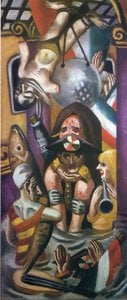
Zkoumání lidské existence a společnosti Tento mocný triptych Maxe Beckmanna zachycuje složitou tkaninu lidské existence a společenských rolí prostřednictvím živé, emocionálně nabité kompozice. Každý panel představuje dynamickou scénu plnou deformovaných postav, symbolických objektů a expresivních gest, která zvou diváka k zamyšlení nad tématy věznění, identity a sociální interakce. Beckmannův portrét lidských postav – některé sedící, jiné stojící nebo za mřížemi – vyvolává pocit napětí, introspekce a vzdoru, což z tohoto…

Ručně malovaná olejná reprodukce od $225 41 × 24 cm
Pořiďte si ho pro sebe Zjistit více
6
Selfportrait in tuxedo, Busch-Reisinger M (1927) od Max Beckmann

Selfportrait in tuxedo, Busch-Reisinger M

1927 · Oil On Canvas

The gaze of Max Beckmann meets the viewer directly in Selfportrait in tuxedo, Busch-Reisinger M. This oil-on-canvas work, executed in 1927, captures the artist in a moment of poised, formal presence. He stands before us, a figure of quiet strength, wearing the elegant attire of a tuxedo that marks a specific era of social transition. The painting exists as a significant presence within the German Expressionism movement, embodying the tension…

Ručně malovaná olejná reprodukce od $175 26 × 38 cm
Nechte si ji namalovat ručně Přečtěte si jeho příběh
7
Temptation (1937) od Max Beckmann

Temptation

1937 · Oil On Canvas

Max Beckmann, a renowned German Expressionist painter, created his masterpiece Temptation in 1937. This oil on canvas painting is housed at the Bayerische Staatsgemäldesammlungen (Munich, Germany), and it exemplifies Beckmann's unique style and thematic exploration of human nature. The Artistic Context Beckmann was a key figure in the Expressionist movement, which emphasized subjective emotional experience. His work often drew upon historical and mythological themes to convey contemporary moral and spiritual…

Ručně malovaná olejná reprodukce od $175 41 × 24 cm Velikost jako originál $1128 199 × 170 cm Objednat v originální velikosti →
Objednat tento dílo Více informací o tomto díle
9
The argonauts (1950) od Max Beckmann

The argonauts

1950 · Oil On Canvas

The artwork is a triptych titled The Argonauts, created between 1949 and 1950. The composition features a middle panel containing several figures: the poet Orpheus is positioned at the center, with Jason located at his right and the sea god Glaucus at his left. The painting depicts a variety of people in different positions, including individuals who are standing, sitting, or lying down. The scene includes at least 12 people,…

Ručně malovaná olejná reprodukce od $175 38 × 26 cm
Nechte si ji namalovat ručně Přečtěte si jeho příběh
10
Temptation (1936) od Max Beckmann

Temptation

1936 · Oil On Canvas · Bavarské státní sbírky malby, Mnichov

We are looking at Temptation, a significant work by Max Beckmann. Created in 1937, this oil on canvas painting is a triptych, a format that allows the artist to structure a complex narrative across three distinct panels. The work is a definitive example of German Expressionism within the Modern era.

Ručně malovaná olejná reprodukce od $225 26 × 38 cm Velikost jako originál $824 100 × 216 cm Objednat v originální velikosti →
Pořiďte si ho pro sebe Zjistit více

Pokračujte v objevování Max Beckmann: 11 až 100

11Quappi in blue in a boat (1950) od Max BeckmannQuappi in blue in a boat1950 Nechte si ji namalovat ručně od $175 →
12Apachentanz (1938) od Max BeckmannApachentanz1938 · Kunsthalle Bremen Pořiďte si ho pro sebe od $275 →
13Still Life with Large Green Fruits od Max BeckmannStill Life with Large Green Fruits Objednat tento dílo od $175 →
14Galleria Umberto (1925) od Max BeckmannGalleria Umberto1925 Pořiďte si ho pro sebe od $175 →
15Siesta od Max BeckmannSiesta Pořiďte si ho pro sebe od $200 →
16Bathing Scene (The Green Cloak) (1934) od Max BeckmannBathing Scene (The Green Cloak)1934 · National Gallery of Art Pořiďte si ho pro sebe od $175 →
17Christ in Limbo (1947) od Max BeckmannChrist in Limbo1947 · National Gallery of Art Objednat tento dílo od $225 →
18Still Life with Cigar Box (1926) od Max BeckmannStill Life with Cigar Box1926 · Bavarské státní sbírky malby Objednat tento dílo od $200 →
19Self Portrait in Olive and Brown (1945) od Max BeckmannSelf Portrait in Olive and Brown1945 · Detroit Institute of Arts Pořiďte si ho pro sebe od $175 →
20The Argonauts: Music (1949) od Max BeckmannThe Argonauts: Music1949 · National Gallery of Art Objednat tento dílo od $250 →
21Self-Portrait in Gray Robe (1941) od Max BeckmannSelf-Portrait in Gray Robe1941 · Bavarské státní sbírky malby Nechte si ji namalovat ručně od $175 →
22Portrait of Carl Couple (1918) od Max BeckmannPortrait of Carl Couple1918 · Städel Museum Nechte si ji namalovat ručně od $200 →
23Leave-Taking (1942) od Max BeckmannLeave-Taking1942 · Thyssen-Bornemisza Museum Objednat tento dílo od $200 →
24Cabins (1948) od Max BeckmannCabins1948 · Kunstsammlung Nordrhein-Westfalen Objednat tento dílo od $250 →
25Reclining Woman by the Sea (1950) od Max BeckmannReclining Woman by the Sea1950 · Hamburger Kunsthalle Pořiďte si ho pro sebe od $175 →
26Farmers Carrying Wood (1941) od Max BeckmannFarmers Carrying Wood1941 · Bavarské státní sbírky malby Nechte si ji namalovat ručně od $300 →
27The Duchess of Malvedi (1926) od Max BeckmannThe Duchess of Malvedi1926 · Bavarské státní sbírky malby Pořiďte si ho pro sebe od $175 →
28The Circus Carriage (1940) od Max BeckmannThe Circus Carriage1940 · Städel Museum Pořiďte si ho pro sebe od $225 →
29Lady in gray cap (1944) od Max BeckmannLady in gray cap1944 · Kunsthalle Bremen Objednat tento dílo od $175 →
30Declaration of War od Max BeckmannDeclaration of War Objednat tento dílo od $450 →
31Family Scene (Beckmann Family) od Max BeckmannFamily Scene (Beckmann Family) Objednat tento dílo od $225 →
32Maternidad od Max BeckmannMaternidad Nechte si ji namalovat ručně od $200 →
33Departure (1935) od Max BeckmannDeparture1935 Objednat tento dílo od $175 →
34Portrait of Edie Rickey (1949) od Max BeckmannPortrait of Edie Rickey1949 · Saint Louis Art Museum Nechte si ji namalovat ručně od $175 →
35Double image. People on the street (1914) od Max BeckmannDouble image. People on the street1914 · Berlinische Galerie Nechte si ji namalovat ručně od $225 →
36Hotel de l’Ambre (1949) od Max BeckmannHotel de l’Ambre1949 · Bavarské státní sbírky malby Objednat tento dílo od $200 →
37Small cafe, revolving door (1944) od Max BeckmannSmall cafe, revolving door1944 · Kunstmuseum Den Haag Nechte si ji namalovat ručně od $175 →
38The argonauts, Detalj, Private collect (1950) od Max BeckmannThe argonauts, Detalj, Private collect1950 Nechte si ji namalovat ručně od $175 →
39Conversation (Society I) (1908) od Max BeckmannConversation (Society I)1908 · Alte Nationalgalerie Nechte si ji namalovat ručně od $250 →
40Vampire (1948) od Max BeckmannVampire1948 · Museum Folkwang Pořiďte si ho pro sebe od $175 →
41The removal of the sphinxes (1945) od Max BeckmannThe removal of the sphinxes1945 · Staatliche Kunsthalle Karlsruhe Nechte si ji namalovat ručně od $250 →
42Studio with Table and Glasses (1931) od Max BeckmannStudio with Table and Glasses1931 · Bavarské státní sbírky malby Objednat tento dílo od $175 →
43Woman Reading at the Beach od Max BeckmannWoman Reading at the Beach Objednat tento dílo od $175 →
44Fisherwomen od Max BeckmannFisherwomenSaint Louis Art Museum Objednat tento dílo od $250 →
45Resting Woman with Carnations od Max BeckmannResting Woman with Carnations Nechte si ji namalovat ručně od $175 →
46Small italian Landscape od Max BeckmannSmall italian Landscape Objednat tento dílo od $175 →
47Sinagoga od Max BeckmannSinagogaStädel Museum Pořiďte si ho pro sebe od $200 →
48Girl in Black on Gray / Young Girl (1940) od Max BeckmannGirl in Black on Gray / Young Girl1940 · Bavarské státní sbírky malby Objednat tento dílo od $175 →
49Floral still life with mirror (1927) od Max BeckmannFloral still life with mirror1927 Nechte si ji namalovat ručně od $175 →
50Rugby players, Wilhelm-Lehmbruck-Museum, (1929) od Max BeckmannRugby players, Wilhelm-Lehmbruck-Museum,1929 Pořiďte si ho pro sebe od $175 →
51Sculpture Studio / Studio Corner (1950) od Max BeckmannSculpture Studio / Studio Corner1950 · Bavarské státní sbírky malby Pořiďte si ho pro sebe od $200 →
52Red Clown / Man with Crown (1941) od Max BeckmannRed Clown / Man with Crown1941 · Bavarské státní sbírky malby Objednat tento dílo od $175 →
53The Argonauts: Painting (1949) od Max BeckmannThe Argonauts: Painting1949 · National Gallery of Art Pořiďte si ho pro sebe od $175 →
54Still life with yellow roses od Max BeckmannStill life with yellow rosesThyssen-Bornemisza Museum Pořiďte si ho pro sebe od $175 →
55Carnival Paris (1930) od Max BeckmannCarnival Paris1930 · Bavarské státní sbírky malby Objednat tento dílo od $200 →
56The Trapeze (1923) od Max BeckmannThe Trapeze1923 · Toledo Museum of Art Objednat tento dílo od $250 →
57Baccarat (1947) od Max BeckmannBaccarat1947 · The Nelson-Atkins Museum of Art Objednat tento dílo od $375 →
58Portrait of Augusta Countess vom Hagen (1908) od Max BeckmannPortrait of Augusta Countess vom Hagen1908 · Staatliche Kunstsammlungen Dresden Pořiďte si ho pro sebe od $175 →
59Self-Portrait in Black (1944) od Max BeckmannSelf-Portrait in Black1944 · Bavarské státní sbírky malby Objednat tento dílo od $175 →
60Woman with Mirror and Orchids (1947) od Max BeckmannWoman with Mirror and Orchids1947 · Muzeum umění Houston Pořiďte si ho pro sebe od $175 →
61The Harbor of Genoa od Max BeckmannThe Harbor of GenoaSaint Louis Art Museum Nechte si ji namalovat ručně od $175 →
62The Rape of Europa od Max BeckmannThe Rape of Europa Objednat tento dílo od $175 →
63The acrobats (1939) od Max BeckmannThe acrobats1939 · Saint Louis Art Museum Pořiďte si ho pro sebe od $175 →
64Flower Shop / In Front of the Hotel (1936) od Max BeckmannFlower Shop / In Front of the Hotel1936 · Bavarské státní sbírky malby Pořiďte si ho pro sebe od $225 →
65Self-Portrait (1905) od Max BeckmannSelf-Portrait1905 · Städel Museum Objednat tento dílo od $175 →
66Self-portrait (1899) od Max BeckmannSelf-portrait1899 Pořiďte si ho pro sebe od $175 →
67Self-portrait (1901) od Max BeckmannSelf-portrait1901 Pořiďte si ho pro sebe od $175 →
68Self-portrait with champagne glass (1919) od Max BeckmannSelf-portrait with champagne glass1919 · Städel Museum Pořiďte si ho pro sebe od $175 →
69The street (1914) od Max BeckmannThe street1914 · Berlinische Galerie Nechte si ji namalovat ručně od $250 →
70Self-Portrait with Raised Hand (1908) od Max BeckmannSelf-Portrait with Raised Hand1908 · Thyssen-Bornemisza Museum Nechte si ji namalovat ručně od $175 →
71Dance halls (1909) od Max BeckmannDance halls1909 Pořiďte si ho pro sebe od $250 →
72Company III. Family Battenberg (1915) od Max BeckmannCompany III. Family Battenberg1915 Nechte si ji namalovat ručně od $250 →
73Before the Masked Ball (1922) od Max BeckmannBefore the Masked Ball1922 · Bavarské státní sbírky malby Pořiďte si ho pro sebe od $300 →
74Carnival (1920) od Max BeckmannCarnival1920 Objednat tento dílo od $225 →
75Women's Bath (1919) od Max BeckmannWomen's Bath1919 Pořiďte si ho pro sebe od $350 →
76Double Portrait (1923) od Max BeckmannDouble Portrait1923 · Städel Museum Pořiďte si ho pro sebe od $200 →
77Portrait of Käthe von Porada (1924) od Max BeckmannPortrait of Käthe von Porada1924 · Städel Museum Objednat tento dílo od $175 →
78Portrait of an Argentinean (1929) od Max BeckmannPortrait of an Argentinean1929 · Bavarské státní sbírky malby Objednat tento dílo od $175 →
79The Beach (1927) od Max BeckmannThe Beach1927 · Städel Museum Nechte si ji namalovat ručně od $275 →
80Two Ladies at the Window (1928) od Max BeckmannTwo Ladies at the Window1928 Nechte si ji namalovat ručně od $200 →
81Carnival (Pierrette and Clown) (1925) od Max BeckmannCarnival (Pierrette and Clown)1925 · Kunsthalle Mannheim Pořiďte si ho pro sebe od $175 →
82Portrait of S.H. (1928) od Max BeckmannPortrait of S.H.1928 Objednat tento dílo od $175 →
83Still Life with Gramophone and Irises (1924) od Max BeckmannStill Life with Gramophone and Irises1924 Nechte si ji namalovat ručně od $175 →
84Reclining woman with book and irises (1931) od Max BeckmannReclining woman with book and irises1931 Nechte si ji namalovat ručně od $175 →
85The Skaters (1932) od Max BeckmannThe Skaters1932 · Minneapolis Institute of Art Nechte si ji namalovat ručně od $225 →
86Departure: The Castle (1933) od Max BeckmannDeparture: The Castle1933 · MoMA - Museum of Modern Art Nechte si ji namalovat ručně od $175 →
87Lute Player / Banjo-Playing Woman (1930) od Max BeckmannLute Player / Banjo-Playing Woman1930 Pořiďte si ho pro sebe od $175 →
88Margarethe Wichert (daughter of Professor Wichert) (1930) od Max BeckmannMargarethe Wichert (daughter of Professor Wichert)1930 Nechte si ji namalovat ručně od $175 →
89Girls Playing with Dogs (1933) od Max BeckmannGirls Playing with Dogs1933 Nechte si ji namalovat ručně od $200 →
90Woman in Bed (1932) od Max BeckmannWoman in Bed1932 Objednat tento dílo od $175 →
91Claridge II (1930) od Max BeckmannClaridge II1930 Nechte si ji namalovat ručně od $175 →
92Portrait of the Family Lütjens (1944) od Max BeckmannPortrait of the Family Lütjens1944 · Museum Boijmans Van Beuningen Nechte si ji namalovat ručně od $225 →
93Self-Portrait (1938) od Max BeckmannSelf-Portrait1938 · Solomon R. Guggenheim Museum Nechte si ji namalovat ručně od $175 →
94Artist (1936) od Max BeckmannArtist1936 Objednat tento dílo od $175 →
95Portrait of a Frenchmen (1933) od Max BeckmannPortrait of a Frenchmen1933 · Centre Pompidou Pořiďte si ho pro sebe od $175 →
96Heinrich George Family Portrait (1935) od Max BeckmannHeinrich George Family Portrait1935 Nechte si ji namalovat ručně od $250 →
97Death (1938) od Max BeckmannDeath1938 Pořiďte si ho pro sebe od $250 →
98Birth (1937) od Max BeckmannBirth1937 Pořiďte si ho pro sebe od $300 →
99Woman thinking by the sea (1937) od Max BeckmannWoman thinking by the sea1937 · Kunsthalle Bremen Objednat tento dílo od $175 →
100Self Portrait with Crystal Ball (1936) od Max BeckmannSelf Portrait with Crystal Ball1936 · Kunstmuseum Liechtenstein Nechte si ji namalovat ručně od $175 →

Obrazy umělce Max Beckmann podle jednotlivých období

Co nejčastěji maloval Max Beckmann

Čtyři nejčastější motivy těchto děl, z nichž každý má svůj nejznámější příklad.

Kde si můžete prohlédnout obrazy autora Max Beckmann

8 muzea, v nichž je umístěno nejvíce obrazů z této stránky.

Muzea Město Díla autora Max Beckmann Obrazy z tohoto seznamu
Bavarské státní sbírky malby, MnichovBavarské státní sbírky malby Mnichov 38 Velká scéna utrpení, Woman with Mandolin in Yellow and Red, Temptation
Städel Museum, Frankfurt nad MohanemStädel Museum Frankfurt nad Mohanem 18 Portrait of Carl Couple, The Circus Carriage, Sinagoga
Saint Louis Art Museum, Saint LouisSaint Louis Art Museum Saint Louis 39 Kolumbina, Portrait of Edie Rickey, Fisherwomen
National Gallery of Art, WashingtonNational Gallery of Art Washington 7 Bathing Scene (The Green Cloak), Christ in Limbo, The Argonauts: Music
Kunsthalle Bremen, BremenKunsthalle Bremen Bremen 4 Apachentanz, Lady in gray cap, Woman thinking by the sea
Thyssen-Bornemisza Museum, MadridThyssen-Bornemisza Museum Madrid 4 Leave-Taking, Still life with yellow roses, Self-Portrait with Raised Hand
Kunstsammlung Nordrhein-Westfalen, DüsseldorfKunstsammlung Nordrhein-Westfalen Düsseldorf 3 Noc, Železný most (Výhled na Frankfurt), Cabins
Berlinische Galerie, BerlínBerlinische Galerie Berlín 2 Double image. People on the street, The street

Jedno slavné dílo Max Beckmann pro každé desetiletí

Díla podle dekád

Vyberte si desetiletí a prohlédněte si jeho nejvýraznější dílo.

Obrazy autora Max Beckmann: co si lidé chtějí vědět

Kterým obrazem je Max Beckmann nejznámější?Zobrazit odpověď

Na vrcholu žebříčku je Noc (1919), Kunstsammlung Nordrhein-Westfalen, Düsseldorf. Hned za ním následují: Velká scéna utrpení (1906) a Železný most (Výhled na Frankfurt) (1922).

Kolik let bylo Max Beckmann ve době vzniku díla Noc?Zobrazit odpověď

35 let. Max Beckmann se narodil(a) v 1884 a dílo Noc pochází z roku 1919.

Kterých 10 obrazů autora Max Beckmann je nejznámějších?Zobrazit odpověď

Noc, Velká scéna utrpení, Železný most (Výhled na Frankfurt), Kolumbina, Výkonníci, Selfportrait in tuxedo, Busch-Reisinger M, Temptation, Woman with Mandolin in Yellow and Red, The argonauts a Temptation. Rok vzniku a muzeum každého díla najdete v seznamu výše.

Kolik je k dispozici děl autora Max Beckmann?Zobrazit odpověď

V našem katalogu máme 401 děl umělce Max Beckmann z let 1899 až 1950.

Ve kterých muzeích jsou nejznámější obrazy umělce Max Beckmann?Zobrazit odpověď

Většinu z nich najdete v Bavarské státní sbírky malby (Mnichov), Städel Museum (Frankfurt nad Mohanem) a Saint Louis Art Museum (Saint Louis). Seznam muzeí výše obsahuje podrobný přehled.

Kdy byly namalovány nejznámější díla umělce Max Beckmann?Zobrazit odpověď

V období 1930s, více než v jakémkoli jiném čase: 25 z 100 děl na této stránce pochází z této doby, z nichž Temptation.

Jaká jsou nejstarší a nejnovější slavná díla umělce Max Beckmann?Zobrazit odpověď

Nejstarší dílo je z Self-portrait (1899); nejnovější je z Kolumbina (1950).

Co nejčastěji maloval/a Max Beckmann?Zobrazit odpověď

Woman (20), Man (16) a People (16) z celkových 100 kusů na této stránce.

Čím obvykle maloval/a Max Beckmann?Zobrazit odpověď

Oil On Canvas, použito u 44 z 100 děl na této stránce.

S jakým uměleckým směrem je spojen(a) Max Beckmann?Zobrazit odpověď

Cubist expressionism, jak je vidět u děl na této stránce.

Co můžete vidět od Max Beckmann v Bavarské státní sbírky malby?Zobrazit odpověď

Na této stránce můžete uvidět 17 děl v Bavarské státní sbírky malby, Mnichov, včetně Velká scéna utrpení, Woman with Mandolin in Yellow and Red a Temptation.

Mohu si objednat reprodukci Max Beckmann pro svůj domov?Zobrazit odpověď

Ano. Každý obraz na této stránce je k dispozici jako ručně malovaná olejná reprodukce nebo jako tisk v rozměru, který vám vyhovuje. Pro objednání stačí otevřít stránku daného obrazu.

Seznamte se s Max Beckmann

The Life and Art of Max Beckmann

Max Beckmann was a man of many disciplines, working as a painter, draftsman, printmaker, sculptor, and writer. He entered the world on February 12, 1884, in Leipzig, Saxony. He grew up in an upper-middle-class family as the youngest of three children. His early years were shaped by the quiet stability of his home until 1894, when his father, Carl Beckmann, a grain merchant, passed away. His mother, Antoine Beckmann, remained a central figure in his life as he began to find his way through the complexities of modern existence.

His work often felt like a confrontation with the reality of the human condition. He did not merely paint scenes; he captured the tension of a changing era through a variety of mediums. His output was vast, ranging from large-scale canvases to intimate prints. He was a man who sought to articulate the weight of history through his hands, often using the tools of his trade to process the shifting landscapes of the twentieth century.

Early Life and Artistic Training

Born into a middle-class family in Leipzig, Germany, Max Beckmann showed an early inclination toward drawing. His initial sketches revealed a precocious talent that hinted at the depth of his later work. During these formative years, he sought out the rigor of the old traditions, training in a conservative academic style that emphasized technical precision. This grounding in formal technique provided him with a solid foundation, even as his own spirit began to push against the boundaries of conventional methods.

As he matured, Beckmann found himself drawn to the Old Masters. He spent much of his time studying their compositions and mastery of form, a fascination that would eventually help him develop a strikingly original style. He was not content with mere imitation; instead, he used the lessons of the past to build a personal visual language. This period of study was marked by a tension between his academic training and a growing desire to express something more profound and less structured.

By 1912, he was already tackling ambitious subjects that required a command of large-scale composition. One such work was his painting of The Sinking of the Titanic, a piece that demonstrated his ability to handle complex, dramatic narratives. At this stage, his work was characterized by academically correct depictions, focusing on the weight and presence of figures within a defined space. He was a history painter at heart, using the grand scale of the past to explore the human condition through a lens of structured, deliberate form.

Experiences During World War I

The outbreak of World War I brought a sudden, violent end to Beckmann's academic training. He did not remain a bystander to the conflict; instead, he volunteered to serve in the medical corps. Working as a medical orderly, he was thrust into the direct reality of human suffering. The clinical, structured world of his early training was replaced by the chaotic and harrowing conditions of the front lines.

The strain of this service eventually became too much to bear. While stationed on the Belgian front, the weight of the war's devastation led to a nervous breakdown. He was discharged from the military in 1915, returning to a life that had been fundamentally altered by what he had witnessed. The horrors he saw during his time in the medical corps ignited a radical shift in his vision. The academic precision of his youth gave way to a new way of seeing, one that reflected a fractured and troubled humanity.

Artistic Style and Technique

Beckmann’s visual language was built from a tension between tradition and a restless, modern impulse. He looked back to the Old Masters, finding a foundation in the works of Rembrandt and Rubens, while also drawing from the structured forms of Cézanne and the emotive brushwork of Van Gogh. His compositions often felt crowded and compressed, utilizing shallow space and dark, heavy outlines to push his subjects toward the viewer. This technique created a sense of claustrophobia, as if the figures were trapped within the frame. He frequently paired this distorted figuration with a brutal realism, using his canvases to offer sharp social criticism of the world around him.

The physical application of paint was central to his expressive power. He favored a masterful impasto technique, applying the medium in thick, gestural brushstrokes that gave his surfaces a palpable, heavy weight. This texture added a sense of urgency to his depictions of human struggle. His interests were not limited to the Western tradition; he also found inspiration in the unsettling, symbolic narratives of Northern European artists like Bosch, Bruegel, and Matthias Grünewald. By blending these influences, he developed a way of painting that felt both ancient and deeply rooted in the anxieties of the twentieth century.

The Weimar Republic and New Objectivity

During the 1920s, Beckmann found himself moving through a Germany that was struggling to find its footing. He became associated with the New Objectivity movement, a style that moved away from the inward-looking emotions of earlier years toward a more direct, often biting, look at reality. His work from this period captured the doomed nature of the Weimar Republic with a sense of acidic cynicism. He did not shy away from the chaos of the era, instead using his brush to document the tension of a society in transition.

Even when his subjects appeared light or festive, such as circus performers or social gatherings, an undercurrent of moodiness or unease often remained beneath the surface. There was a persistent sense of discomfort in his compositions. This tension was particularly evident in his graphic work. He produced several black-and-white print portfolios during these years, including the work titled Hell, which utilized the raw power of printmaking to explore the darker aspects of the human condition.

Exile in Amsterdam and the Nazi Regime

The political climate in Germany grew increasingly hostile toward Beckmann’s vision. In 1933, the rise of the Nazi regime brought direct consequences to his professional life when he was dismissed from his teaching position at the Stadel Art School in Frankfurt. His work was targeted by the authorities and included in the Degenerate Art exhibition, a move that signaled the impossibility of remaining in his homeland. Facing this mounting pressure and the threat of the regime, he chose to leave Germany behind.

Beckmann spent ten years in self-imposed exile in Amsterdam. This period was marked by the profound uncertainty of living through the Second World War. While in Amsterdam, his paintings often turned toward mythic and parabolic images, moving away from the specific realities of the world he had left behind. His art during these years reflected a sense of being unmoored from a particular time or place, focusing instead on the internal struggles of the human condition.

Life and Work in America

After years of living in exile in Amsterdam, Max Beckmann finally immigrated to America in 1947. His arrival marked a new chapter of stability, though his focus remained deeply tied to the act of creation and the sharing of his craft. He spent his first two years in the United States living in St. Louis, Missouri, where he became an active part of the local artistic community. During this time, he shared his knowledge through teaching positions at Washington University in St. Louis and the Brooklyn Museum.

The final years of his life were spent in New York, where he moved in 1949. This period was brief, lasting only until his death in 1950. Even in these concluding months, his work continued to reflect the personal and psychological depth that had characterized his entire career. His presence in the American art scene was marked by a refusal to simplify his complex visual language, even as he settled into a new home far from his German roots.

Notable and Key Artworks

Beckmann’s canvases often felt like crowded, claustrophobic rooms where the tension of the era was physically palpable. In 1919, he produced The Night, a work that captures the fragmentation of modern life through distorted figures and a sense of profound alienation. This piece reflects the societal trauma left in the wake of the Great War, using a heavy, psychological approach to depict the chaos of the post-war period. His ability to translate internal anxiety into a visual language became a defining feature of his output.

As the industrial landscape of Germany shifted, so did his focus. His 1922 painting, The Iron Bridge (View of Frankfurt), uses thick, gestural brushstrokes to depict a city in transition. The composition is anchored by the heavy, geometric silhouette of the suspension bridge, cutting through a palette of saturated earth tones and industrial grays. It captures the pulsating energy of an urban environment caught between the old world and a rapidly modernizing future.

Throughout his life, Beckmann returned to his own image, using his own face to explore the human condition. His 1938 work, Self-Portrait with Horn, shows him navigating a world of increasing uncertainty. Even in his final years, his work remained deeply personal. His Self-Portrait in Blue Jacket, painted in 1950, remains a significant part of his late period, reflecting the man he had become after his time in exile and his move to America.

Legacy and Historical Impact

Max Beckmann remains a central figure in the history of 20th-century painting. While he often resisted the labels placed upon him, his work is widely considered a cornerstone of the German Expressionism movement. He possessed a singular ability to translate the fractured psyche of a continent into a visual language that felt both deeply personal and universally understood. His paintings do not merely depict scenes; they carry an extraordinary psychological depth that forces a confrontation with the human condition.

His influence extended far beyond the borders of Germany. Even as he navigated the difficult years of exile in Amsterdam and his eventual move to the United States, his voice remained distinct. He managed to bridge the gap between traditional academic training and the radical shifts of modernism. By refusing to settle into a single movement, he carved out a space that was entirely his own, characterized by a tension between the physical world and the internal, often troubled, landscape of the mind.

Where to See His Works Today

Finding the physical traces of Beckmann's life requires traveling through the cities that shaped his exile and his later years. In Germany, the Kunstsammlung Nordrhein-Westfalen in Duesseldorf maintains a significant presence of his work, holding pieces like The Night from 1919. His presence in Europe is also felt in Zurich, where the Kunsthaus Zürich preserves his imagery. These collections offer a way to see how his vision shifted as he moved through the complexities of the early twentieth century.

For those following his path to the United States, his later life is documented in American institutions. The Metropolitan Museum of Art in New York holds works from his final years, including his 1950 Self-Portrait in Blue Jacket. The Museum of Modern Art (MoMA) also maintains his works within its permanent collection. These pieces reflect the final chapter of a man who spent his last years navigating the streets of New York.