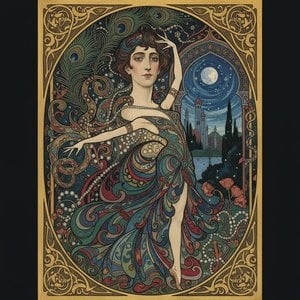
Early Life and the Seeds of Artistic Rebellion
Léon Bakst, originally born Lev Samojlovich Rosenberg in 1866 within the confines of Grodno—a city then part of the Russian Empire—was a figure whose artistic journey was deeply intertwined with both innate talent and the constraints imposed by his social context. His upbringing, rooted in a Jewish family connected to the imperial court through his grandfather’s position as a celebrated tailor, instilled within him an early awareness of cultural nuances alongside a burgeoning passion for drawing – a talent vividly demonstrated when he secured first place in a competition at just twelve years old. However, this nascent artistic inclination initially encountered resistance from his parents, who were hesitant to embrace such an unconventional path. Despite their reservations, Bakst persevered, ultimately enrolling in the prestigious St. Petersburg Academy of Arts as a non-credit student while simultaneously supplementing his education through work as a book illustrator – a practical necessity that honed his skills and provided crucial financial independence. This period of dual engagement shaped his perspective, exposing him to both the formal training of an artist and the realities of the commercial world, experiences that would later inform his approach to design. It was in 1889 that he adopted the surname “Bakst,” a pragmatic decision reportedly motivated by concerns regarding potential career limitations stemming from his birth name within a society often prejudiced against Jewish individuals – a poignant reflection of the challenges faced by artists from marginalized communities during that era.The World of Art and Embracing Modernity
Bakst’s artistic development truly blossomed with his active participation in the influential “World of Art” movement, a collective dedicated to exploring diverse artistic expressions and challenging established norms. He swiftly became a pivotal figure alongside luminaries such as Sergei Diaghilev and Alexandre Benois, contributing significantly to the group's eponymous periodical through his striking graphics and innovative designs. This association brought him widespread recognition within Russia’s vibrant artistic circles, establishing him as a rising star poised at the forefront of contemporary aesthetics. His early works encompassed compelling portraits of prominent figures – including Filipp Malyavin, Vasily Rozanov, Andrei Bely, and Zinaida Gippius – showcasing his ability not only to capture physical likeness but also to delve into the intellectual and emotional depths of his subjects. Bakst’s style during this period was a fascinating synthesis of Russian artistic traditions with burgeoning European influences—particularly Orientalism and early Modernism. He embraced vibrant colors, exotic themes, and stylized forms, foreshadowing the revolutionary aesthetic he would later bring to the stage. This willingness to experiment and synthesize diverse influences marked him as an artist attuned to the shifting currents of his time. His work began to whisper of a new visual language, one that moved beyond strict representation toward evocative suggestion. The group’s periodical served as a platform for disseminating ideas and promoting artistic experimentation, fostering a dynamic environment where Bakst could refine his skills and develop his unique vision.Revolutionizing Ballet with the Ballets Russes
The pivotal moment in Bakst’s career arrived in 1908 when he began designing sets and costumes for theatrical productions – a transformative shift that would forever alter the landscape of stage design. His collaboration with Sergei Diaghilev's Ballets Russes proved to be nothing short of revolutionary, catapulting both artists to international fame and establishing a new paradigm for balletic spectacle. Bakst’s designs were groundbreaking; they moved away from traditional, realistic depictions, embracing stylized forms, bold colors, and a sense of opulent fantasy. Productions like *Cleopatra*, *Scheherazade* (1910)—arguably his most iconic work—*Carnaval* (1910), *Narcisse* (1911), and particularly *L’Après-midi d'un Faune* (1912) became legendary for their visual splendor. L’Après-midi d'un Faune, in particular, was a seminal work that profoundly influenced the development of ballet and stage design, establishing a new aesthetic language for the art form—one characterized by dreamlike imagery, fluid movement, and an exploration of primal emotions. He didn’t merely create backdrops; he constructed immersive worlds that heightened the emotional impact of the choreography and music. The costumes were equally innovative, often incorporating exotic fabrics, shimmering embellishments, and daring silhouettes that challenged conventional notions of theatrical attire. This collaboration with Diaghilev marked a turning point in Bakst's career, solidifying his position as a leading figure in the modern art world.Legacy and Enduring Influence
Léon Bakst’s legacy extends far beyond his contributions to ballet. He is rightfully considered one of the most important figures in the history of theatrical design, significantly impacting both set and costume creation for generations to come. His designs also contributed to the development of the Art Deco style with their emphasis on stylized forms, rich colors, and exotic themes—a testament to his far-reaching influence on visual culture. Despite facing some criticism during his lifetime for perceived extravagance, Bakst’s work was widely celebrated, and his funeral in 1924 was attended by a remarkable gathering of prominent artists, poets, musicians, dancers, and critics – a poignant demonstration of the esteem in which he was held. Today, his artwork can be found in museums worldwide and continues to inspire through reproductions available on platforms like ArtsDot.com, ensuring that his innovative spirit and artistic vision endure for audiences around the globe. Bakst’s ability to synthesize diverse influences, embrace experimentation, and create visually stunning worlds cemented his place as a true visionary of the 20th century.- A master of color and composition.
- Pioneered new approaches to theatrical design.
- Influenced Art Deco aesthetics.
Otázky a odpovědi
Kde mohu vidět všechna umělecká díla autora Léon Bakst?
Veškerá díla umělce Léon Bakst na tento web lze prohlédnout na jeho stránce Všechna umělecká díla.
Která umělecká díla umělce Léon Bakst mají nejvyšší počet zhlédnutí?
Pro umělce Léon Bakst existuje stránka Statistiky, která zobrazuje statistiky o dílech tohoto umělce na tento web.
Kde najdu díla umělce Léon Bakst seskupená podle klíčových slov?
Stránka Podle klíčových slov umělce Léon Bakst seskupuje díla tohoto umělce podle jejich klíčových slov.