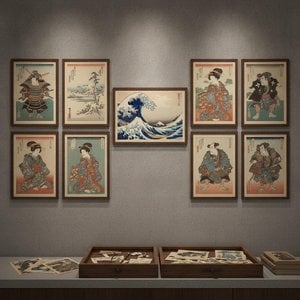
Kobayashi Ikuhide: A Master of Edo’s Evolving Landscape
Kobayashi Ikuhide (小林幾英), a pivotal figure in late 19th and early 20th-century Japanese art, stands as a testament to the dynamic evolution of ukiyo-e printmaking during a period of profound social and political transformation. Born around 1885 in Tokyo, Ikuhide’s artistic journey was deeply intertwined with the legacy of Utagawa Yoshiiku (1833-1904), one of the most influential artists of the Edo period, who served as his mentor. This connection established a strong foundation in the traditional techniques and subject matter that would define much of Ikuhide’s oeuvre, while simultaneously allowing him to forge his own distinctive artistic voice.
Ikuhide's early training under Yoshiiku focused primarily on the production of *matsuri-e* – prints depicting festivals and popular entertainment. These works, characterized by their vibrant colors, dynamic compositions, and meticulous attention to detail, established him as a skilled craftsman within the ukiyo-e tradition. However, Ikuhide quickly surpassed mere technical proficiency, demonstrating an innate ability to capture the essence of Edo society—its customs, manners, and everyday life. He adopted various artistic names throughout his career, including Hikitei (飛幾亭) and Shinbitei (箴飛亭), reflecting a desire for stylistic experimentation and a willingness to embrace new approaches.
The Shifting Sands of Meiji Japan: Themes and Subjects
Ikuhide’s work is inextricably linked to the dramatic changes occurring in Japan during the Meiji Restoration (1868-1912). The dismantling of the feudal system, the rapid adoption of Western technologies and ideas, and the rise of a new urban culture profoundly impacted Japanese art. Ikuhide responded to these shifts by exploring themes that reflected both the continuity of traditional values and the embrace of modernity. His prints frequently depicted scenes of daily life in Tokyo – bustling markets, elegant tea houses, and lively street performances—offering viewers glimpses into a rapidly changing society.
A significant portion of Ikuhide’s output revolved around *musha-e* (war prints), which were particularly popular during the late 19th century. However, unlike earlier depictions of heroic battles, Ikuhide's musha-e often presented a more nuanced and psychologically complex portrayal of warriors—emphasizing their anxieties, vulnerabilities, and the moral ambiguities of war. He also produced numerous *meishō* (famous views) – prints showcasing iconic landmarks and scenic vistas of Tokyo, capturing the city’s evolving urban landscape.
Technique and Style: A Synthesis of Tradition and Innovation
Ikuhide's artistic style is characterized by a remarkable synthesis of traditional ukiyo-e techniques with elements of Western influence. He skillfully employed *bokashi* (tonal shading) to create subtle gradations of color and volume, while also incorporating bold outlines and simplified forms reminiscent of European academic art. His compositions are often dynamic and asymmetrical, reflecting the energy and movement of Edo society. Ikuhide was a master of *nishiki-e*, or “picturesque prints,” known for their lavish use of color and intricate detail.
Furthermore, Ikuhide’s work demonstrates an exceptional understanding of perspective and spatial relationships—a skill honed through his study of Western art. This is particularly evident in his depictions of urban landscapes, where he effectively conveys the illusion of depth and distance. His prints are not merely representations of reality; they are carefully constructed visual narratives that invite viewers to engage with the complexities of Edo life.
Legacy and Historical Significance
Kobayashi Ikuhide’s career spanned from approximately 1885 until his death in 1898, a period marked by immense social and artistic change. He is considered one of the most important figures in late ukiyo-e, bridging the gap between the traditions of the Edo period and the innovations of the Meiji era. His prints offer invaluable insights into the cultural dynamics of Japan during this transformative period.
While his work was initially overshadowed by the rise of Impressionism and other Western art movements, Ikuhide’s contributions to ukiyo-e are now widely recognized and celebrated. His ability to capture the spirit of Edo society—its beauty, its contradictions, and its inherent dynamism—ensures that his legacy will continue to resonate with audiences for generations to come. His influence can be seen in subsequent generations of Japanese printmakers who sought to synthesize traditional techniques with modern aesthetics.
Today, Kobayashi Ikuhide’s prints are housed in major museums around the world, serving as a vital link to Japan's rich artistic heritage and offering a compelling window into the complexities of a nation undergoing profound transformation.