A Legacy Forged in Fire: The Eternal Spirit of Jingdezhen
To touch a piece of fine ceramic art is to engage in a silent, profound dialogue with the very foundations of our planet. There is an inherent, primordial magic found in the transformation of humble earth into a vessel of profound beauty—a process known as alchemy, where heat and intention converge. This transformative power finds its most sublime expression in the Jingdezhen ceramic kiln, an institution of artistry established around 1004 CE during the reign of Emperor Zhenzong. Located in the heart of China's Jiangxi province, this legendary site has evolved from a regional pottery center into the undisputed “Porcelain Capital” of the world, earning its reputation through a millennium of unparalleled mastery and technical brilliance.
The origins of Jingdezhen’s ceramic prowess are shrouded in legend, with tales recounting a divine mandate to cultivate jade-like clay and produce vessels worthy of imperial splendor. While archaeological evidence confirms that pottery production existed in the region as early as the sixth century CE, it was during the Yuan Dynasty (1271–1368) that the kilns truly ascended to global prominence. Fueled by royal patronage and a strategic location along the vital trade routes connecting China with Central Asia and Persia, Jingdezhen became a crucible of cultural exchange. The artisans here did not merely manufacture goods; they synthesized diverse influences into a singular aesthetic language that would eventually captivate collectors across every continent.
The Zenith of Imperial Artistry
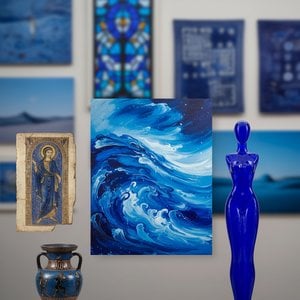
By the Ming Dynasty (1368–1644), the reputation of Jingdezhen had solidified into a standard of excellence that defined an era. The kilns produced porcelain celebrated for its ethereal beauty and technical precision, adhering to a famed aesthetic ideal: “as white as jade, as thin as paper, as bright as a mirror, and as sweet-sounding as a chime stone.” This period saw the perfection of the iconic blue and white wares, where deep, cobalt blue glazes were meticulously applied onto translucent porcelain bodies. The interplay between the rich, opaque pigments and the luminous, glass-like surface created a sense of depth and dimension that felt almost supernatural to the contemporary observer.
As the centuries progressed into the Qing Dynasty (1644–1912), the kiln's influence expanded even further. The production of official imperial wares reached new heights of complexity, with artisans mastering intricate techniques such as Famille rose and Qingbai ware. These creations were not merely decorative; they were symbols of political power and cosmic order, designed to adorn the palaces of the emperors and serve in sacred ceremonies. The technical sophistication required to control the volatile nature of clay and the intense heat of the furnace allowed for a level of detail—from delicate floral carvings to complex geometric patterns—that remains a benchmark for ceramicists today.
A Global Influence and Enduring Heritage
The reach of Jingdezhen extended far beyond the borders of the Middle Kingdom, acting as a vital artery in the global flow of art and commerce. Through the maritime Silk Road, these exquisite ceramics became highly sought-after commodities in Europe and the Middle East. The distinctive style of the kilns profoundly impacted Western ceramic traditions during the Enlightenment era, inspiring legendary figures like Josiah Wedgwood to seek similar levels of refinement in their own productions. This era of global trade saw the emergence of Cantonese export porcelain, which blended Chinese craftsmanship with aesthetic sensibilities tailored for international markets, creating a bridge between East and West.
Today, the legacy of the Jingdezhen ceramic kiln remains as vibrant as the fire that once fueled its furnaces. The historical significance of this site lies not only in the sheer volume of its output but in its role as a continuous thread of human creativity spanning over a thousand years. The mastery of texture, form, and glaze developed within these kilns continues to inspire modern artists and collectors alike. To study the works of Jingdezhen is to witness the enduring triumph of human skill over raw material, a testament to an artistic tradition that remains as luminous and timeless as the porcelain it produced.
Otázky a odpovědi
Jaká jiná jména nebo pseudony používá Jingdezhen Ceramic Kiln?
Jingdezhen Ceramic Kiln je známý/á také pod jmény Jingdezhen Kilns.
Jak najdu díla umělce Jingdezhen Ceramic Kiln na konkrétní téma?
Díla umělce Jingdezhen Ceramic Kiln můžete prozkoumat podle klíčových slov na jeho stránce Podle klíčových slov. Každé klíčové slovo seskupuje související umělecká díla.
Mohu si prohlédnout díla umělce Jingdezhen Ceramic Kiln podle použité techniky?
Díla umělce Jingdezhen Ceramic Kiln si můžete prohlédnout podle použité techniky na stránce Všechna média pro Jingdezhen Ceramic Kiln.