


1


Aktualizováno listopad 2026 · seřazeno podle našeho skóre popularity (vyhledávání, návštěvy a objednávky u každého díla) · 17 děl umělce Isami Doi v našem katalogu
Stručně řečeno
Pokud znáte jedno dílo umělce Isami Doi, je to pravděpodobně (The Wayward Muse, portfolio) Somewhere There Is a Mountain Called Parnassus Where You and I Must Go Anon and Oft (1952). Near Coney Island (1937) a (The Wayward Muse, portfolio) Quand Vous Regardez l'Essor, Etc (1952) doplňují trojici děl, která lidé okamžitě poznají. Náš katalog obsahuje 17 děl umělce Isami Doi. Níže je 17 nejznámějších děl, u každého z nich najdete rok vzniku, místo, kde je lze najít, a to, co je výjimečné.


 (The Wayward Muse, portfolio) It's on Such a Night as This That I Shall Come to You1952
12
 (The Wayward Muse, portfolio) Too Soon Forgotten, Somewhere in the Dusty Attic a Gallant Steed Patiently Awaits Me1952
13
 (The Wayward Muse, portfolio) With Nonchalant Grace He Bends near the Earth1952
14
 (The Wayward Muse, portfolio) Should You Ask Where My Feet Carry Me in Search of Happiness1952
15
 (The Wayward Muse, portfolio) I Hang My Head in Shame before the Humble Flowers1952
16
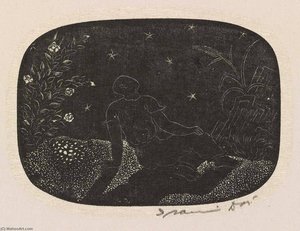 (The Wayward Muse, portfolio) Here Beneath the Canopy of Stars I Shall Sleep a Thousand Years of Dreamless Nights1952
17
 (The Wayward Muse, portfolio) From the Book of Verse by the Smoking Lamp, I Turn to Watch the Phantom Shadows1952
Díla umělce Isami Doi se zde táhnou po dobu 16 let, od 1937 do 1952. Prohlédněte si je rok po roce spolu s jeho nejznámějšími díly.
Vyberte rok a prohlédněte si jeho díla.
Více od 1952
 #3 (The Wayward Muse, portfolio) Quand Vous Regardez l'Essor, Etc
 #4 (The Wayward Muse, portfolio) Once I Grew Happily in the Sun
 #5 (The Wayward Muse, portfolio) Frontispiece
 #6 (The Wayward Muse, portfolio) What Fortunes and Misfortunes Await Me Here
 #7 (The Wayward Muse, portfolio) Proserpine, Once Again the Hills and Vales Throb with Savage Glee
 #8 (The Wayward Muse, portfolio) Relentless and Swift Is the Flow of the Great River
 #9 (The Wayward Muse, portfolio) Long before Man, Long after Man
 #10 (The Wayward Muse, portfolio) No More the Walls Surround, Etc
#11 (The Wayward Muse, portfolio) It's on Such a Night as This That I Shall Come to You
#12 (The Wayward Muse, portfolio) Too Soon Forgotten, Somewhere in the Dusty Attic a Gallant Steed Patiently Awaits Me
#13 (The Wayward Muse, portfolio) With Nonchalant Grace He Bends near the Earth
#14 (The Wayward Muse, portfolio) Should You Ask Where My Feet Carry Me in Search of Happiness
#15 (The Wayward Muse, portfolio) I Hang My Head in Shame before the Humble Flowers
#16 (The Wayward Muse, portfolio) Here Beneath the Canopy of Stars I Shall Sleep a Thousand Years of Dreamless Nights
#17 (The Wayward Muse, portfolio) From the Book of Verse by the Smoking Lamp, I Turn to Watch the Phantom Shadows
Na vrcholu žebříčku je (The Wayward Muse, portfolio) Somewhere There Is a Mountain Called Parnassus Where You and I Must Go Anon and Oft (1952). Hned za ním následují Near Coney Island (1937) a (The Wayward Muse, portfolio) Quand Vous Regardez l'Essor, Etc (1952).
49 let. Isami Doi se narodil(a) v 1903 a dílo (The Wayward Muse, portfolio) Somewhere There Is a Mountain Called Parnassus Where You and I Must Go Anon and Oft pochází z roku 1952.
(The Wayward Muse, portfolio) Somewhere There Is a Mountain Called Parnassus Where You and I Must Go Anon and Oft, Near Coney Island, (The Wayward Muse, portfolio) Quand Vous Regardez l'Essor, Etc, (The Wayward Muse, portfolio) Once I Grew Happily in the Sun, (The Wayward Muse, portfolio) Frontispiece, (The Wayward Muse, portfolio) What Fortunes and Misfortunes Await Me Here, (The Wayward Muse, portfolio) Proserpine, Once Again the Hills and Vales Throb with Savage Glee, (The Wayward Muse, portfolio) Relentless and Swift Is the Flow of the Great River, (The Wayward Muse, portfolio) Long before Man, Long after Man a (The Wayward Muse, portfolio) No More the Walls Surround, Etc. Rok vzniku a muzeum každého díla najdete v seznamu výše.
V našem katalogu máme 17 děl umělce Isami Doi z let 1937 až 1952.
V období 1952, více než v jakémkoli jiném čase: 16 z 17 děl na této stránce pochází z této doby, z nichž (The Wayward Muse, portfolio) Somewhere There Is a Mountain Called Parnassus Where You and I Must Go Anon and Oft.
Nejstarší dílo je z Near Coney Island (1937); nejnovější je z (The Wayward Muse, portfolio) Somewhere There Is a Mountain Called Parnassus Where You and I Must Go Anon and Oft (1952).
Born in 1903 to Japanese immigrants on the island of Oahu, Isami Doi’s life was a profound bridge between cultures and continents. While his roots were firmly planted in the volcanic soil of the Hawaiian Islands, his artistic spirit was forged in the cosmopolitan intensity of New York City and the classical light of Paris. This unique trajectory allowed him to weave together the rugged, natural grandeur of Kauai with the sophisticated principles of modernism. His early years at the University of Hawaii provided a foundational connection to his homeland, but it was his time in Manhattan—studying under masters like Albert Bierstadt and exploring the rigorous color theories of Josef Albers at Columbia University—that equipped him with the technical vocabulary to transform landscape into emotion.
Doi’s early aesthetic was deeply rooted in the tradition of tonal harmony and naturalism. Influenced by Bierstadt’s sweeping landscapes, his initial works often utilized muted duns, browns, and earthy hues to capture the dramatic mountains of Kauai. These early pieces possessed a subtle, almost discreet erotic quality, finding beauty in the textures of the earth and the soft gradations of light. A landmark moment in his burgeoning career arrived in 1929 with his first solo exhibition at the Honolulu Museum of Art, where his prints and paintings immediately established him as a vital new voice in the Hawaiian art scene. His ability to render the landscape not just as scenery, but as a living, breathing entity, earned him national recognition, including being named one of the fifty best printmakers in America for his work Woodstock Village.
As Doi’s career progressed, his work underwent a mesmerizing metamorphosis, moving away from literal representation toward a deeply personal symbolic language. Mid-way through his journey, the artist began to integrate classical motifs inherited from Greek and Roman mythology. He introduced elements such as centaurs, sphinxes, and broken columns into his compositions, creating a dialogue between the ancient Mediterranean world and the Pacific landscape. This period reflected an artist grappling with the weight of history and the permanence of myth, blending the physical reality of Hawaii with the intellectual heritage of Western civilization.
However, it was the deepening of his spiritual life that ultimately led him toward the threshold of pure abstraction. The symbols of the classical world gradually dissolved into more primal, elemental forms. His palette shifted dramatically; the muted tones of his youth gave way to vibrant oranges and vermilions, colors that signified flickering flames and divine light. In this stage of his evolution, Doi utilized a simplified Buddha shape as a personal hieroglyph for meditation, signaling a move toward a Zen-like minimalism. This transition was not merely stylistic but spiritual, as he sought to capture the essence of existence through color and form rather than through recognizable figures.
In his final years during the 1960s, Doi’s work came full circle. He set aside the complex symbols of his middle period to return to the cliffs of Kauai, yet he viewed them through an entirely new lens. No longer just landscapes to be observed, these geological formations became spiritual entities in themselves. His late abstract paintings, such as Early Spring, represent a pinnacle of his achievement, where the distinction between the physical world and the spiritual realm vanishes into fluid, energetic strokes.
The historical significance of Isami Doi lies in his role as a pioneer of Hawaiian Abstract Expressionism. He successfully navigated the complexities of being a second-generation Japanese American artist, creating a body of work that is simultaneously local and universal. His legacy is preserved in prestigious institutions such as:
Through his teaching of printmaking, drawing, and metalwork, and his ability to find the infinite within the local, Isami Doi remains an enduring icon of American modernism, reminding us that art is a continuous journey from the observation of nature to the realization of the soul.