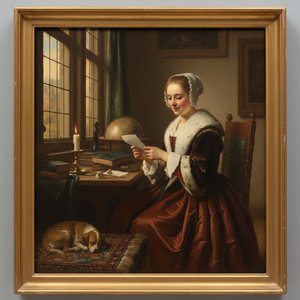
Gerrit Willemsz Horst: A Dutch Master of Biblical and Genre Scenes
Gerrit Willemsz Horst (c. 1612 – 1652) stands as a quietly significant figure within the vibrant tapestry of the Dutch Golden Age. Born in Muiden, a small town near Amsterdam, his life was tragically cut short at the age of forty, yet he left behind a body of work that reveals both technical skill and a profound sensitivity to human emotion – particularly evident in his poignant depictions of biblical narratives and intimate genre scenes.
Horst’s early artistic training is somewhat shrouded in mystery. He began his apprenticeship with Antonie Hendricksz Lust, a painter active from 1626, and later received instruction from the towering figure of Rembrandt van Rijn during the years 1635/1640. This association with Rembrandt undoubtedly shaped his approach to composition, lighting, and characterization, though Horst’s style ultimately developed its own distinct voice – one characterized by a restrained palette, subtle modeling, and an ability to imbue even the most familiar stories with a sense of quiet dignity.
Key Works and Artistic Development
Horst's oeuvre is remarkably diverse, encompassing both grand historical scenes and intimate domestic moments. Among his most celebrated works are depictions of biblical episodes such as “Isaac Blessing Jacob” (c. 1638), a scene brimming with tenderness and familial connection; “Tobias Cleaning the Fish” (circa 1652), showcasing his mastery of light and shadow; and "Esau Selling His Birthright to Jacob" (c. 1640-45), which captures the dramatic tension of this pivotal narrative moment. His genre paintings, often featuring scenes of everyday life – “Beggar Boys,” “A Young Man in Profile,” and “Playing Beggar Boys” – offer a glimpse into the lives of ordinary people, rendered with remarkable realism and empathy.
Notably, Horst’s artistic development appears to have been influenced by several key figures. The influence of Lust is evident in his early works, while Rembrandt's impact can be seen in his use of chiaroscuro and psychological depth. However, there are also indications that he may have worked within the studio of Hendrick Uylenburgh, a prominent art dealer and collector, suggesting a collaborative relationship where he executed commissions based on designs by other artists.
Symbolism and Technique
Horst’s paintings are rich in symbolic meaning. Biblical scenes frequently explore themes of faith, family, and divine providence, while his genre works offer subtle commentary on social issues and human nature. His use of color is restrained, favoring muted earth tones and delicate washes of light – a characteristic that contributes to the overall sense of quiet contemplation found in many of his compositions. He skillfully employed atmospheric perspective to create depth and realism, particularly evident in scenes depicting landscapes or interiors.
Horst’s technique demonstrates a remarkable understanding of anatomy and drapery. His figures are rendered with careful attention to detail, conveying both physical presence and emotional nuance. He was adept at capturing fleeting expressions and subtle gestures, imbuing his subjects with a sense of immediacy and authenticity.
Legacy and Historical Significance
Despite the relative obscurity that has surrounded his career, Gerrit Willemsz Horst’s work holds considerable historical significance. He represents a crucial link between the early Dutch masters and the subsequent generation of artists who would shape the course of Dutch painting. His ability to seamlessly blend technical skill with emotional depth makes him a compelling example of the artistic sensibilities of the Dutch Golden Age.
Today, Horst’s paintings are housed in major museums around the world, including the Rijksmuseum in Amsterdam and the National Gallery in London, testament to their enduring appeal and artistic merit. Further research continues to shed light on his life and work, solidifying his place as a significant, though often overlooked, master of Dutch painting.
Otázky a odpovědi
Kolik děl umělce Gerrit Willemsz Horst je možné si prohlédnout?
V katalogu si můžete prohlédnout 8 děl děl autora Gerrit Willemsz Horst na stránce Všechna umělecká díla.
Kde najdu díla umělce Gerrit Willemsz Horst seskupená podle techniky?
Stránka Všechna média seskupuje díla umělce Gerrit Willemsz Horst podle použité techniky.
Jaká jiná jména nebo pseudony používá Gerrit Willemsz Horst?
Gerrit Willemsz Horst je známý/á také pod jmény Gerrit Willemsz. Horst, Willem Gerritsz. Horst.