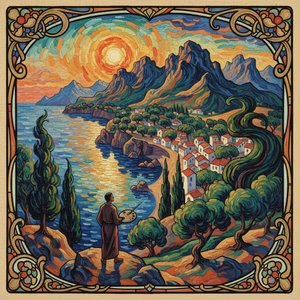
Antoni Gaudí i Cornet – A Life Forged in Stone and Faith
Antoni Gaudí i Cornet, born on June 25, 1852, in the Catalan town of Reus, Spain, was not merely an architect; he was a visionary who sculpted dreams into reality. His life story is as captivating and unconventional as the buildings that bear his indelible mark – structures that continue to inspire awe and wonder centuries later. Growing up amidst the rolling hills and rugged landscapes of Catalonia profoundly shaped Gaudí’s artistic sensibility. Even as a child, he displayed an extraordinary observational skill, meticulously studying the forms and textures of nature – an influence that would become the cornerstone of his unique architectural language. Family life was marked by both comfort and constraint; his father, a coppersmith, instilled in him a deep respect for craftsmanship, while his mother’s devout Catholicism fostered a profound spiritual connection that permeated his later work. These formative experiences laid the foundation for a career dedicated to harmonizing art, nature, and faith – a pursuit that would define his entire life's trajectory. His formal education began at the Piarist school in Reus, where he honed his intellectual curiosity alongside artistic inclinations. Subsequently, he pursued studies at the University of Barcelona before ultimately enrolling in the Provincial School of Architecture, graduating in 1878. Even during his academic years, Gaudí’s talent was evident, though perhaps not conventionally recognized; his professors acknowledged his skill but often struggled to reconcile it with established architectural doctrines. Recognizing the limitations of traditional approaches, Gaudí sought inspiration beyond convention—a quest that would propel him toward groundbreaking innovations. He supplemented his formal education by working as a draughtsman for architect Josep Fontserè i Mestres, contributing to projects like Ciutadella Park in Barcelona – an early glimpse into the urban landscapes he would soon transform with audacious creativity.The Blossoming of a Unique Vision
Gaudí’s initial commissions showcased a developing style that skillfully blended historical influences—Neo-Gothic Revival and Orientalism—but it was his innate ability to transcend imitation and forge something entirely new that set him apart from his contemporaries. The Casa Vicens (1883–1888), commissioned by Catalan industrialist Manuel Vicens i Montaner, stands as an early testament to this burgeoning originality. Gaudí’s design deliberately rejected symmetrical layouts and embraced undulating surfaces, incorporating vibrant ceramic tiles—a technique he termed *trencadís*—to create kaleidoscopic patterns that mirrored the rhythms of nature. The Casa Vicens' façade is adorned with intricate mosaics crafted from broken ceramic shards—a bold departure from conventional architectural ornamentation—reflecting Gaudí’s fascination with organic forms and textures. Simultaneously, Gaudí undertook ambitious projects like Sagrada Família (begun in 1883), a monumental basilica dedicated to the Holy Family that embodies his unwavering vision of Christian faith expressed through architectural grandeur. Unlike many Gothic Revival churches of the time, Sagrada Família eschewed rigid symmetry and embraced parabolic arches—a structural innovation inspired by the curves of seashells—demonstrating Gaudí’s mastery of biomimicry. His exploration of organic forms extended to Casa Milà (La Pedrera), completed between 1905 and 1910, which is arguably Gaudí's most iconic masterpiece. The building’s undulating façade resembles a honeycomb structure—a deliberate reference to beehive architecture—and its interior spaces are characterized by sculptural staircases and fluid lines that defy conventional architectural conventions. Gaudí skillfully integrated natural materials—such as limestone and sandstone—into the building’s design, creating a harmonious dialogue between human craftsmanship and geological forces. Furthermore, Gaudí's commitment to spiritual symbolism is palpable throughout Casa Milà, where intricate mosaics depict biblical scenes and geometric patterns convey profound theological concepts. He also designed Parc Güell (1900–1914), a whimsical urban park that blends architectural innovation with landscaped gardens—a testament to Gaudí’s belief in the importance of fostering connection between humanity and nature. The undulating benches and sculptural mosaics of Parc Güell exemplify Gaudí's distinctive style, inviting visitors to contemplate the beauty and grandeur of the Catalan countryside.Nature, Faith, and Innovation: Gaudí’s Architectural Philosophy
At the core of Gaudí’s architectural philosophy lay an unwavering reverence for nature—a conviction that informed every aspect of his creative process. He meticulously studied geological formations, animal skeletons, and plant structures, seeking inspiration in their inherent symmetries and patterns. This biomimicry wasn't merely aesthetic; it underpinned his structural innovations as well. Gaudí’s groundbreaking use of parabolic arches—inspired by the curves of seashells—allowed him to distribute weight efficiently without relying on external buttressing—a revolutionary departure from traditional architectural techniques. He skillfully employed inclined columns and lightweight tile vaults—another innovative structural system—creating buildings that seemed to defy gravity while simultaneously harmonizing with the surrounding environment. Gaudí’s meticulous attention to detail extended beyond structural considerations; he incorporated handcrafted ceramic tiles, stained glass windows, and wrought ironwork into his designs—each element contributing to a holistic artistic experience. His deep Catholic faith profoundly influenced his creative vision—a conviction that fueled his relentless pursuit of beauty and truth. Sagrada Família embodies Gaudí’s spiritual aspirations—a monumental basilica conceived as a physical manifestation of Christian theology. The basilica's intricate sculptural program depicts biblical narratives and saints—reflecting Gaudí’s desire to communicate religious ideas through visual art—demonstrating the transformative power of faith in shaping artistic expression. Gaudí’s legacy transcends architectural achievement; he remains an enduring symbol of Catalan identity—a visionary artist who dared to challenge conventions and forge a unique aesthetic language that continues to captivate audiences worldwide. His unwavering dedication to craftsmanship, his profound understanding of nature, and his fervent belief in the sacred cemented his place as one of the most influential architects of the 20th century.A Lasting Legacy: Gaudí’s Impact on Art and Architecture
Antoni Gaudí died unexpectedly on June 10, 1926, in Barcelona—a tragic end to a life devoted entirely to artistic creation. Despite his untimely demise, Gaudí's influence on subsequent generations of architects persists—inspiring designers to embrace innovation, explore organic forms, and infuse their work with spiritual resonance. His masterpiece, Sagrada Família, continues to inspire awe and wonder—a testament to Gaudí’s enduring vision and the transformative power of architectural grandeur. UNESCO recognized Sagrada Família as a World Heritage Site in 1984—affirming its exceptional universal value and ensuring its preservation for future generations. Gaudí's pioneering structural techniques—such as parabolic arches and inclined columns—have become foundational principles of modern architecture, shaping buildings across the globe. Furthermore, his distinctive *trencadís* technique—the use of broken ceramic shards—has inspired artists and designers to experiment with unconventional materials and textures—demonstrating Gaudí’s enduring influence on artistic expression. Antoni Gaudí remains an unparalleled figure in architectural history—a visionary artist who transformed Barcelona into a living testament to Catalan creativity and spiritual devotion.Otázky a odpovědi
Kde najdu díla umělce Antoni Gaudí seskupená podle klíčových slov?
Chcete-li najít díla umělce Antoni Gaudí na konkrétní téma, využijte stránku Podle klíčových slov, která seskupuje umělecká díla podle klíčových slov.
V jakém historickém období působil/a Antoni Gaudí?
Antoni Gaudí působil v období – 19. století. Toto období historicky vymezuje uměleckou činnost tohoto autora.
Kde najdu díla umělce Antoni Gaudí uspořádaná podle tématu?
Abeceda témat umělce Antoni Gaudí je stránka, která mapuje díla daného umělce podle jejich témat.
Mohu si díla umělce Antoni Gaudí seřadit podle barvy?
Stránka Spektrální index organizuje díla umělce Antoni Gaudí podle barvy.
Kolik děl umělce Antoni Gaudí je možné si prohlédnout?
V katalogu si můžete prohlédnout 19 děl děl autora Antoni Gaudí na stránce Všechna umělecká díla.
Kde a kdy se narodil/a Antoni Gaudí?
Antoni Gaudí se narodil(a) ve městě Riudoms v roce 1852.
What other names is Antoni Gaudí known by?
Antoni Gaudí is also known as Gaudi.
Odkud pochází Antoni Gaudí?
Antoni Gaudí se narodil(a) v zemi Španělsko.