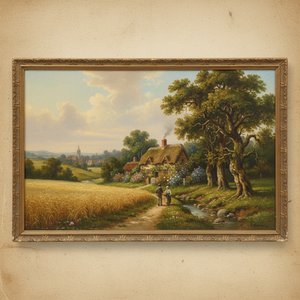
The Ethereal Light of Alfred I Glendening
Alfred Augustus Glendening stands as a singular figure in the tapestry of British art, a painter who masterfully bridged the stylistic elegance of Impressionism with the enduring, rugged legacy of English sporting traditions. Born in 1861 in Worcestershire, his life and work unfolded against the backdrop of a Victorian era caught between the rigid structures of academic realism and the burgeoning fascination with atmospheric, fleeting beauty. Glendening’s oeuvre is characterized by an intimate connection to the natural world, particularly through his ability to translate the subtle nuances of light and shadow across the rolling landscapes of the British Isles. His canvases do not merely depict scenery; they capture a sense of profound tranquility and the poetic essence of a rural England that was, even during his lifetime, beginning to feel the tremors of industrial change.Academic Foundations and the Slade Influence
The artistic journey of Glendeline was shaped by a rigorous formal education that provided him with the technical precision necessary to later embrace more fluid, impressionistic techniques. Following his early studies at Marlborough College, his enrollment at the Slade School of Fine Art in London proved transformative. It was here, under the esteemed tutelage of Frederic Leighton—a titan of the Victorian Salon—that Glendening absorbed the essential precepts of Academic Impressionism. From Leighton, he learned the importance of tonal harmony and the use of atmospheric perspective to create depth and emotion within a landscape. This period of intense training instilled in him a meticulous attention to detail, yet it also gave him the freedom to prioritize the capture of light, allowing his brushwork to evolve from strict academic observation toward a more evocative, luminous style that celebrated the ephemeral qualities of the English atmosphere.A Tapestry of Landscapes and Sporting Grace
Glendening’s subject matter was deeply rooted in the geography and culture of his homeland. His work often oscillates between the serene, water-bound reflections of the River Thames and the dramatic, mist-shrouded peaks of Wales. In masterpieces such as Cader Idris, one can witness his ability to render the rugged majesty of the Welsh mountains with a Romantic sensibility, utilizing balanced compositions and atmospheric detail to draw the viewer into a world of quiet grandeur. Beyond the purely landscape-driven works, Glendening possessed a profound fascination for equestrian pursuits, blending the grace of movement with the stillness of nature. This intersection of sporting art and landscape painting allowed him to explore themes of motion and vitality within a tranquil setting. His association with the celebrated Bertram Munnings further solidified this connection, as they both shared a devotion to capturing the pastoral beauty of the Worcestershire countryside, producing works like Penton Hook On The Thames that remain quintessential examples of late nineteenth-century British landscape painting.An Enduring Artistic Legacy
Though his life was relatively short, ending in 1907, the impact of Glendening’s vision continues to resonate through the halls of significant institutions. His ability to imbue even the most simple rural scenes with a sense of timelessness ensures his place within the broader canon of British art. Whether depicting the sun-drenched coastal scenes of The Red Parasol or the pastoral peace of A Shepherd And His Flock Changing Pastures, Glendening’s work serves as a window into a vanished era of English tranquility. Today, his paintings are cherished not only for their technical mastery and use of light but as historical documents that preserve the soul of the British landscape, inviting modern viewers to reconnect with the quiet, enduring beauty of the natural world.Otázky a odpovědi
Odkud pochází Alfred I Glendening?
Alfred I Glendening se narodil(a) v zemi United Kingdom.
Mohu si prohlédnout díla umělce Alfred I Glendening podle jednotlivých uměleckých směrů?
Díla umělce Alfred I Glendening si můžete prohlédnout podle jednotlivých směrů na stránce Všechna umělecká hnutí daného umělce.
V jakém historickém období působil/a Alfred I Glendening?
Alfred I Glendening působil v období 19th Century. Toto období historicky vymezuje uměleckou činnost tohoto autora.