

Robert Julian Onderdonk: Pioneering Texas Impressionism & Capturing Regional Light
Obsah textu
Early Life & Artistic Foundations: The Onderdonk Family Legacy
 Wikipedia: Julian Onderdonk
Robert Julian Onderdonk (July 30, 1882 – October 27, 1922) was a Texan Impressionist painter, often called "the father of Texas painting." == Early years == Julian Onderdonk was born in San Antonio, Texas, to Robert Jenkins Onderdonk, a painter, an...
The story of Robert Julian Onderdonk is inextricably linked to that of his father, Robert Jenkins Onderdonk, a figure often hailed as the “Dean of Texas Painters.” Born in San Antonio in 1882, Julian entered a world already steeped in artistic tradition. His grandfather, Henry Onderdonk, instilled a scholarly foundation, while his father provided the initial spark—a passion for sketching and capturing the essence of the Texan landscape. Robert Jenkins Onderdonk’s own journey began with academic training at the National Academy in New York before he was drawn to the untamed beauty of Texas in 1879. He quickly established himself as a versatile portraitist, but it was his embrace of landscape painting that would profoundly shape his son's artistic path. The family settled in Monte Vista, San Antonio, fostering an environment where young Julian’s natural inclination towards art flourished. While some accounts suggest a degree of initial reservation from his father regarding a career in painting, the reality appears to be one of careful guidance and foundational instruction. This early exposure wasn’t merely about technique; it was about understanding light, form, and the very spirit of the land—a legacy that would become Julian Onderdonk's defining characteristic.
Embracing Impressionism: A Journey to Capture Texas Landscapes
 Wikipedia: American Impressionism
American Impressionism was a style of painting related to European Impressionism and practiced by American artists in the United States from the mid-nineteenth century through the beginning of the twentieth. The style is characterized by loose brushw...
As a teenager, Julian demonstrated an exceptional aptitude for art, but his true artistic awakening came with the opportunity to study under William Merritt Chase. Following in his father’s footsteps, he journeyed north in 1901, spending a formative summer at Chase's Shinnecock Hills Summer School of Art on Long Island. This immersion into American Impressionism proved pivotal. Chase, a master of capturing fleeting moments and atmospheric effects, instilled in Onderdonk the principles of *plein air* painting—the act of painting outdoors directly from nature. This wasn’t simply about replicating what he saw; it was about conveying the sensation of being present within the landscape, translating light and color into an emotional experience. After a period attempting to establish himself as an artist in New York City, Onderdonk returned to San Antonio in 1909, armed with a refined technique and a burgeoning vision. He sought not to merely copy European Impressionist styles but to adapt them to the unique character of Texas—its vast skies, rolling hills, and vibrant wildflowers.
Plein Air Painting in the Lone Star State: Technique and Inspiration
En plein air (pronounced [ɑ̃ plɛ.n‿ɛʁ]; French for 'outdoors'), or plein-air painting, is the act of painting outdoors. This method contrasts with studio painting or academic rules that might create a predetermined look. The theory of 'En plein air' ...
The Texan landscape presented both challenges and opportunities for an *en plein air* painter. The intense sunlight, expansive vistas, and often-unforgiving climate demanded a swift hand and keen observational skills. Onderdonk embraced these conditions, becoming renowned for his ability to capture the ephemeral beauty of the Hill Country. He worked rapidly, building up layers of paint directly on canvas, striving to convey the immediacy of the moment. His technique involved a delicate balance between capturing precise details and suggesting form through expressive brushstrokes. He wasn’t interested in photographic realism; rather, he sought to evoke the *feeling* of Texas—the warmth of the sun, the scent of wildflowers, the vastness of the open sky. This dedication to working directly from nature allowed him to capture subtleties of light and atmosphere that would have been impossible to achieve in a studio setting. His palette favored bright, luminous colors, reflecting the intense hues of the Texan environment.
Iconic Bluebonnet Scenes & the Rise of a 'Texas' Style
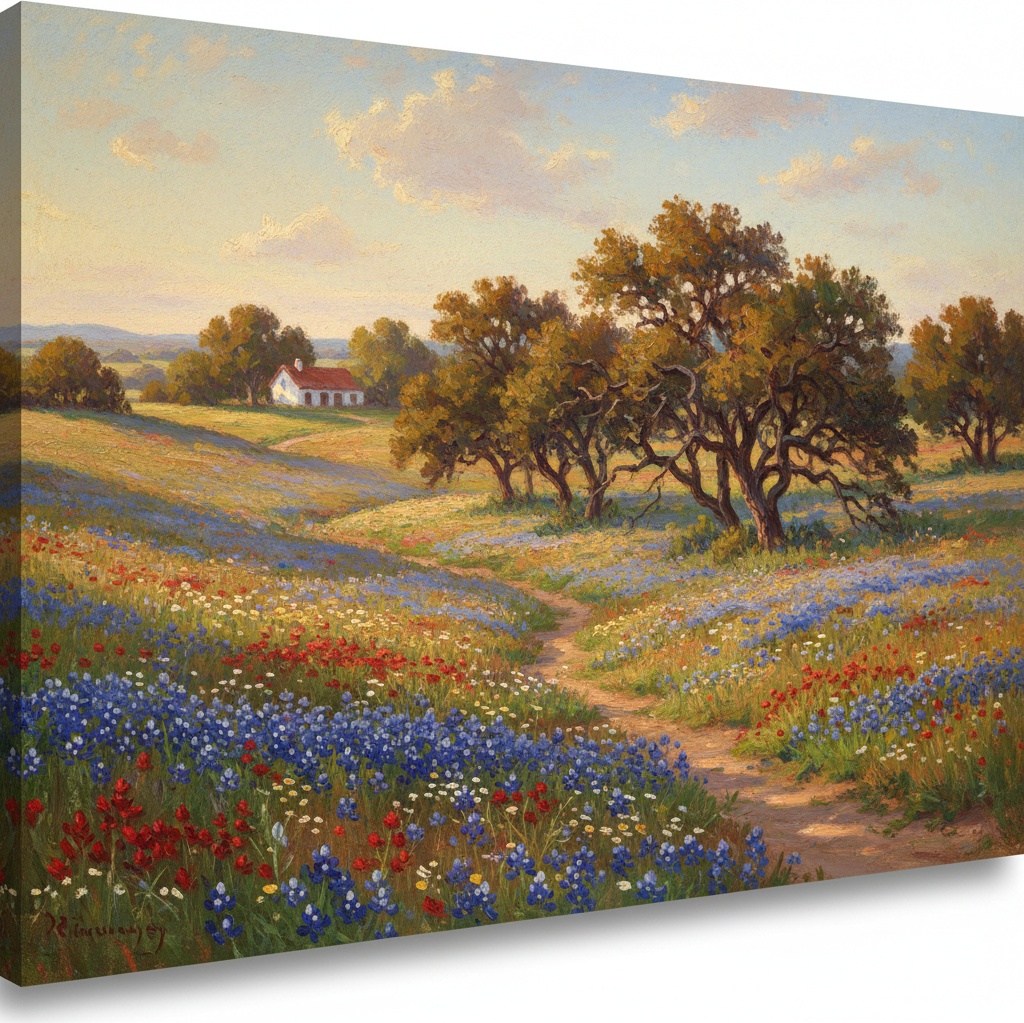
While Onderdonk painted a variety of subjects—live oaks draped with Spanish moss, rustic ranches bathed in golden light—it was his depictions of bluebonnets that truly captured the public’s imagination. He transformed these wildflowers into an emblem of Texas identity, elevating them from simple flora to symbols of beauty and resilience. His paintings weren't merely representations of fields filled with flowers; they were celebrations of the Texan spirit. The vibrant blues and greens, combined with his masterful handling of light, created scenes that resonated deeply with viewers. This focus on bluebonnets wasn’t accidental. Onderdonk recognized their cultural significance and understood their power to evoke a sense of place. He developed a distinctive style—a blend of Impressionist techniques and a uniquely Texan sensibility—that set him apart from his contemporaries. This “Texas” style, characterized by its luminous colors, expressive brushwork, and evocative atmosphere, quickly gained recognition both locally and nationally.
Legacy and Influence: Onderdonk’s Enduring Impact on Texas Art
Robert Julian Onderdonk's career was tragically cut short in 1922 at the age of forty. However, his impact on Texas art remains profound. He is rightfully regarded as “the Father of Texas Painting,” not simply for being an early pioneer of Impressionism in the state but for establishing a distinctly Texan artistic identity. His paintings helped to shape the way Texans viewed their own landscape, fostering a greater appreciation for its beauty and uniqueness. His influence extended beyond his immediate circle of students and followers. He inspired generations of artists to embrace *plein air* painting and to capture the essence of Texas in their work. Today, Onderdonk’s paintings are highly sought after by collectors and museums alike. The Dallas Museum of Art boasts a significant collection dedicated exclusively to his work, testament to his enduring legacy. His art continues to evoke a sense of nostalgia and pride, reminding viewers of the beauty and spirit of the Lone Star State.
Collecting Onderdonk Today: Value, Authenticity, and Appreciation
As interest in American Impressionism grows, so too does the demand for Onderdonk’s paintings. His works command significant prices on the art market, reflecting their rarity, historical importance, and artistic merit. However, navigating the world of collecting Onderdonk requires careful consideration. Authenticity is paramount, as with any sought-after artist. Provenance—the documented history of ownership—is crucial in establishing a painting’s legitimacy. Understanding his signature styles and techniques can also aid in identifying genuine works. While iconic bluebonnet scenes are particularly popular, exploring his broader body of work reveals a remarkable range of subjects and artistic approaches. Beyond the investment value, collecting Onderdonk is about appreciating a uniquely Texan vision—a celebration of light, color, and the enduring beauty of the landscape. ArtsDot.com offers high-quality reproductions of Onderdonk’s masterpieces, allowing art enthusiasts to experience his work firsthand and bring a touch of Texas Impressionism into their homes.
Související články
Capturing Ephemeral Light: A Comprehensive Exploration of Plein Air Painting's History & Enduring Legacy
Explore the rich history of plein air painting, from its origins to Impressionism & beyond. Discover key artists, techniques, and the enduring legacy of capturing light in landscape art. Find museum-quality reproductions at ArtsDot.


Richard Parkes Bonington: A Brief but Brilliant Career – Romantic Landscapes & the Dawn of Plein Air Painting
Explore the short but impactful career of Richard Parkes Bonington, a pivotal figure bridging British Romanticism & French plein air painting. Discover his luminous landscapes and lasting influence on Delacroix & beyond.
Evocations of Open Air: A Comprehensive Exploration of Outdoor Scenes in Art History
Explore the rich history of outdoor painting! Discover Impressionism, en plein air techniques & renowned landscape artists. Learn about light, color & enduring artistic legacies with ArtsDot.

Robert Bevan: Pioneering British Post-Impressionism & the Camden Town Group's Intimate Vision
Explore the life & work of Robert Bevan, a pioneer of British Post-Impressionism and founding member of the Camden Town Group. Discover his vibrant landscapes and lasting impact on early 20th-century art.

The Allure of Open Airs: Exploring Representations of Outdoors in Art History
Explore the rich history of outdoor painting! From Romantic landscapes to Impressionism's revolution, discover key artists, techniques & the enduring legacy of capturing light and nature in art. Learn more at ArtsDot.

