

John Fulleylove: Evoking Rural England Through Watercolour & Oil
Obsah textu
Early Life & Architectural Roots: The Foundations of an Artistic Vision
John Fulleylove, born in Leicester in 1845, embarked on a path that initially seemed destined for the precision and structure of architecture. His early training with the local firm Shenton and Baker instilled within him a keen eye for detail and a foundational understanding of form – qualities that would later profoundly shape his artistic endeavors. However, the rigid lines and technical demands of architectural drafting proved insufficient to contain his burgeoning creative spirit. A natural inclination towards observation and a growing passion for capturing the nuances of the world around him led Fulleylove to abandon blueprints for brushes and palettes. This transition wasn’t abrupt; early instruction from drawing-master Henry Ward provided crucial guidance, nurturing his nascent talent in watercolour painting. It was this shift—from the constructed environment to the natural one—that truly unlocked his potential, setting the stage for a career dedicated to portraying the beauty of the English countryside and beyond.
A Flourishing Career: Exhibitions, Recognition & Establishing a Style
The year 1871 marked a turning point in Fulleylove’s life as he began exhibiting his work with increasing frequency across England. London quickly became a central hub for his artistic pursuits, with regular showings at prestigious venues like the Royal Academy, the Royal Society of British Artists, and the Fine Art Society. These exhibitions weren't merely opportunities to display his talent; they were crucial stepping stones in establishing his reputation and cultivating a dedicated following. Fulleylove’s style, characterized by meticulous detail and a gentle luminosity, resonated with an audience captivated by scenes of idyllic rural life. His election as an Associate of the Royal Institute of Painters in Water Colours (ARI) in 1878, followed by full membership (RI) in 1879, and later his inclusion in the Royal Institute of Oil Painters (ROI) in 1883, solidified his position within the established art world. A bronze medal at the Exposition Universelle in Paris in 1889 further affirmed his international recognition.
The Charm of the English Countryside: Recurring Themes and Motifs in Fulleylove’s Work
Landscape painting, also known as landscape art, is the depiction in painting of natural scenery such as mountains, valleys, rivers, trees, and forests, especially where the main subject is a wide view—with its elements arranged into a coherent compo...
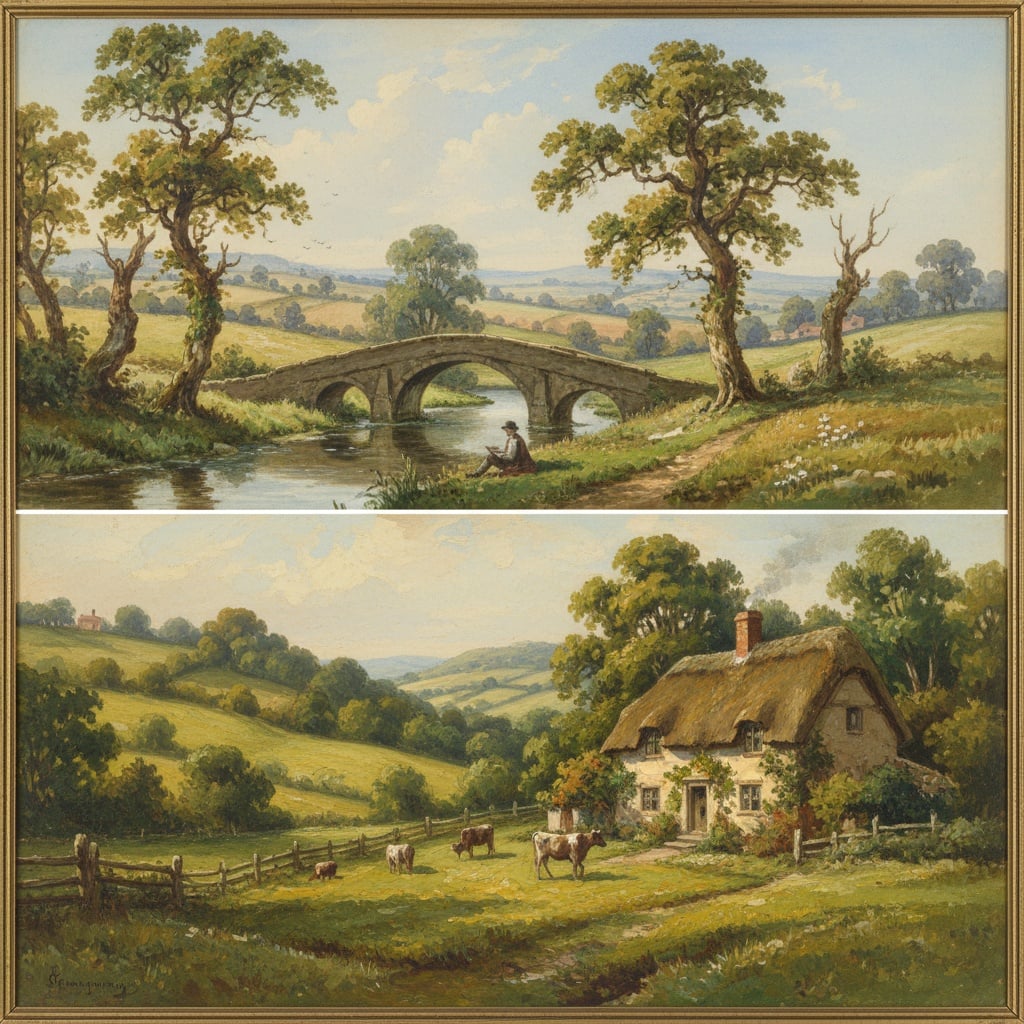
Fulleylove's artistic heart belonged to the English countryside. His paintings are imbued with a deep affection for the pastoral landscapes, quaint villages, and timeless scenes of rural life. Thatched cottages, often nestled amongst verdant fields or alongside meandering streams, became a signature motif – symbols of tranquility and enduring tradition. He possessed an exceptional ability to capture the subtle shifts in light and atmosphere, lending his works a remarkable sense of realism and emotional depth. “Thatched Cottage with Barn Adjoining”, exemplifies this mastery; the scene is not merely a depiction of buildings but a nostalgic evocation of a simpler time. Beyond cottages, Fulleylove frequently depicted livestock – prize oxen, sheep grazing in meadows – reflecting an appreciation for the agricultural heartland of England. These weren’t simply animal studies; they were integral components of the rural tapestry he so lovingly portrayed.
Beyond Britain: Travels and Illustrative Commissions in Europe and the Middle East
While deeply rooted in English landscapes, Fulleylove's artistic curiosity extended beyond his native shores. He embarked on extensive travels throughout France, Italy, Greece, and the Middle East, seeking new subjects and broadening his artistic horizons. These journeys weren’t solely for personal inspiration; they led to lucrative commissions illustrating travel books published by prominent firms like A & C Black. His watercolours provided a visual narrative for these publications, bringing distant lands to life for readers back home. The Holy Land, illustrated by Fulleylove, showcases his ability to capture the exotic beauty and historical significance of foreign locales. These illustrative works demonstrate not only his technical skill but also his adaptability – seamlessly transitioning between detailed landscapes and architectural renderings.
Fulleylove's Legacy: Family Connections and Enduring Appeal
John Fulleylove’s artistic legacy extends beyond his own prolific output. In 1878, he married fellow artist Elizabeth Sara Elgood, forging a creative partnership that enriched both their lives. Their daughter, Joan Fulleylove (1886-1947), followed in her parents' footsteps, becoming a renowned stained glass designer and contributing to the aesthetic landscape of the early 20th century with windows for notable structures like the Anglican cathedral in Khartoum. Even his son, John Christopher Fulleylove, connected through marriage to the family of puzzle designer Henry Dudeney, demonstrates the enduring influence of artistic talent within the lineage. Today, Fulleylove’s paintings continue to captivate audiences with their serene beauty and nostalgic charm. His works offer a glimpse into a bygone era – a celebration of rural England and the timeless allure of the natural world. At ArtsDot.com, you can explore a curated selection of his masterpieces, meticulously reproduced to capture the essence of his original vision.
Související články

John Frederick Herring Sr.: Equestrian Mastery & the Rise of Sporting Art in Victorian England
Explore the life & work of John Frederick Herring Sr., a leading Victorian equestrian artist. Discover his masterpieces, patronage, techniques & investment potential. Expert insights for collectors.


Sir John Watson Gordon: A Study in Scottish Landscape Painting & Tonal Impressionism
Explore the captivating portraits of Sir John Watson Gordon, a leading Scottish master. Discover his evolution from neoclassical style to atmospheric Tonalism and influence on 19th-century British art. Learn about his iconic sitters & legacy.

James Sant: Capturing Victorian Childhood & the Evolving Landscape of British Genre Painting
Explore the life & art of James Sant (1820-1916), renowned Victorian portraitist to Queen Victoria. Discover his captivating depictions of childhood, landscapes, and aristocratic society. Learn about his legacy & find fine art reproductions.

Alfred Worthington: Bridging Victorian Realism & Early Modern Landscape Painting
Explore the captivating landscapes of Alfred Worthington (1834-1927), a pivotal figure bridging Victorian realism & early Impressionism. Discover his Welsh hunting scenes, artistic evolution, and collecting guide.

James Baker Pyne: Navigating Victorian Topography & Sentiment Through Watercolour – A Reassessment
Explore the captivating landscapes of James Baker Pyne, a Victorian master influenced by Turner. Discover his serene river scenes, atmospheric paintings & artistic evolution. Learn about this rediscovered artist and find fine art reproductions at ArtsDot.

