

 Náhled v interiéru
 Sdílet
 Sdílet
 Podrobnosti o díle
 Průvodce

 Stáhnout
 Podobné položky
 Rentgenové snímky
 Slideshow
 Otázky a odpovědi
 Statistiky
Gothic


 Zobrazit více
Giclée / Umělecký tisk
Giclée nebo plátěný tisk muzeální kvality s rychlou výrobou a širokou nabídkou povrchových úprav. ( Koupit ručně malovaný obraz Přepnout na digitální obraz)




P118B Kč10

P118H Kč10

P118W Kč10

P438Z Kč10

P508JH Kč12

P508YH Kč12

P805H Kč10

P805Z Kč10

P919BZ Kč10

P919G Kč10

P919XJ Kč10

P959ZH Kč10

P968JZ Kč12

W106C Kč8

W218G Kč10

W218JH Kč8

W218Y Kč10

W307PJ Kč10

W316G Kč10

W316PJ Kč8

W316Y Kč10

W398PJ Kč8

W4111J Kč10

W500HY Kč15

W500JH Kč15

W692G Kč12

W849H Kč8

W940BG Kč15

W953PJ Kč8




Vyberte si z našich přednastavených velikostí, které odpovídají původním proporcím díla.

Zadejte šířku a výšku, které potřebujete pro váš rám nebo stěnu. Tisk lze pouze oříznout, nikdy však nelze zvětšit obraz nad jeho původní rozměr, proto při výběru jiného formátu dochází ke ztrátě části obrazu. Před samotným tiskem vám zašleme digitální náhled k schválení. Obraz zobrazený na této stránce nenabízí skutečný výřez — ten uvidíte pouze v náhledu.
Celosvětové doručení () do 2 týdnů namísto standardních 4/5 týdnů. (12 listopad)

Zdarma celosvětová expresní doprava

Vysoce kvalitní lněné plátno

Kompletní pojištění přepravy

Záruka vrácení celního poplatku

Záruka věrného barevného souladu

100dení lhůta pro vrácení zboží (pouze při vadách výroby)

100% záruka vrácení peněz

Sleva při více objednávkách
 Skleněná varianta je dostupná pouze u rozměrů menších než 110 cm

Gothic
Giclée / Umělecký tisk
Rozměry reprodukce
-


Celková cena za vybrané možnosti reprodukcí
Kč 1372
Identification of the Artwork Gothic
The canvas known as Gothic emerges from the creative mind of Paul Jackson Pollock. Created in 1944, this work exists within the permanent collection of The Museum of Modern Art in New York. It carries the specific archive designation IN1819.16, a mark of its place within the museum's vast holdings. The piece pulses with a presence that demands immediate attention, pulling the viewer into its immediate, swirling reality.
In this work, Paul Jackson Pollock captures a specific moment of intensity. The painting, Gothic, resides in the heart of New York's most significant art institution. It remains a vital part of the history of the Abstract Expressionist movement, holding its ground within the halls of The Museum of Modern Art. Every line and color choice feels active, as if the energy of 1944 is still vibrating through the pigment.
Visual Composition and Subject Matter
A group of people occupies the center of the frame, caught in a moment of social interaction. At least five individuals appear within the scene, their forms suggesting a dance or a shared activity. They move through a landscape of color, where deep reds, blues, yellows, and greens intertwine. These figures are not static; they seem to be in perpetual motion, mirroring the restless energy of human connection. The arrangement of these people draws the eye inward, pulling the viewer toward the heart of the gathering.
The composition relies on a tension between stability and movement. Horizontal bands of color stretch across the canvas, providing a sense of structure that is constantly interrupted by vertical drips of paint. This interplay creates a visual dialogue, where the steady flow of color meets the sudden, gravity-fed descent of pigment. The result is a scene that feels both organized and chaotic, as if the social interaction of the figures is being mirrored by the very medium itself.
Technique and Artistic Method
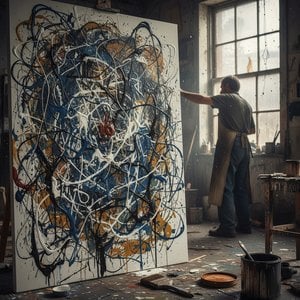
The canvas lies flat upon the floor, stripped of the traditional easel. Here, the artist moves around the perimeter, standing over the work to engage with the medium from all sides. This physical performance turns the act of creation into a rhythmic release of energy. Gravity becomes a primary collaborator, guiding the liquid paint as it falls in unpredictable patterns. The signature drip technique transforms the surface into a record of movement, where splatters and pools of color settle where they land.
Unconventional tools dictate the texture of the work. Sticks, knives, and even syringes are used to manipulate the fluid medium, pushing and pulling the pigment across the surface. These gestures create a dense, layered effect. The resulting surface feels almost sculptural, a thick crust of paint that captures a dynamic, restless energy. Every drip and splash contributes to a complex network of lines that seem to possess a life of their own.
Related Works by the Artist
The evolution of this creative energy continues through other canvases that capture the artist's restless spirit. Around 1945, the work There Were Seven in Eight emerges, reflecting a period of intense development. Shortly after, the composition of Number 3 takes shape about 1948, continuing the exploration of rhythm and movement across the surface. These pieces exist as markers of a shifting approach to the canvas, where the physical act of creation becomes a central part of the visual language.
As the years progress, the intensity of the paint application reaches new heights. In 1950, Lavender Mist, Number 1 appears, presenting a complex network of lines and colors that seem to dance in a state of perpetual motion. This momentum carries forward into 1952 with Blue Poles, Number 11, where the interplay of verticality and chaotic splatters creates a sense of boundless space. Each work acts as a record of a specific moment in time, capturing the pulse of an artist constantly redefining the boundaries of abstraction.
Otázky a odpovědi
Jakým způsobem se dílo „Gothic“ zapojuje do témat a stylu umělce Jackson Pollock?
„Gothic“ patří k dílu Jackson Pollock v rámci směru Abstract Expressionism, jehož typická témata zahrnují regionalist style, social commentary, american landscape, dynamic rhythm, pollock legacy.
Jak moc se zdá, že barvy díla „Gothic“ odrážejí světlo?
Dílo „Gothic“ od Jackson Pollock má luminanci na úrovni Soft Shadow. Luminance popisuje, jak velkou míru světla barvy odrážejí.
Do jaké části domácnosti se hodí reprodukce díla „Gothic“?
Dílo „Gothic“ od Jackson Pollock je doporučeno do místnosti Living Room. Toto doporučení vychází z tématu, barevnosti a nálady daného díla.
Podobná díla


Související články

Paul Jenkins: Abstraction, Color Field Painting & the Pursuit of Lyrical Expression
Explore the captivating world of Paul Jenkins, a pioneer of abstract expressionism & color field painting. Discover his unique ‘Phenomena’ series and investment potential for art collectors. Expert insights at ArtsDot.
Paul Jackson Pollock: A Radical Departure – Exploring Abstract Expressionism's Pioneering Figure and His Enduring Legacy
Explore the revolutionary art of Jackson Pollock & Abstract Expressionism. Discover his iconic drip paintings, lasting impact, and considerations for collecting this pivotal American artist. Expert insights at ArtsDot.

Beyond Representation: Exploring the Emotional Landscape of Abstract Expressionism
Explore the profound emotional world of Abstract Expressionism with ArtsDot. Discover key artists like Pollock & Rothko, learn about collecting, and find museum-quality reproductions to inspire your space.

Paul Klee: 25 mistrovských děl a inspirace pro váš interiér | ArtsDot.com
Objevte 25 ikonických děl Paula Kleeho – od abstraktních kompozic po barevné sny. Ponořte se do světa expresionismu, Bauhausu a jedinečného uměleckého stylu. Reprodukce obrazů nejvyšší kvality pro váš interiér na ArtsDot.com

Top 10 mistrovských děl abstraktního expresionismu | Umění a dekorace s ArtsDot.com
Prozkoumejte 10 ikonických děl abstraktního expresionismu od Pollocka, Rothka a dalších. Objevte příběhy za obrazy, techniky a barevné palety tohoto revolučního uměleckého hnutí. Reprodukce obrazů s ArtsDot.com – luxusní dekorace pro váš interiér. Prozkoumejte celou kolekci online!


