

Съдържание
Бързи факти
- Movements: realism
- Died: 1920
- Also known as: Раимundo Мадразо
- Museums on APS:
- Grão Vasco National Museum
- Grão Vasco National Museum
- Grão Vasco National Museum
- Grão Vasco National Museum
- Grão Vasco National Museum
- Top 3 works:
- Masqueraders
- Portrait of a girl
- Garden of the house of Fortuny
- Copyright status: Public domain
- Art period: 19-ти век
- Още…
- Top-ranked work: Masqueraders
- Lifespan: 79 years
- Born: 1841, Рим, Италия
- Works on APS: 90
- Creative periods: mature period
- Nationality: Италия
Тест за изкуство
Има само един верен отговор за всеки въпрос.
Въпрос 1:
Кой е бил баща му и какъв беше неговият професионален опит?
Въпрос 2:
Каква художествена школа посещава Раимundo де Мадразо и какви художници са му влиятелни?
Въпрос 3:
Какъв е основният стил на Раимundo де Мадразо и какви елементи от други художествени движения се използват в неговата творба?
Въпрос 4:
Кои са основните теми на творбите на Раимundo де Мадразо и какви емоции се опитват да предадат тези произведения?
Въпрос 5:
Какво е известно за международното признание на Раимundo де Мадразо и каква роля играе той в културната история на Испания?
A Legacy of Elegance: The Life and Art of Raimundo de Madrazo y Garreta
Raimundo de Madrazo y Garreta, born in Rome in 1841, entered a world already steeped in artistic tradition. His lineage was one of considerable prestige; his grandfather, José de Madrazo, held the esteemed position of Director of the Museo del Prado, while his father, Federico de Madrazo, was himself a celebrated portraitist. This familial foundation wasn’t merely about inheritance—it instilled within young Raimundo not only a technical mastery but also an understanding of the power and social standing associated with artistic creation. His earliest training unfolded within the intimate setting of his family's studios, absorbing principles of classical technique from both father and grandfather. Formal studies at the Real Academia de Bellas Artes de San Fernando in Madrid, under Carlos Luis de Ribera and Carlos de Haes, further refined his skills, exposing him to contemporary artistic currents. However, it was a pivotal sojourn to Paris in 1860 that truly transformed his trajectory. Studying with Léon Cogniet and forging connections within the Parisian art world would define his aesthetic sensibilities for decades to come. The influence of Alfred Stevens during this period proved particularly significant, subtly shifting his approach towards a more refined and decorative sensibility—a move away from strict academicism toward a style imbued with grace and allure.Realism Infused with Refinement: Artistic Style and Influences
Madrazo’s artistic style is fundamentally rooted in Realism, yet it transcends mere imitation through an infusion of elegance and sophistication. While committed to accurate representation, his paintings possess a delicate grace that distinguishes them from the more austere strains of the movement. This refinement evolved over time, subtly incorporating elements reminiscent of Rococo—a fondness for ornate detail and playful composition—and *Japonisme*, the burgeoning Western fascination with Japanese art, particularly in its emphasis on flattened perspective and decorative patterns. He became renowned for his portraits, capturing not merely physical likeness but also the inner essence of his subjects with remarkable skill. Cogniet’s academic rigor, combined with Stevens’ decorative flair, created the foundation for Madrazo’s unique artistic voice. He wasn't simply recording reality; he was crafting an idealized vision of it, one that appealed to the tastes of a discerning clientele who sought beauty and refinement in art. This ability to blend realism with a touch of fantasy allowed him to create works that were both captivating and aspirational. Critics praised his meticulous attention to detail—the subtle nuances of expression, the precise rendering of fabrics and textures—demonstrating an unparalleled command of technique. He skillfully blended classical influences with contemporary trends, establishing himself as a leading figure in the Spanish artistic landscape.Portraits of an Era: Major Works and Themes
Madrazo’s oeuvre is populated with captivating portraits and genre scenes that offer a window into the social world of the late 19th century. His *Portrait of his father painting* stands as a testament to both filial affection and artistic skill, showcasing not only a likeness but also the very act of creation itself—a painter portraying a painter, a meta-commentary on the artistic process. Works like *Fond Memories*, depicting intimate domestic scenes bathed in soft light, reveal his talent for evoking nostalgia and capturing fleeting moments with poignant sensitivity. However, it was his genre paintings, often featuring Aline Masson as the model, that garnered him widespread acclaim. *The Reluctant Mistress*, *After the Bath*, and *Portrait of Aline Masson in a Mantilla* are prime examples—sensuous, meticulously rendered scenes that celebrate feminine beauty and grace. Aline Masson’s presence is central to understanding Madrazo's artistic output; she served as his muse for many years, embodying the ideal of refined elegance that permeated his paintings. These works weren’t merely depictions of fashionable society; they were carefully constructed fantasies, designed to appeal to a clientele eager to possess images of beauty and luxury. The recurring motif of feminine allure, often veiled in an atmosphere of gentle mystery, became a hallmark of his style. He skillfully captured the subtleties of human emotion—joyful exuberance, quiet contemplation, tender affection—transforming everyday life into extraordinary art.International Recognition and Lasting Impact
Raimundo de Madrazo’s career unfolded on an international stage. His debut exhibition in Paris in 1860 marked the beginning of his professional journey, quickly followed by frequent trips to New York where he cultivated a loyal clientele among prominent families like the Vanderbilts and Alexander Turney Stewart. Despite this success abroad, he remained relatively reserved about exhibiting in Spain. A testament to his commitment to fostering artistic exchange was his co-founding of an “International Painting Exhibition” in Paris in 1882, alongside Alfred Stevens, de Nittis, and Petit—an initiative designed to promote the work of foreign artists. He consistently exhibited at the prestigious Paris Salon, receiving a major medal at the Exposition Universelle in 1889, solidifying his reputation as a leading artist of his time. Beyond his artistic achievements, Madrazo demonstrated a commitment to cultural preservation through his generous donation of Francisco de Goya’s works to the Museo del Prado in 1894 and his membership in the Royal Academy of London—a recognition of his enduring contribution to Spanish art history. Raimundo de Madrazo died peacefully in Versailles on September 15, 1920, leaving behind a legacy as one of Spain’s foremost realist painters—a master portraitist who captured the spirit of an era with elegance, skill, and enduring appeal. His son, Federico Carlos de Madrazo y Ochoa ("Coco"), continued the family tradition, ensuring that the Madrazo name remained synonymous with artistic excellence for generations to come.Всички статии
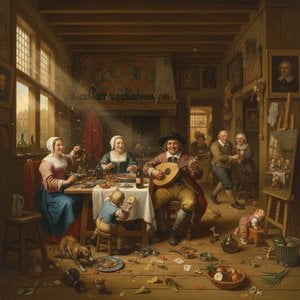
Jan Steen: A Master of Dutch Genre Painting & the Golden Age
Explore the life & art of Jan Steen, a leading Dutch Golden Age painter renowned for his humorous genre scenes & insightful social commentary. Discover his techniques, legacy, and collecting tips.


The Golden Age Reforged: Dramatic Realism & Religious Zeal in Spanish Baroque Art
Explore the dramatic world of Spanish Baroque art! Discover masters like Zurbarán & the powerful influence of religious zeal on painting techniques – a guide for collectors and enthusiasts.

Ignacio Díaz Olano: Bridging Realism & Costumbrismo in Spanish Portraiture
Explore the captivating works of Ignacio Díaz Olano, a pivotal Spanish Realist painter. Discover his intimate portraits, evocative scenes of Andalusia, and unique 'Costumbrista' style. Learn about his legacy & find museum-quality reproductions.



