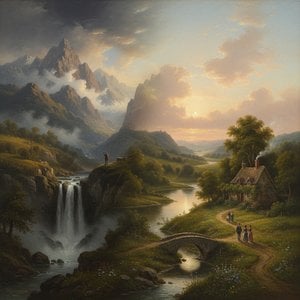
Arnold Topp: A Landscape of Shadows
Arnold Topp’s artistic journey began in Germany, nurtured by a fascination with the Romantic tradition and its exploration of emotion and sublime beauty. Unlike many artists of his era who sought to capture idealized visions of nature, Topp consistently confronted darkness—both literal and metaphorical—within his canvases. He was driven by an unwavering conviction that true art resided not merely in aesthetic perfection but also in confronting the unsettling truths inherent within human existence.Early Influences: The Romantic Spirit
The profound impact of Caspar David Friedrich’s monumental landscapes on Topp's artistic sensibilities cannot be overstated. Friedrich’s depictions of solitary figures dwarfed by towering mountains instilled a desire to convey not just visual grandeur but also the depths of psychological experience—a yearning for transcendence amidst the immensity of creation. This preoccupation with sublime beauty served as a cornerstone of Topp’s aesthetic worldview, informing his compositional choices and color palettes throughout his career.Technique: Impasto and Emotional Resonance
Topp honed his skills in oil painting, favoring a technique known as impasto—a deliberate layering of pigment onto the canvas—to create textured surfaces that seemed to pulsate with inner energy. This painstaking process demanded considerable patience and precision but yielded results that captured subtle nuances of light and atmosphere—transforming mere pigments into conduits for emotional expression. The thick impasto created palpable depth, mirroring Topp’s belief that art should engage all senses and provoke profound contemplation.Recurring Themes: Desolation and Reflection
Topp's oeuvre centers around landscapes imbued with an unsettling stillness—scenes of desolate plains punctuated by solitary trees or bodies of water reflecting distorted images of reality. These compositions are populated by figures rendered in muted tones, often positioned at the periphery of view—suggesting a preoccupation with isolation and introspection. Topp’s artistic vision sought to capture not merely visual beauty but also the psychological complexities associated with confronting existential anxieties—a theme that resonated deeply within his contemporaries and continues to captivate audiences today.The Surrealist Dialogue: Geometric Abstraction
As Topp's artistic sensibilities matured, he embraced the principles of Surrealism, recognizing its capacity to liberate imagination from rational constraints. Influenced by artists like Giorgio Morandi and Yves Klein, he experimented with geometric abstraction alongside his continued exploration of landscape imagery—a bold departure from traditional representational art that nonetheless retained a core preoccupation with conveying emotional depth. The use of Yves Klein Blue – a pigment created by Klein himself – became a signature element in Topp’s work. This intensely saturated ultramarine hue conveyed a sense of profound isolation and spiritual yearning, mirroring Topp's own conviction that art should transcend mere visual perception.Notable Achievements: Collaborative Vision
Topp achieved considerable success as a painter and educator—collaborating with filmmaker Werner Herzog on “ZWEI WELTEN” (“Two Worlds”), which captured the desolate grandeur of Patagonia and mirrored Topp’s artistic preoccupation with confronting darkness within seemingly serene environments. His paintings are held in collections worldwide, testifying to their enduring appeal and cementing his legacy as an artist who championed both visual splendor and psychological introspection—a singular contribution to the history of modern art.Въпроси и отговори
Мога ли да разгледам творбите на Арнолд Топ чрез ключови думи?
Страницата По ключови думи на Арнолд Топ групира произведенията на художника по техните ключови думи.
Къде мога да видя всички произведения на Арнолд Топ?
Всяка творба на Арнолд Топ в този уебсайт може да бъде разгледана на страницата за всички произведения на Арнолд Топ: Всички произведения.
Къде мога да видя творбите на Арнолд Топ в 3D галерия?
3D Музей на Арнолд Топ е страница, която представя произведенията на художника в една виртуална триизмерна галерия.