Портрет на Марк Шагал

Meet the 100 Most Famous Paintings by Марк Шагал

Обновено Октомври 2026 · класирано според нашия индекс на популярност (търсения, посещения и поръчки за всяко произведение) · 936 творби на Марк Шагал в нашия каталог

In short

If you know one Марк Шагал painting, it's probably Аз и селото (1911), which hangs in the MoMA - Музеят на модерното изкуство, Ню Йорк. Бяло разпятие (1938) and Рожден ден (1915) round out the three pieces people recognise right away. Our catalogue has 936 works by Марк Шагал. Below are the 100 people know best, each with its year, where to find it and what makes it special.

1887 – 1985, Лйозна Най-много творби: MoMA - Музеят на модерното изкуство

Start here: the top 10 Марк Шагал paintings

1
Аз и селото (1911) на Марк Шагал

Аз и селото

1911 · Масло върху платно · MoMA - Музеят на модерното изкуство, Ню Йорк

Една прозорец към паметта: Изследване на шедьовъра на Шагал от 1911 г. „Аз и селото“ Създадена през 1911 г., тази завладяваща маслена картина върху платно е крайъгълен камък в ранното творчество на Марк Шагал и ключова работа в развитието на модерното изкуство. С размери 191 x 150 см, това е внушително произведение, което привлича вниманието, въвличайки зрителите в свят, пропит с лични спомени и универсална символика. „Аз и селото“ не…

2
Бяло разпятие (1938) на Марк Шагал

Бяло разпятие

1938 · Масло върху платно · Art Institute of Chicago, Чикаго

The center of the canvas holds a pale figure on a white cross. This Christ wears a prayer shawl, a tallit, draped across his body. Above his head, the inscription INRI appears alongside its Aramaic translation in Hebrew characters. The palette is drained of much color, leaving a landscape of muted greys and whites.

3
Рожден ден (1915) на Марк Шагал

Рожден ден

1915 · Масло върху платно

„Рожден ден“ на Марк Шагал, създаден през 1915 година, е повече от просто изображение на празник; това е буйна изява на любов, очакване и възраждащата се душа на модерното изкуство. Картината ни потапя в радостен танц между художника и неговата любима, Бела Розенфелд, непосредствено преди сватбата им – свидетелство за връзка, която дълбоко оформи визуалния език на Шагал. Това не е просто портрет, а момент, уловен в една мечта, изпълнена…

4
Над града (1918) на Марк Шагал

Над града

1918 · Масло върху платно

Написана през 1918 г., тази завладяваща творба пренася зрителите в царство, където реалността и въображението се преплитат. С две фигури, зависнали над стилизиран град, произведението олицетворява характерната за Марк Шагал смесица от лична символика, ярки цветове и мечтателна атмосфера – което го прави завладяващ фокус за всяка арт колекция или интериорно пространство.

5
Зеленият музикант (1924) на Марк Шагал

Зеленият музикант

1924 · Масло върху платно

Потопете се в приказния свят на „Зеленият музикант“ на Марк Шагал – шедьовър, който улавя самата същност на еврейския фолклор и жизнената енергия на модернизма в началото на XX век. Тази емблематична картина, създадена през 1924 г., е свидетелство за уникалната способност на Шагал да преплита сюрреализма, кубизма и символизма в една цялостна и емоционално резонансна композиция.

6
Падащи ангелски крила (1947) на Марк Шагал

Падащи ангелски крила

1947 · Масло върху платно · Художествения музей Базел, Базел

Субект и композиция Този впечатляващ шедьовър представя сложна, символна картина, изпълнена с живи образи и динамично движение. В центъра на композицията е разположена огнена, крилата фигура, която изглежда или пада, или се издига, предизвиквайки теми за духовен конфликт, трансформация и божествена намеса. Окол фокалната точка са разположени алегорични фигури — интроспективен индивид с зелено лице, мрачна брадата фигура, държеща нотен лист или текст, и сюрреалистични животински лица — като всеки…

7
Пиещ войник (1912) на Марк Шагал

Пиещ войник

1912 · Акрил върху платно · Музей Соломон Р. Гугенхайм, Ню Йорк

Субект и композиция Тази завладяваща творба представя сцена, изпълнена с емоционална дълбочина и многопластови символи, в която войник е потопен в момент на размисъл или приятелство. Разкъсаните форми подсказват разказ, който намеква за теми като войната, паметта и човешката връзка. Композицията кани зрителите да изследват множество перспективи едновременно, разкривайки сложен диалог между фигурите, обектите и пространството. Присъствието на малка танцуваща двойка добавя нотка на игривост и контраст, обогатявайки цялостното разказване…

8
Авраам и три ангела (1966) на Марк Шагал

Авраам и три ангела

1966 · Акрил върху платно

Картината „Авраам и три ангела“ от Марк Шагал, създадена през 1966 г., е забележително произведение на изкуството в стил Натив арт (Примитивизъм), което оживява ключов момент от библейската история. Тази картина с размери 190 х 292 см е майсторски изпълнена с масло върху платно и демонстрира уникален подход на Шагал към изкуството и неговата способност да съчетае религиозни теми с ярки цветове и мечтателни образи.

9
Adam and Eve expelled from Paradise (1961) на Марк Шагал

Adam and Eve expelled from Paradise

1961 · Oil On Canvas

A Dreamscape of Divine Disobedience In the luminous realm of Marc Chagall’s 1961 masterpiece, Adam and Eve Expelled from Paradise, the boundaries between the earthly and the ethereal dissolve into a vibrant tapestry of color and myth. This monumental work, part of his profound Biblical Message cycle, is far more than a mere illustration of Genesis; it is a poetic meditation on loss, memory, and the enduring human spirit. As…

10
Освобождение (1952) на Марк Шагал

Освобождение

1952 · Масло върху платно

Създадена през 1952 г., тази завладяваща творба на Марк Шагал е жизнеосъществено свидетелство за вечната сила на любовта, вярата и културното наследство. Тя е нещо много повече от просто изображение на сватбена церемония; това е дълбоко символична и емоционално резонираща композиция, която кани зрителя да се потопи в съновиден свят, изпълнен със духовна интензивност.

More Марк Шагал favourites, 11 to 100

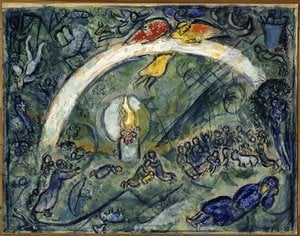
11Синята птица (1968) на Марк ШагалСинята птица1968 12Мадона на селото (1942) на Марк ШагалМадона на селото1942 13A wheatfield on a summer's afternoon (1942) на Марк ШагалA wheatfield on a summer's afternoon1942 14Концертът (1957) на Марк ШагалКонцертът1957 15Единствено (1933) на Марк ШагалЕдинствено1933 16Елегия (1918) на Марк ШагалЕлегия1918 17Моше приемането на Десетте заповеди (1966) на Марк ШагалМоше приемането на Десетте заповеди1966 18Song of Songs III (8) (1960) на Марк ШагалSong of Songs III (8)1960 19Букет с летящи влюбнени (1947) на Марк ШагалБукет с летящи влюбнени1947 20Laid Table with View of Saint-Paul de Vance (1968) на Марк ШагалLaid Table with View of Saint-Paul de Vance1968 21The Myth of Orpheus (1977) на Марк ШагалThe Myth of Orpheus1977 22Възкресението е произведение на изкуството на Марк Шагал – мощна сюрреалистична шедьовър! Разгледайте този картина от 1952 г., която съчетава драматично осветление, религиозни теми и експресивен стил. Завладяващо произведение на изкуството. (1952) на Марк ШагалВъзкресението е произведение на изкуството на Марк Шагал – мощна сюрреалистична шедьовър! Разгледайте този картина от 1952 г., която съчетава драматично осветление, религиозни теми и експресивен стил. Завладяващо произведение на изкуството.1952 23A red horse (1938) на Марк ШагалA red horse1938 24Обещаните и Айфеловата кула (1913) на Марк ШагалОбещаните и Айфеловата кула1913 25Moses with the Burning Bush (1966) на Марк ШагалMoses with the Burning Bush1966 26Blue Lovers (1914) на Марк ШагалBlue Lovers1914 27The Wedding (1944) на Марк ШагалThe Wedding1944 28Молитвен евреин (Равин от Витебск) (1914) на Марк ШагалМолитвен евреин (Равин от Витебск)1914 29The Three Candles (1940) на Марк ШагалThe Three Candles1940 30Сън в лятна нощ (1939) на Марк ШагалСън в лятна нощ1939 31Сватбените свещи (1945) на Марк ШагалСватбените свещи1945 32Nude Lying Down (1914) на Марк ШагалNude Lying Down1914 33Рожден ден, МOMA Ню Йорк (1915) на Марк ШагалРожден ден, МOMA Ню Йорк1915 34Moses receiving the Tablets of Law (1963) на Марк ШагалMoses receiving the Tablets of Law1963 35Снег, зима във Витебск (1911) на Марк ШагалСнег, зима във Витебск1911 · Метрополитън Музей на изкуствата 36Пътниците на „Антилопа“ (1969) на Марк ШагалПътниците на „Антилопа“1969 37Поклонение на Гогол. Дизайн за завеса за фестивал на Гогол. (1917) на Марк ШагалПоклонение на Гогол. Дизайн за завеса за фестивал на Гогол.1917 · MoMA - Музеят на модерното изкуство 38Paris through the Window (1913) на Марк ШагалParis through the Window1913 39Изход (1966) на Марк ШагалИзход1966 40Поетът Лежащ (1915) на Марк ШагалПоетът Лежащ1915 41Война (1966) на Марк ШагалВойна1966 42Bella and Ida by the Window (1916) на Марк ШагалBella and Ida by the Window1916 43Dans mon pays на Марк ШагалDans mon paysGalleria Civica di Arte Moderna e Contemporanea Torino 44The Jacob's Dream (1966) на Марк ШагалThe Jacob's Dream1966 45Домът със зелено око (1944) на Марк ШагалДомът със зелено око1944 46Нещоново брачно с кулата на Ейфел в фона (1983) на Марк ШагалНещоново брачно с кулата на Ейфел в фона1983 47Lovers in pink (1916) на Марк ШагалLovers in pink1916 48Пасища с крави (1917) на Марк ШагалПасища с крави1917 49To Russia, with Asses and Others (1912) на Марк ШагалTo Russia, with Asses and Others1912 50The Lovers (1929) на Марк ШагалThe Lovers1929 · Tel Aviv Museum of Art 51Moses and the burning bush (1966) на Марк ШагалMoses and the burning bush1966 52The dream (The rabbit) (1927) на Марк ШагалThe dream (The rabbit)1927 53Still Life with Lamp (1910) на Марк ШагалStill Life with Lamp1910 54Голям цирк (1968) на Марк ШагалГолям цирк1968 55The Creation of Man (1958) на Марк ШагалThe Creation of Man1958 56The flying clown (1981) на Марк ШагалThe flying clown1981 57Небето пламва (1954) на Марк ШагалНебето пламва1954 58White crucifixion, The Art Institute of Chicag (1938) на Марк ШагалWhite crucifixion, The Art Institute of Chicag1938 59Фест на Таберетските (1916) на Марк ШагалФест на Таберетските1916 60Влюблени до моста (1948) на Марк ШагалВлюблени до моста1948 61Циркът (1964) на Марк ШагалЦиркът1964 62Song of Songs II (10) (1957) на Марк ШагалSong of Songs II (10)1957 63The Descent towards Sodom (1931) на Марк ШагалThe Descent towards Sodom1931 64Цирк (1980) на Марк ШагалЦирк1980 65Обнажена над Витебск (1933) на Марк ШагалОбнажена над Витебск1933 66Композиционна ескиз за „Към Русия, към ослите и другите“ (1912) на Марк ШагалКомпозиционна ескиз за „Към Русия, към ослите и другите“1912 · Музей на изкуствата (Будапеща) 67Зелени влюбени (1915) на Марк ШагалЗелени влюбени1915 68The Carnival, scene II of the Ballet ''Aleko'' (1942) на Марк ШагалThe Carnival, scene II of the Ballet ''Aleko''1942 69The Fiddler, National Gallery of Art at Was (1913) на Марк ШагалThe Fiddler, National Gallery of Art at Was1913 70The rooster in love (1947) на Марк ШагалThe rooster in love1947 71Крава с чадър (1946) на Марк ШагалКрава с чадър1946 72The Vision of Ezekiel (Ezekiel, I, 4-14) (1956) на Марк ШагалThe Vision of Ezekiel (Ezekiel, I, 4-14)1956 73Три ангела посещават Авраам (Книгата на Съдиите, XVIII, 1-8) (1956) на Марк ШагалТри ангела посещават Авраам (Книгата на Съдиите, XVIII, 1-8)1956 74Mounting the ebony horse (1948) на Марк ШагалMounting the ebony horse1948 75Birth (1910) на Марк ШагалBirth1910 76In the night (1943) на Марк ШагалIn the night1943 77Field of Mars (1955) на Марк ШагалField of Mars1955 78The War (1943) на Марк ШагалThe War1943 79Noah and the Rainbow (16) (1963) на Марк ШагалNoah and the Rainbow (16)1963 80The walk (1973) на Марк ШагалThe walk1973 81The Father (1911) на Марк ШагалThe Father1911 · Musée d'Art et d'Histoire du Judaïsme 82Le Quai de Bercy на Марк ШагалLe Quai de Bercy 83Lovers на Марк ШагалLovers 84Moses is saved from the waters of Nile by Pharaoh's daughter (Exodus II, 5 6) (1956) на Марк ШагалMoses is saved from the waters of Nile by Pharaoh's daughter (Exodus II, 5 6)1956 85Grey Lovers (1917) на Марк ШагалGrey Lovers1917 86Bercy Embankment (1953) на Марк ШагалBercy Embankment1953 87Feast Day (Rabbi with Lemon) (1914) на Марк ШагалFeast Day (Rabbi with Lemon)1914 88The Wailing Wall (1932) на Марк ШагалThe Wailing Wall1932 · Tel Aviv Museum of Art 89Portrait of Brother David with Mandolin (1914) на Марк ШагалPortrait of Brother David with Mandolin1914 90Lovers for Berggruen (The offering) (1965) на Марк ШагалLovers for Berggruen (The offering)1965 91Composition with Circles and Goat (1920) на Марк ШагалComposition with Circles and Goat1920 92Hour between Wolf and Dog (Betwenn Darkness and Light) (1943) на Марк ШагалHour between Wolf and Dog (Betwenn Darkness and Light)1943 93Великолепен цирк (1984) на Марк ШагалВеликолепен цирк1984 94Marching (1915) на Марк ШагалMarching1915 95Нощ (1953) на Марк ШагалНощ1953 96The Holy Coachman (1912) на Марк ШагалThe Holy Coachman1912 97Song of Songs I (1960) на Марк ШагалSong of Songs I1960 98The Praying Jew, oil on canvas, The Art Instit (1923) на Марк ШагалThe Praying Jew, oil on canvas, The Art Instit1923 · Art Institute of Chicago 99The return of the prodigal son (1975) на Марк ШагалThe return of the prodigal son1975 100Noah and the Rainbow (13) (1963) на Марк ШагалNoah and the Rainbow (13)1963

Марк Шагал's paintings, period by period

What Марк Шагал painted most

The four subjects that come up most often in these pieces, each with its best-known example.

Where you can see Марк Шагал's paintings

8 музея, които притежават най-голям брой от картините на тази страница.

Музеи Град Творения на Марк Шагал Картини от този списък
MoMA - Музеят на модерното изкуство, Ню ЙоркMoMA - Музеят на модерното изкуство Ню Йорк 4 Аз и селото, Поклонение на Гогол. Дизайн за завеса за фестивал на Гогол.
Art Institute of Chicago, ЧикагоArt Institute of Chicago Чикаго 4 Бяло разпятие, The Praying Jew, oil on canvas, The Art Instit
Tel Aviv Museum of Art, Тел АвивTel Aviv Museum of Art Тел Авив 2 The Lovers, The Wailing Wall
Метрополитън Музей на изкуствата, Ню ЙоркМетрополитън Музей на изкуствата Ню Йорк 2 Снег, зима във Витебск
Художествения музей Базел, БазелХудожествения музей Базел Базел 1 Падащи ангелски крила
Музей Соломон Р. Гугенхайм, Ню ЙоркМузей Соломон Р. Гугенхайм Ню Йорк 1 Пиещ войник
Galleria Civica di Arte Moderna e Contemporanea Torino, ТориноGalleria Civica di Arte Moderna e Contemporanea Torino Торино 1 Dans mon pays
Музей на изкуствата (Будапеща), БудапещМузей на изкуствата (Будапеща) Будапещ 1 Композиционна ескиз за „Към Русия, към ослите и другите“

Марк Шагал decade by decade: one standout piece each

Произведения по десетилетия

Pick a decade to see its standout piece.

Your questions about Марк Шагал's paintings

Which Марк Шагал painting is the most famous?See the answer

Top of the list is Аз и селото (1911), MoMA - Музеят на модерното изкуство, Ню Йорк. Right behind it: Бяло разпятие (1938) and Рожден ден (1915).

How old was Марк Шагал when Аз и селото was made?See the answer

24 years old. Марк Шагал was born in 1887, and Аз и селото dates from 1911.

What are the 10 best-known Марк Шагал paintings?See the answer

Аз и селото, Бяло разпятие, Рожден ден, Над града, Зеленият музикант, Падащи ангелски крила, Пиещ войник, Авраам и три ангела, Adam and Eve expelled from Paradise и Освобождение. You'll find the year and the museum of each in the list above.

How many paintings did Марк Шагал create?See the answer

We have 936 works by Марк Шагал in our catalogue, dated 1910 to 1984.

Where can you see Марк Шагал's famous paintings?See the answer

You'll find most of them in MoMA - Музеят на модерното изкуство (Ню Йорк), Art Institute of Chicago (Чикаго) и Tel Aviv Museum of Art (Тел Авив). The museum list above has the full breakdown.

When did Марк Шагал paint the best-known pieces?See the answer

In 1910s, more than any other time: 30 of the 100 pieces on this page date from then, Аз и селото among them.

Which famous Марк Шагал paintings came first and last?See the answer

The earliest piece here is Still Life with Lamp (1910); the most recent is Великолепен цирк (1984).

What subjects show up most in Марк Шагал's paintings?See the answer

Folklore (22), Dreams (18) и Jewish folklore (14), out of the 100 pieces on this page.

What materials did Марк Шагал paint with most?See the answer

Масло върху платно, used in 34 of the 100 pieces on this page.

Which Марк Шагал pieces can you see at the MoMA - Музеят на модерното изкуство?See the answer

You can see 2 of the pieces on this page at the MoMA - Музеят на модерното изкуство, Ню Йорк, including Аз и селото и Поклонение на Гогол. Дизайн за завеса за фестивал на Гогол..

Getting to know Марк Шагал

Early Life, Family and Training

Marc Chagall enters the world on July 7, 1887, in Vitebsk, Russian Empire, born Moishe Segal. He is the first of nine children in a modest Jewish family. Life is defined by the rhythms of labor and small-scale commerce. His father, Khatskel Segal, works as a herring pickler at a warehouse, while his mother, Feïga-Ita Tchernina, manages a small grocery store. These early years are rooted in the specific textures of a provincial town, where the boundaries of his world are shaped by the needs of a large household and the traditions of his community.

Education begins within the walls of the heder, a traditional Jewish elementary school. Here, the focus remains on religious instruction and the foundational texts of his upbringing. By age thirteen, the scope of his learning shifts toward the secular. He enters Vitebsk’s official middle school to pursue a Russian education, a move that marks a departure from the strictly religious sphere of his childhood. This dual existence—between the sacred traditions of the heder and the secular requirements of the state school—creates a tension that defines his early development.

Artistic impulse finds its first formal outlet in Vitebsk. Chagall receives his initial training at a local art school operated by Iouri Pen. It is here that the raw instinct for visual expression begins to coalesce into a disciplined practice. He moves from the structured lessons of the classroom toward a more profound engagement with the act of seeing, setting the stage for a life spent translating memory into form.

The Formative Years in St. Petersburg

The transition from the provincial quiet of Vitebsk to the imperial scale of Saint-Petersburg is marked by struggle. Between 1907 and 1909, the capital offers little in the way of comfort. Poverty is a constant companion; there are moments of hunger so severe that physical collapse becomes a reality. To survive, he takes to the streets, earning a meager living by drawing shop signs. These commercial tasks provide the necessary rubles to sustain a presence in the city while he navigates the complexities of being a Jewish student in a vast, shifting empire.

The academic pursuit is relentless. He enrolls in several academies, seeking a formal structure for his burgeoning visual language. The atmosphere of the capital is heavy with the influence of the avant-garde, a tension that pulls him away from classical training. He finds himself in the studio of Léon Bakst, a designer for the Ballets Russes, where the theatricality of set design begins to seep into his perception of space and form. This period is a collision of necessity and ambition, a time of sketching for survival while simultaneously absorbing the radical shifts occurring in the Russian art scene.

The Paris Years and Avant-Garde Influence

Paris arrives in 1910 or 1911, a sudden shift from the provincial constraints of the Russian Empire. The city offers a sensory shock. He finds light, color, and liberty in the streets of Montparnasse. This is no longer the world of the herring merchant or the traditional heder school; it is a landscape of radical possibility. He settles in La Ruche, the famous artist's residence, where the air is thick with the presence of the new avant-garde. He shares this space with Amedeo Modigliani and Fernand Léger, figures who are redefining the boundaries of modern expression. The influence of the era is inescapable, yet he remains an outlier, absorbing the discoveries of Fauvism and Cubism without surrendering his own internal logic.

The work produced during this period begins to reflect a departure from literal representation. He moves toward a style that prioritizes emotional and poetic associations over the strict rules of pictorial logic. The colors brighten, fueled by the exposure to the Parisian scene. He navigates the tension between the formal training of his past and the experimental freedom of the present. This period of intense creative friction continues until the political upheavals of the war pull him back toward the East. It is not until 1923 that he returns to Paris with his family, re-establishing his presence in the city that first unlocked his visual language.

The Russian Years and Revolution

The revolution pulls Chagall back to Vitebsk. He does not merely observe the upheaval; he attempts to shape its cultural landscape. He takes on the mantle of Vitebsk Commissioner of Fine Arts and assumes the directorship of a local Fine Arts School. His vision is one of community and education, yet the political climate shifts beneath his feet. The rise of Suprematism creates a fracture. Figures like Malevitch and Lissitzky push for a radical, non-objective abstraction that clashes with Chagall’s more lyrical, figurative approach. The tension is unsustainable. He is forced out of his positions, his dream of a localized artistic renaissance colliding with the rigid demands of the new regime.

By 1920, the focus shifts to Moscow. He works on the decoration of the Jewish theatre, a project that captures the intersection of his personal identity and the public stage. His lines are confident, his colors strong and pale, even as the world around him fractures. He navigates a period of intense creative output and profound material struggle, moving between the memory of the shtetl and the demands of a changing state. The era is defined by this friction: the attempt to build a cultural home while the very foundations of his world are being rewritten.

Life in the United States

The outbreak of World War II forces a sudden shift in geography. In 1941, Chagall and his family seek refuge in the United States, fleeing the instability of occupied France. He settles in and around New York City, a period of residence that lasts until 1948. The city provides a backdrop of profound emotional upheaval. Amidst the anxieties of the war years, his brush captures the tension of a world in flux. The work reflects the uncertainty of the era, translating personal and global unrest into a visual language of suffering and hope.

During these seven years, the artist finds a way to engage with large-scale institutional projects. He undertakes major commissions for the United Nations headquarters, translating his poetic vision into the architectural fabric of a global institution. This period in America marks a significant chapter of experimentation and survival, bridging his European roots with a new, intense reality. He remains a man between worlds, his heart still pulling him toward France even as he navigates the complexities of his American exile.

Technique and Artistic Style

Logic yields to emotion. Chagall rejects the rigid rules of pictorial logic, choosing instead to compose images through poetic association. His canvases operate on the mechanics of a dream. Figures float through the air, defying gravity, while colors pulse with a non-naturalistic intensity. This approach allows him to capture the essence of feeling rather than the literal appearance of the world. He moves beyond mere imitation, using a bold palette to translate memory into a visual language.

His aesthetic is a collision of influences. He absorbs the fragmented structures of Cubism and the intense color of Fauvism, yet he filters these avant-garde movements through a deeply personal lens. The result is a style that bridges Expressionism and abstraction. He weaves together the sacred and the mundane, populating his scenes with symbolic and surreal imagery. Jewish folktales and the quiet, lived-in details of shtetl life become the building blocks of a private mythology. The familiar becomes fantastic.

The imagery often centers on recurring motifs: flying lovers, fiddlers, and massive bouquets. These elements are not mere decorations but symbols of a spiritual and emotional landscape. In works like The Lovers (1929), the sense of weightlessness and the use of intense color create a space where the physical laws of the world no longer apply. His work remains a constant negotiation between the tangible reality of his upbringing and the boundless possibilities of the imagination.

Patrons, Workshop and Commissions

The mid-1920s find Chagall in Paris, navigating the influential circles of the art market. He enters the orbit of Ambroise Vollard, a dealer whose influence shapes the trajectory of many avant-garde artists. Vollard commissions a series of engravings from Chagall, tasking him with illustrating the works of Nikolay Gogol, specifically Dead Souls. This period marks a shift toward the precision of printmaking, moving away from the fluid spontaneity of his earlier canvases.

In 1931, the focus shifts toward the Middle East. The Mayor of Tel Aviv extends an invitation to Chagall to travel to Palestine. The objective is ambitious: the founding of a Jewish Art Museum. This period deepens his engagement with religious and cultural symbolism, a theme that would persist through his later, large-scale architectural works. His ability to translate personal and communal memory into physical space becomes a defining aspect of his professional output.

As his reputation grows, the scale of his work expands from the intimate page to the monumental. He moves into the realm of light and architecture, designing stained-glass windows for the Cathedral of Metz and the United Nations building in New York. These works demand a mastery of how color interacts with sunlight. In 1964, he reaches a peak of public recognition with a commission for the ceiling of the Paris Opera, a massive undertaking that brings his dreamlike imagery into one of Europe's most significant cultural venues.

Where to See the Works Today

The legacy of his vision remains anchored in several key institutions across the globe. In Nice, France, the Musée National Marc Chagall houses an extensive collection of his works, preserving the core of his creative output. This museum offers a concentrated look at the imagery that defined his long career. Meanwhile, the State Russian Museum in Saint-Petersburg, Russia, maintains a significant presence of his art, holding pieces that connect back to his early years and his time in the Russian Empire.

The reach of his work extends across the Atlantic to the United States. The Museum of Modern Art in New York City holds works that reflect his complex relationship with the city during his years of exile. In the American Midwest, the Art Institute of Chicago features his art, ensuring his presence in major international collections. These locations provide the primary physical touchpoints for those seeking to encounter his specific use of color and form.

Всички 936 произведения на Марк Шагал →