A Tapestry of Politics and Poetic Vision
The life of Hung Hsiu Chu, born in Taipei in 1948, represents a rare and compelling intersection between the rigorous arena of political leadership and the contemplative depths of artistic expression. To understand her work is to understand a journey shaped by the turbulent and transformative history of Taiwan itself. Her early years in Taipei instilled a profound respect for intellectual rigor and academic excellence, qualities that would later define her formidable presence on the national stage. While her public identity is inextricably linked to her ascent through the ranks of the Kuomintang, her creative soul seeks a different kind of discourse—one found in the quietude of brushstrokes and the subtle interplay of light and shadow.
Her political trajectory is nothing short of legendary, marked by a tenacity that mirrors the resilience often found in her aesthetic choices. From her election to the Legislative Yuan in 1990 through her influential roles as Deputy Chairperson and Deputy Secretary-General, Chu has navigated the complexities of governance with a sharp, analytical mind. Reaching the heights of the presidency of the Legislative Yuan in 2012 and later serving as Vice President until 2017, she became a central figure in the shaping of modern Taiwanese policy. Yet, beneath this veneer of political authority lies an artist who utilizes her experiences of power, duty, and diplomacy to inform a visual language of profound serenity.
The Language of Simplicity and Tradition
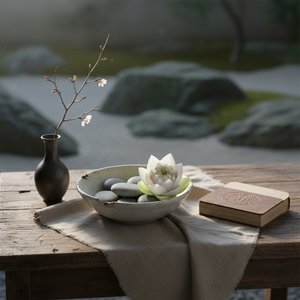
In the realm of fine art, Chu’s oeuvre is characterized by a deliberate and masterful simplicity. She eschews the chaotic for the harmonious, focusing the viewer's attention on tonal balance and the delicate nuances of texture. Her palette is a study in restraint, often dominated by the cooling elegance of jade green, the deep tranquility of azure blue, and the pure, grounding presence of ivory white. This choice of color does more than decorate a canvas; it creates an atmosphere of meditative stillness, inviting the observer to step away from the noise of the contemporary world and into a space of reflection.
The technical foundation of her work draws heavily from the ancient traditions of Eastern calligraphy. There is a rhythmic, almost spiritual quality to her application of medium, reminiscent of the expressive, disciplined brushwork found in Zen Buddhist practices. This connection to calligraphic tradition allows her to imbue each piece with a sense of movement and breath, where every stroke carries the weight of intention. Through this fusion of traditional technique and modern sensibility, she achieves a unique form of visual poetry that speaks to the enduring strength of cultural heritage.
Legacy of a Dual Identity
The historical significance of Hung Hsiu Chu lies in her ability to bridge two seemingly disparate worlds. She stands as a testament to the idea that the analytical mind of a stateswoman and the emotive heart of an artist are not mutually exclusive, but rather complementary forces. Her work serves as a visual counterpart to her political life—where politics deals with the complexities of human organization and conflict, her art seeks the resolution of harmony and peace.
As her legacy continues to unfold, she remains a singular figure in the contemporary landscape, offering a perspective that is both deeply rooted in Taiwanese identity and universally resonant. Her achievements are not merely found in the legislative halls or the political podium, but in the quiet moments of beauty she captures on canvas, reminding us that even amidst the most intense struggles for leadership and change, there remains an essential, unshakeable need for grace and contemplative beauty.