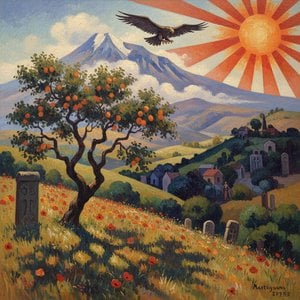
The Quiet Observer of the Armenian Landscape
Grigor Azizyan lived a life deeply rooted in the textures of his surroundings, capturing the subtle shifts of light and shadow that define the Armenian spirit. Born in 1923, he moved through a century of profound change, yet his brush remained focused on the immediate, tangible world. His hands were skilled in the medium of oil on canvas, a tool he used to translate the fleeting moments of existence into permanent forms. There was a certain humility in his approach, a preference for the lived experience over the grandiosity of abstract theory.
His work often reflected a profound connection to the everyday. Whether he was documenting the simple act of an artist sketching by his house in 1970 or capturing the sudden movement of people seeking shelter, his subjects were never distant. They were part of a continuous, breathing reality. This commitment to the present moment allowed him to find depth in the mundane, turning a simple scene into a study of light and human presence.
A Legacy in Color and Form
The development of his style reveals a painter who understood the weight of atmosphere. His compositions were not merely arrangements of shapes but were attempts to grasp the very air between the viewer and the subject. In his later years, his ability to convey emotion through color and texture became even more pronounced, as seen in his works from the 1970s and 1990s.
His contributions to the artistic landscape of his time are marked by several notable achievements and recognitions:
- The title of Honored Artist of the Armenian SSR, a distinction reflecting his standing within his community.
- A collection of works held within the National Gallery of Armenia, Yerevan.
- A body of work that spans decades, from the early 1960s through the final years of his life.
Through these milestones, one sees a man who was deeply integrated into the cultural fabric of his nation. His paintings were not isolated objects but were part of a larger conversation regarding the identity and the visual language of Armenia.
The Final Strokes
As the years progressed, Azizyan continued to refine his vision, even as the world around him transformed. His later works, such as those produced in 1992, show a continued mastery of oil on canvas, maintaining a sense of purpose and clarity. He passed away in 2003, leaving behind a record of a life spent looking closely at the world. His paintings remain as quiet witnesses to the light and the people of his homeland, preserved in galleries and private collections alike.