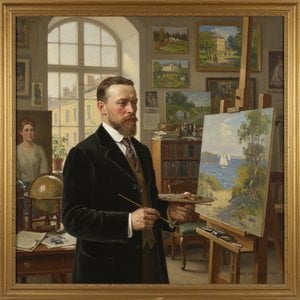
The Life of Ferdinand Julius Fagerlin
Ferdinand Julius Fagerlin was a Swedish-German genre painter whose life spanned much of the nineteenth century. Born in Stockholm on 5 February 1825, he began his professional life far from the canvas, serving as an apprentice to a shipbuilder between 1842 and 1843. This early labor preceded his entry into the Royal Swedish Academy of Arts and a period of military service. By 1854, he had abandoned the army to devote himself entirely to the practice of painting.
His career was defined by a movement between the major artistic centers of Europe. After establishing himself in the Düsseldorf art scene, he spent time in Paris, eventually settling in Germany. His travels frequently took him to the Netherlands, where the imagery of the Dutch coast and the lives of sailors became central to his genre painting. He remained a member of the Düsseldorf art society, Malkasten, for nearly four decades, from 1862 until 1902.
Fagerlin’s life reached its conclusion in Düsseldorf. He died on 19 March 1907, just six weeks after his eighty-second birthday. He left behind a body of work focused on the quiet, observational details of daily life and human interaction.
Early Life and Artistic Training
Born in Stockholm, Ferdinand Julius Fagerlin’s path toward the canvas was neither direct nor certain. His early years were marked by a practical apprenticeship as a shipbuilder between 1842 and 1843, a period of manual labor that preceded his formal entry into the fine arts. By 1845, he had transitioned from the shipyard to the Royal Swedish Academy of Arts, where he studied for two years before his training was interrupted by military service. He served in the army from 1850 to 1854, a time that momentarily diverted his attention from the easel to the rigors of duty.
The discipline of his military years gave way to a dedicated pursuit of painting once again. Seeking to refine his technical command, he moved toward the Kunstakademie Düsseldorf. Between 1854 and 1855, he studied under Karl Ferdinand Sohn and Friedrich Wilhelm Schadow. This period of intense instruction provided the academic foundation necessary for his transition into a professional genre painter. His time in Düsseldorf helped shape the precision and observational skill that would characterize his later depictions of life.
Artistic Activity in Paris and Düsseldorf
Between 1856 and 1858, Fagerlin’s development took him to Paris, where he worked in the shop of Thomas Couture. This period of professional immersion provided a crucial bridge between his early training and his eventual establishment in Germany. Upon returning to Düsseldorf in 1858, he settled into the life of a professional painter. This transition was marked by a significant personal union; he married Alice, the daughter of the painter Henry Ritter, who had previously owned the shop Fagerlin would eventually inherit.
His presence in the Düsseldorf art scene was both enduring and institutional. From 1862 until 1902, he was an active member of the Malkasten art society. This long-standing affiliation anchored his career within the local artistic community for four decades. His work during these years reflected the influences gathered during his travels, particularly the imagery of the Dutch coast and the lives of sailors, which he acquired during frequent trips to the Netherlands after 1863.
Notable Works and Collections
Fagerlin’s canvases often captured the quiet tensions of domestic and social life. Several of his significant compositions are held within the Nationalmuseum Stockholm, including Die angehenden Raucher and Die Eifersucht. His ability to render human interaction is further seen in Die Liebeserklärung, Die Krankenstube, and Der verschmähte Freier. These works reflect a steady hand and an interest in the subtle nuances of character and setting.
His output also included pieces that explored more formal or sentimental themes. Der Heiratsantrag remains a notable example of his genre painting, much like the 1867 work Die Genesende (Häusliche Andacht), which is also part of the collection at the Nationalmuseum Stockholm. These paintings demonstrate a commitment to the observational detail required of the Düsseldorf school tradition.
Beyond these Swedish collections, his reach extended into other European institutions. The Royal College of Music Museum in London holds Sydney Lane Applegarth, “Syd” our piano player, a work that highlights his skill in depicting specific individuals. Through these various holdings, his presence in the nineteenth-century art landscape remains documented through his varied subject matter.
Въпроси и отговори
Как да намеря творби на Фердинанд Юлиус Фагерлин в специфична цветова палитра?
Страницата По палитра групира произведенията на Фердинанд Юлиус Фагерлин според техните цветни палитри.
Къде могат да бъдат намерени произведенията на Фердинанд Юлиус Фагерлин, групирани по художествено направление?
Работите на Фердинанд Юлиус Фагерлин могат да бъдат разгледани по художествени направления на страницата за Всички художествени направления на артиста.
В кой град и държава е роден/а Фердинанд Юлиус Фагерлин?
Фердинанд Юлиус Фагерлин е роден в Щокхолм, Швеция.