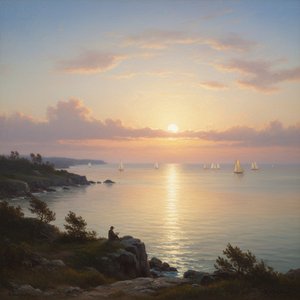
Alfred Thompson Bricher: Luminism's Mariner
Alfred Thompson Bricher (April 10, 1837 – September 30, 1908) stands as a pivotal figure in the Hudson River School and American Luminism—a movement dedicated to capturing the sublime beauty of nature with meticulous detail and ethereal light. Born in Portsmouth, New Hampshire, Bricher’s artistic journey began amidst the burgeoning intellectual fervor of Victorian America, shaping his worldview and profoundly influencing his distinctive style. His formative years instilled a deep appreciation for observation and scientific inquiry, qualities that would later permeate his landscapes and seascapes.
- Early Life & Education: Bricher’s upbringing in Newburyport fostered an early exposure to artistic pursuits. He attended Newburyport Academy before pursuing further studies at Lowell Institute, honing his technical skills and immersing himself in the burgeoning aesthetic debates of the time.
- Boston Beginnings & Artistic Formation: Following graduation, Bricher established a career as a businessman in Boston but quickly recognized that his true vocation lay in painting. He studied with luminist masters like Albert Bierstadt and William Morris Hunt, absorbing their techniques for conveying atmospheric effects and capturing the grandeur of the natural world.
- The Luminist Vision: Bricher’s artistic philosophy centered on the Luminist movement—a reaction against Romanticism's dramatic narratives and emotional intensity. Luminists sought to depict landscapes with a serene stillness, prioritizing subtle gradations of light and color over bold brushstrokes. This approach allowed Bricher to convey an unparalleled sense of tranquility and contemplation.
Bricher’s oeuvre is characterized by his extraordinary ability to render the effects of sunlight on coastal vistas—particularly Grand Manan Island off the coast of Maine. He spent seventeen summers meticulously documenting this region, producing canvases that exemplify Luminist principles with breathtaking accuracy. His magnum opus, *Morning at Grand Manan* (1878), remains a testament to his mastery of watercolor and his profound connection to the natural world. The painting’s luminous palette and delicate brushwork capture the ethereal beauty of dawn over the turbulent waters—a scene imbued with spiritual significance.
- Notable Works: Among Bricher's most celebrated paintings are *Grand Manan Island at Dawn* (1878), *The Coast of Maine* (1880), and *Twilight on Narragansett Bay* (1882). These works demonstrate his unwavering commitment to Luminist ideals and solidify his reputation as one of America’s foremost maritime painters.
- Recognition & Influence: Bricher's work gained considerable acclaim during his lifetime, securing membership in the National Academy of Design and establishing him as a respected voice within the artistic community. His influence extended beyond his immediate contemporaries, inspiring subsequent generations of landscape artists to embrace Luminist techniques.
By the 1980s, Bricher’s paintings experienced a revival of interest, prompting scholars to reassess his contribution to American art history. Critics recognized him as a visionary artist who had captured the essence of the sublime—a concept championed by Edmund Burke and Coleridge—and elevated Luminism to its rightful place among the major artistic movements of the nineteenth century. Alfred Thompson Bricher’s legacy continues to resonate today, reminding us of the enduring power of observation and the transformative beauty found in capturing fleeting moments of natural splendor.