


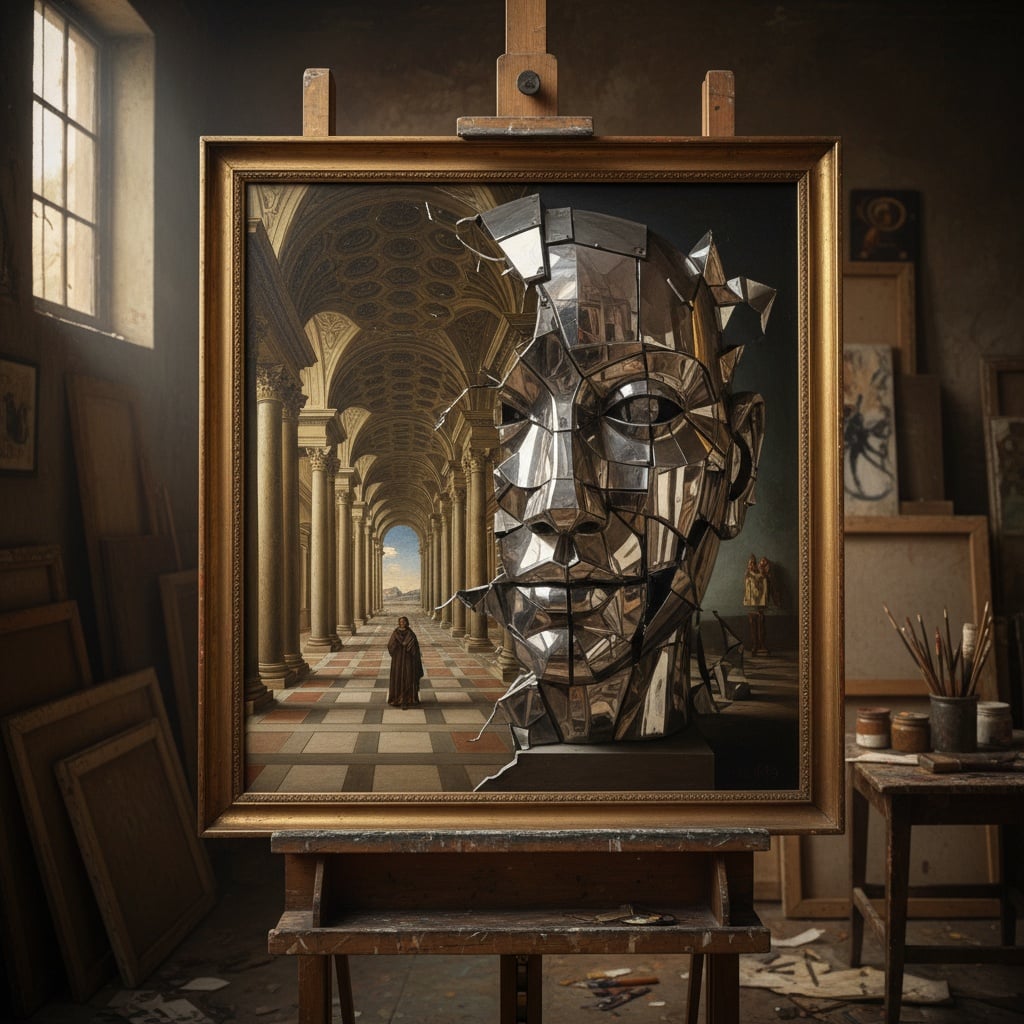
The Genesis of Perspective: From Ancient Roots to Renaissance Innovation
Renaissance art (1350 – 1620) is the painting, sculpture, and decorative arts of the period of European history known as the Renaissance, which emerged as a distinct style in Italy in about AD 1400, in parallel with developments which occurred in phi...
For millennia, artists sought to capture the world around them, but the challenge wasn’t merely replication—it was representation. Early attempts at depicting depth were often intuitive, relying on size and overlapping forms to suggest spatial relationships. Hierarchical scaling, where importance dictated dimension rather than distance, dominated many ancient traditions, from Egyptian tomb paintings to Byzantine mosaics. Yet, a nascent understanding of visual perception simmered beneath the surface. The Greeks, particularly in theatrical skenographia—stage painting designed to create illusory depth—began exploring geometric principles, though systematic documentation remained elusive. These early explorations laid a crucial foundation, hinting at the possibility of a more mathematically rigorous approach. However, it wasn’t until the Italian Renaissance that these seeds truly blossomed into what we recognize as perspective drawing.
The rediscovery of classical texts and a burgeoning humanist spirit fueled a desire for realism grounded in observation and reason. Artists weren't simply recreating scenes; they were striving to understand how we see, and then translate that understanding onto a two-dimensional plane. This quest culminated in the groundbreaking work of Filippo Brunelleschi, an architect whose experiments with linear perspective revolutionized artistic representation around 1415. His method, meticulously documented by Leon Battista Alberti in *Della Pittura* (On Painting) in 1435, provided a systematic framework for constructing believable spatial illusions.
Linear Perspective Decoded: Brunelleschi, Alberti, and the Mathematical Illusion of Depth
At its core, linear perspective is a system predicated on the convergence of parallel lines towards a single vanishing point on the horizon line. Imagine standing on a straight road; the edges appear to narrow as they recede into the distance, eventually meeting at a point far away—this is the fundamental principle at play. Brunelleschi’s innovation wasn't merely recognizing this phenomenon but codifying it mathematically, allowing artists to accurately depict depth and volume. Alberti’s treatise provided a theoretical basis for this practice, outlining how to establish a horizon line, determine vanishing points, and construct orthogonal lines—imaginary lines receding into the distance that guide the artist in creating a convincing illusion of space.
Early masterpieces like Donatello's relief *St. George Killing the Dragon* (c. 1416–17) and Masaccio’s *The Holy Trinity* (1425–27) stand as testaments to this newfound power. In *The Holy Trinity*, the architectural setting is rendered with astonishing realism, creating a chapel-like space that seems to extend beyond the fresco itself. The use of a single vanishing point draws the viewer’s eye into the composition, establishing a profound sense of depth and spiritual resonance. This wasn't simply about technical skill; it was about harnessing mathematics to evoke emotion and create a more immersive experience for the observer.
Atmospheric Perspective: Creating Distance Through Color and Clarity
Aerial perspective, or atmospheric perspective, is the effect the atmosphere has on the appearance of an object as viewed from a distance. As the distance between an object and a viewer increases, the contrast between the object and its background de...
While linear perspective addressed spatial relationships through geometry, artists soon realized that distance also affects our perception of color and clarity. This led to the development of atmospheric perspective—also known as aerial perspective—a technique that simulates the effects of the atmosphere on objects viewed from afar. As distance increases, contrast diminishes, colors become less saturated, and hues shift towards cooler tones, typically bluish. The air itself acts as a filter, softening edges and reducing detail.
Pompeian Second Style frescos offer early examples of atmospheric perspective, dating back to 30 BCE. However, the technique truly flourished during the Renaissance, with artists meticulously studying how light interacts with the atmosphere to create subtle gradations in color and tone. This wasn’t merely an aesthetic choice; it was a scientific observation—a recognition that our perception of depth is inextricably linked to atmospheric conditions.
Mastering Spatial Representation: Key Artists and Their Pioneering Techniques
Piero della Francesca stands as perhaps the quintessential master of Renaissance perspective. His works, such as *The Baptism of Christ* and *Meeting Between Queen Sheba and King Solomon*, are characterized by a serene clarity and geometric precision that borders on mathematical perfection. He didn’t simply employ linear perspective; he understood it, using it to create compositions of unparalleled balance and harmony. His attention to detail, coupled with his mastery of light and shadow, resulted in paintings that feel both monumental and deeply human.
Leonardo da Vinci, another towering figure of the Renaissance, further refined these techniques. His *Mona Lisa*, while renowned for its enigmatic smile, also showcases a subtle but masterful use of atmospheric perspective, creating a sense of depth and mystery around the subject. He wasn’t just painting a portrait; he was exploring the complexities of human emotion and perception.
Beyond Realism: Challenging and Expanding Traditional Perspective in Modern Art
By the 19th century, artists began to question the limitations of traditional perspective. While linear perspective had proven remarkably effective at creating realistic illusions, it also imposed a rigid structure on artistic representation. Artists like Paul Cézanne challenged these norms, opting for flattened picture planes and multiple perspectives in an attempt to capture a more subjective experience of space. This marked a significant departure from Renaissance ideals, paving the way for Cubism and other modern art movements.
The exploration of perspective didn’t end with realism; it evolved into a tool for expressing emotion, challenging conventions, and exploring new ways of seeing. Artists began to manipulate perspective to create distorted realities, fragmented forms, and ambiguous spaces—reflecting the complexities of the modern world.
Perspective Today: Contemporary Applications & The Enduring Legacy
Today, perspective remains a fundamental principle in art, architecture, and design. While digital tools have simplified the process, the underlying principles remain unchanged. From film and animation to video games and virtual reality, understanding perspective is crucial for creating believable immersive experiences.
The legacy of Renaissance artists like Brunelleschi, Alberti, and Piero della Francesca continues to inspire contemporary creators. Their quest for realism—grounded in observation, reason, and mathematical precision—laid the foundation for a new way of seeing the world. At ArtsDot.com, we celebrate this enduring legacy by offering high-quality reproductions of these masterpieces, allowing you to bring the beauty and innovation of Renaissance art into your own home. Explore our collection today and discover the power of perspective!


