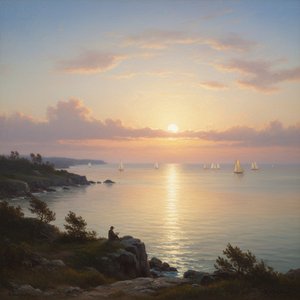
Richard Wilson: A Pioneer of British Landscape Painting
Early Life and Training
Richard Wilson was born on July 24, 1713, in Islington, United Kingdom. Details regarding his early life remain scarce, but it is believed he received foundational artistic training. Wilson’s initial skills were likely developed through self-study and observation, as well as potentially from other artists of the time. His work demonstrates a strong grasp of classical techniques, suggesting a deliberate effort to master fundamental principles.
Artistic Career & Development
Wilson’s artistic journey unfolded in two distinct phases. He began his career as a portrait painter, but gradually transitioned towards landscape painting – the genre for which he is now celebrated. This shift marked a pivotal moment in British art history. His landscapes were not merely depictions of scenery; they were carefully constructed compositions imbued with atmosphere and emotion.
- Early Influences: Initially, Wilson’s portraits showed the influence of established artists like Godfrey Kneller.
- Transition to Landscape: His travels in Italy (around 1752) proved transformative. Exposure to Italianate landscapes and the works of Claude Lorrain profoundly impacted his style.
- Mature Style: Wilson developed a uniquely British approach to landscape, blending classical ideals with the specific qualities of the English countryside.
Influences & Artistic Style
The most significant influence on Richard Wilson was Thomas Gainsborough. He admired Gainsborough’s ability to capture light and atmosphere, and incorporated similar techniques into his own work. However, Wilson distinguished himself through a more deliberate compositional structure and a greater emphasis on idealized beauty.
- Classical Composition: Wilson often employed classical principles of balance and harmony in his landscapes.
- Atmospheric Perspective: He skillfully used atmospheric perspective to create a sense of depth and distance.
- Golden Light: His paintings are characterized by a warm, golden light that evokes a feeling of tranquility.
Notable Works & Achievements
Several works exemplify Wilson’s mastery.
- Meleager and Atalanta (c. 1743): This painting showcases his skill in capturing the essence of the British countryside.
- The Hengö Watch (1756-57): A masterpiece demonstrating Wilson’s ability to balance light, color and composition.
- Numerous other landscapes: He produced a substantial body of work depicting various locations throughout Britain and Italy.
Historical Significance & Legacy
Richard Wilson is considered a pivotal figure in the development of British landscape painting. He paved the way for future generations of artists, including Francis Cotes, by demonstrating the artistic potential of the British countryside. His emphasis on capturing the beauty and tranquility of nature helped to establish a distinctively British tradition of landscape art.
- Breaking from Portraiture: Wilson’s focus on landscape challenged the prevailing dominance of portraiture in British art.
- National Identity: His paintings contributed to a growing sense of national identity and pride in the beauty of the British Isles.
- Lasting Influence: Wilson’s work continues to inspire artists and art lovers today, solidifying his place as a key figure in art history.
Museum Collections
Wilson's works can be found in prominent museums including:
- Tate Britain, London, United Kingdom
- Walker Art Gallery, Liverpool, United Kingdom
- National Museum of Wales, Cardiff, United Kingdom