The Life and Identity of Paul Jobert
The story of Paul Jobert begins far from the galleries of Paris, in the city of Tlemcen, Algeria. Born on 19 August 1863, his early years were shaped by the light and atmosphere of North Africa, a setting that would eventually inform his perspective as a French painter. He moved through a life that saw him navigate the complexities of his era, eventually finding his way to the heart of the French art scene. His presence was felt not only in private studios but also in the grand arenas of international competition.
His talent reached a notable peak during the 1928 Summer Olympics, where his work was included in the painting event of the art competition. This involvement highlights a moment when his creative output intersected with the global stage of athletic and cultural celebration. It was a period of significant recognition for a man whose life was deeply tied to the shifting landscapes of the French territories.
As the years passed, the painter moved through many chapters of his existence, eventually settling in Constantine. He remained active in his craft until his passing on 24 March 1942. From the shores of Algeria to the established circles of France, the life of Paul Jobert reflects a man whose identity was defined by the movement between different worlds and the steady pursuit of his chosen medium.
Notable Works and Artistic Subjects
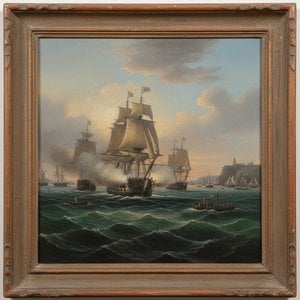
The brush of Paul Jobert often sought the movement of the sea and the heavy presence of naval power. He possessed a keen interest in the maritime life of the French coast and the colonial reaches of North Africa. In his earlier years, he captured specific moments of naval activity, such as the Release of Military Pigeons Aboard a Torpedo Boat, in the English Channel, which he painted about 1895. This work shows a fascination with the intersection of military precision and the natural world upon the water.
As his career progressed, his subjects turned toward the grander, more historical aspects of naval engagement and the atmosphere of Mediterranean ports. He looked back to the history of Algiers, producing Bombardment of Algiers by the French Fleet on July 3, 1830 in 1930, a work that required him to reconstruct a significant moment of conflict. That same year, he turned his attention to the contemporary spectacle of the Naval Review in Alger in 1930. His ability to handle different mediums allowed him to explore light and texture through various materials, whether working with oil on board for a piece like Soleil Couchant or applying oil to cardboard to depict Le Port de la Rochelle.
In his final years, the artist continued to observe the elements. His work West wind, dated about 1942, suggests a focus on the invisible forces that shape the maritime landscapes he loved so well. His output remained varied, moving between the detailed documentation of naval scenes and the more atmospheric study of light and wind.
Exhibitions and Artistic Presence in Paris
The salons of Paris provided the stage upon which Paul Jobert established his presence during the late nineteenth century. His name appeared frequently within the halls of the Palais des Champs-Elysées, marking a steady and persistent engagement with the city's formal art circles. This period of activity began in earnest in 1886, when he first exhibited his work at the Palais des Champs-Elysées. He did not remain a stranger to these venues, returning to the Palais des Champs-Elysées in 1888 and again in 1889. Such frequent appearances suggest a man deeply embedded in the competitive atmosphere of the Parisian art scene, seeking to find his footing among his contemporaries.
As the decade progressed, his presence in the capital grew more consistent. He continued to present his paintings at the Palais des Champs-Elysées throughout 1890, 1891, and 1892. This relentless pursuit of visibility through the annual exhibitions shows a dedicated commitment to the professional life of a painter. By 1893 and 1894, he was once again featured at the Palais des Champs-Elysées, maintaining his visibility in the heart of the French art world. His career was defined by this rhythmic participation in the great exhibitions of Paris, where his works were measured against the standards of the day.