A Life Immersed in the Light of Budapest: The World of Jeno Koszkol
Jeno Koszkol, a name perhaps less globally recognized than some of his contemporaries, nevertheless represents a vital thread in the tapestry of 20th and 21st-century Hungarian painting. Born in 1897, Koszkol’s life spanned an era of immense upheaval – two World Wars, political revolutions, and profound artistic shifts. While biographical details remain somewhat elusive, his work speaks volumes about a man deeply connected to his surroundings, particularly the vibrant city of Budapest and the landscapes that cradled it. He wasn't merely *recording* scenes; he was translating an emotional experience of place onto canvas with remarkable sensitivity. Koszkol’s longevity as an artist – continuing to paint well into the present day – is a testament to both his enduring passion and his ability to adapt while retaining a distinctive artistic voice. His story isn’t one of radical innovation, but rather of consistent refinement, a quiet dedication to capturing beauty and atmosphere with masterful technique.
Early Influences and Artistic Development
The precise nature of Koszkol's formal training is not extensively documented, however it is clear that his early work reflects the strong realist traditions prevalent in Hungarian art during the first half of the 20th century. He absorbed the lessons of artists who sought to depict the world with accuracy and detail, but quickly moved beyond mere imitation. The influence of Impressionism can be detected in his handling of light and color, particularly in his depictions of urban scenes.
He wasn’t interested in simply recreating a visual image; he wanted to convey the feeling of being *in* that moment, bathed in the specific quality of Hungarian sunlight. Later influences appear to stem from Post-Impressionism, with subtle echoes of artists like Van Gogh and Cézanne visible in his brushwork and compositional choices. However, Koszkol never fully embraced any single stylistic movement; instead, he synthesized these various elements into a uniquely personal approach. His early paintings often focused on the bustling life of Budapest – street scenes, cafes, markets – rendered with a warmth and intimacy that set him apart.
Budapest as Muse: Themes and Techniques
The city of Budapest is undeniably the central subject of Koszkol’s oeuvre. He painted its grand boulevards, its hidden courtyards, its iconic bridges spanning the Danube River, and the everyday lives of its inhabitants. But his depictions are rarely straightforward representations.
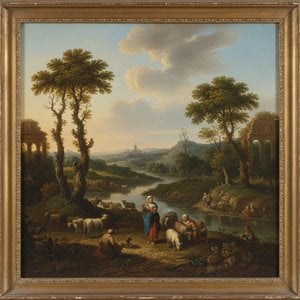
Koszkol was a master of atmosphere. He used color not just to describe form but to evoke mood – the golden glow of late afternoon light on a cobblestone street, the cool shadows cast by ancient buildings, the vibrant energy of a crowded marketplace. His technique is characterized by loose, expressive brushwork and a keen eye for detail. He often employed a limited palette, relying on subtle variations in tone and hue to create depth and luminosity. Beyond urban scenes, Koszkol also painted landscapes – the rolling hills surrounding Budapest, the banks of the Danube, and the Hungarian countryside. These paintings share the same sensitivity to light and atmosphere as his cityscapes, but often possess a greater sense of tranquility and solitude.
Major Achievements and Historical Significance
While Koszkol may not have achieved widespread international fame during his lifetime, he was highly respected within Hungary and enjoyed a long and successful career. His paintings are held in numerous private collections and museums throughout Hungary, and continue to be exhibited regularly.
- His consistent dedication to capturing the beauty of Budapest has resulted in a remarkable visual record of the city’s evolution over the course of the 20th and 21st centuries.
- Koszkol's work provides valuable insights into the everyday life of Hungary during a period of significant social and political change.
- His mastery of light and color, combined with his expressive brushwork, has influenced generations of Hungarian painters.
In a broader historical context, Koszkol’s work represents a continuation of the realist tradition in Hungarian art, but one that is infused with a distinctly modern sensibility. He wasn't interested in making grand statements or challenging artistic conventions; instead, he focused on capturing the beauty and complexity of the world around him with honesty and sensitivity.
His paintings are a testament to the power of observation, the importance of place, and the enduring appeal of traditional painting techniques. As Hungary continues to navigate its own identity in the 21st century, Koszkol’s work serves as a poignant reminder of its rich artistic heritage and the timeless beauty of its landscapes and cities.