Hercules Seghers: A Life in Landscape and Print
- Born: Haarlem, Netherlands (c. 1590)
- Died: c. 1638
Early Life and Training
- Hercules Pieterszoon Seghers was born in Haarlem, the son of a Mennonite cloth merchant originally from Flanders.
- In 1596, his family moved to Amsterdam.
- He was apprenticed to Gillis van Coninxloo, a leading Flemish landscapist, but this apprenticeship was cut short by Coninxloo's death in 1606. Seghers and his father acquired several of Coninxloo’s works after the artist passed away.
- Following his father's death in 1612, he returned to Haarlem and joined the Haarlem Guild of St. Luke.
Artistic Development and Style
- Seghers is recognized as "the most inspired, experimental and original landscapist" of his period, particularly noted for his innovative printmaking techniques.
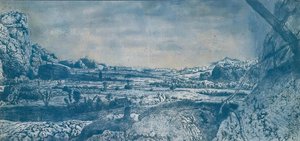
- His paintings often feature fantastic mountainous compositions with a wide horizontal view, emphasizing earth over sky.
- He experimented extensively with etching, using drypoint, aquatint (including the "sugar-bite" technique), and other methods to create unique textural effects.
- Seghers’s prints are characterized by their use of colored paper or cloth, colored inks, and hand-coloring, often resulting in miniature paintings.
- His style shows influence from earlier artists like Joos de Momper and Gillis van Coninxloo.
Major Achievements and Innovations
- Innovative Printmaking: Seghers’s most significant contribution lies in his experimental printmaking techniques, particularly the sugar-bite aquatint. This technique was later rediscovered in England.
- Unique Landscapes: His landscapes are characterized by their starkness, originality, and often otherworldly quality. He depicted rocky formations resembling alien terrain.
- Influence on Rembrandt: Rembrandt collected Seghers’s works and reworked elements from his paintings and etchings into his own compositions, demonstrating the significant impact of Seghers' style.
- Diverse Impressions: Unlike many printmakers of his time, Seghers produced multiple impressions of each plate, varying their color schemes and adding hand-coloring to create unique artworks.
Historical Significance
- Seghers’s work was highly regarded during his lifetime, though he faced financial difficulties later in life.
- Samuel van Hoogstraten's *Inleyding tot de hooge schoole der schilderkonst* romanticized Seghers as a misunderstood genius, contributing to his posthumous reputation.
- He is considered a pioneer of landscape printmaking and an important figure in the Dutch Golden Age, known for his experimental techniques and unique artistic vision.
- His influence can be seen in later artists who adopted his innovative printing methods and appreciated his distinctive style.