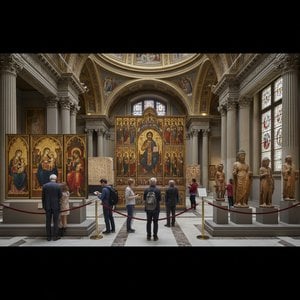
Giuseppe Salviati: A Master of Mannerist Drama
Giuseppe Salviati (c. 1520 – c. 1575), originally known as Giuseppe Porta, stands as a pivotal figure in the late Italian Renaissance and early Mannerist period. Born in Castelnuovo di Garfagnana, he initially apprenticed under Francesco Salviati, a renowned painter of his time, ultimately adopting his mentor’s surname – a common practice among artists seeking recognition and prestige. Salviati's career unfolded primarily in Venice, a city that served as a vibrant hub for artistic innovation during this era, absorbing the stylistic influences of both Rome and its own rich Venetian tradition.
His early training instilled within him a deep understanding of classical composition and technique, yet Salviati quickly developed his own distinctive style – characterized by dramatic dynamism, opulent detail, and a masterful manipulation of perspective. Unlike many of his contemporaries who adhered strictly to the established rules of High Renaissance art, Salviati embraced exaggeration, distortion, and an intense emotionalism that defined the Mannerist movement. This wasn’t simply stylistic choice; it reflected a broader shift in artistic sensibilities, moving away from idealized beauty towards a more expressive and psychologically charged representation of reality.
Religious Themes and Dramatic Compositions
Salviati's oeuvre is overwhelmingly dominated by religious subjects, reflecting the patronage demands of Venetian churches and noble families. He frequently depicted scenes from the lives of Christ, Mary, and the saints, but approached these narratives with a distinctly Mannerist flair. His compositions are rarely static; instead, they pulsate with movement, energy, and often unsettling intensity. Figures are elongated, their poses exaggerated, and drapery flows in swirling, dramatic folds – elements that contribute to a sense of heightened emotionality.
Consider his ‘Presentation of Mary in the Temple,’ a powerful depiction of this pivotal biblical event. The figures are arranged in a complex, almost claustrophobic space, conveying both the sacredness and the inherent tension of the scene. Similarly, ‘Pallas Athene between Fortune and Virtue’ showcases Salviati's ability to fuse classical mythology with Mannerist dynamism, creating a visually arresting tableau that explores themes of wisdom, fate, and moral choice. These works demonstrate his skill in layering complex narratives within a single image, inviting viewers to contemplate the deeper meanings behind each scene.
Technique and Venetian Influence
Salviati’s technical approach was deeply rooted in the Venetian painting tradition, yet he pushed its boundaries further. He employed a technique known as “stiacciato,” building up layers of thin paint – often dozens – to create a sense of depth and volume. This meticulous layering resulted in surfaces that shimmered with an almost tactile quality, particularly evident in his ceiling frescoes. His use of color was equally distinctive—rich, saturated hues combined with subtle gradations and atmospheric effects, creating a luminous and dramatic visual experience.
However, Salviati wasn’t simply replicating Venetian techniques; he adapted them to serve his own expressive goals. He incorporated elements of Roman Mannerism – such as distorted perspective and elongated figures – while simultaneously embracing the vibrant color palette and dynamic compositions characteristic of Venice. This synthesis created a uniquely personal style that distinguished him from both his Roman predecessors and his Venetian contemporaries.
Legacy and Recognition
Despite his considerable talent, Salviati’s work was often overshadowed during his lifetime. Many of his most ambitious commissions – particularly his large-scale frescoes – were tragically lost to fire or neglect. However, in recent decades, scholars have increasingly recognized Salviati's importance as a key figure in the development of Mannerism and a significant contributor to Venetian art history. His influence can be seen in the work of subsequent generations of artists, including Girolamo da Santacroce.
Today, his masterpieces – such as ‘Pallas Athene between Fortune and Virtue’ and ‘Presentation of Mary in the Temple’ – are treasured examples of Italian Renaissance art, offering a compelling glimpse into the dramatic world of Giuseppe Salviati, a master painter who skillfully blended classical ideals with the expressive power of Mannerism.