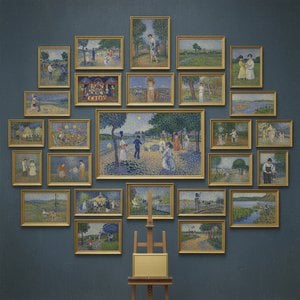
Marie Victor Émile isenbart: A Painter of Jura’s Tranquil Beauty
Marie Victor Émile isenbart (1846 – 1921) was a French landscape painter who achieved renown for his masterful depictions of the Jura Mountains region, specifically focusing on serene vistas and intimate portrayals of rural life. Born in Besançon, France, he possessed an innate fascination with nature’s subtleties—a passion that would profoundly shape his artistic vision and propel him to become one of the most celebrated artists of his era.- Early Life & Education: Born in Besançon, Marie Victor Émile isenbart received a formal education at École Supérieure des Beaux-Arts in Paris, where he honed his artistic skills under the tutelage of prominent instructors.
- Influences: Gustave Courbet, a pivotal figure in Impressionism and Realism, served as a significant inspiration for isenbart. Courbet’s commitment to capturing natural landscapes with uncompromising honesty resonated deeply within isenbart's artistic sensibilities.
The Jura Landscape: A Recurring Motif
isenbart’s oeuvre is overwhelmingly dominated by scenes of the Jura Mountains—a region nestled between France and Switzerland. He meticulously observed the changing seasons, capturing the ethereal glow of dawn, the dappled sunlight filtering through dense foliage, and the misty grandeur of alpine peaks. His canvases convey not merely visual representations but palpable emotions – a sense of peace, contemplation, and reverence for the unspoiled wilderness.- Technique: isenbart employed a distinctive Impressionistic technique characterized by loose brushstrokes and vibrant color palettes. He prioritized capturing fleeting moments of light and atmosphere rather than striving for photographic accuracy.
- Notable Works: Le ruisseau du Val Noir: This iconic painting exemplifies isenbart’s ability to convey the tranquility of Jura's waterways, utilizing subtle tonal variations to create a luminous effect.
CHASSEUR DANS UN SOUS BOIS DANS LE JURA: A captivating portrayal of a hunter amidst the dense undergrowth of the Jura forest, showcasing isenbart’s meticulous attention to detail and his masterful rendering of textures.
Le soir: This evocative nocturne captures the stillness of twilight over Jura's landscape, employing atmospheric perspective to heighten the sense of depth and serenity.