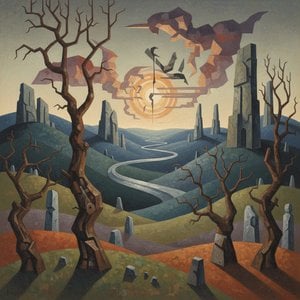
Colin Middleton (1910–1983) was born in Belfast, Northern Ireland, the only child of Charles Middleton, a damask designer who fostered an appreciation for European Modernism within his family. Despite initial reluctance to pursue formal artistic training—influenced by his father’s preference for Impressionist aesthetics—Middleton attended Belfast Royal Academy until 1927 and continued his studies with evening classes at Belfast School of Art under the guidance of Newton Penprase, gaining invaluable experience in design. From a young age, Middleton was captivated by the visionary landscapes of Vincent van Gogh, whose expressive brushstrokes and emotional intensity profoundly shaped his artistic sensibilities. Simultaneously, he absorbed inspiration from James Ensor’s unsettling imagery and symbolic explorations, broadening his understanding of Surrealist principles. These formative influences would become central to his distinctive artistic vision throughout his career.
Van Gogh: Particularly admired for his use of color and emotive brushwork.
Middleton's artistic journey began with exhibitions at Ulster Academy of Arts in 1931, showcasing landscapes imbued with a palpable sense of atmosphere. He quickly gained recognition for his participation in the inaugural exhibition of Ulster Unit, reflecting the burgeoning Surrealist movement in Northern Ireland—a movement championed by Paul Nash and Tristam Hillier. His early work demonstrated an Expressionist approach, capturing Belfast’s urban environment with bold colors and dynamic compositions.
He married Maye McLain in 1934, establishing a family life alongside his artistic pursuits. Following his father’s death in 1935, Middleton took over the damask business and dedicated himself to painting full-time—a decision that would define his subsequent creative output.
Throughout the mid-war years, Middleton’s artistic style evolved towards a more contemplative exploration of landscape and figure painting. He meticulously documented everyday life in Northern Ireland, capturing scenes with remarkable detail and sensitivity—a characteristic that would earn him praise from critics as “Ireland's greatest Surrealist.”“Apart from the brilliance of his paint, he has one rare quality in his inexhaustible capacity for wonder,” a Dublin magazine noted during his artistic prime.
Dublin Magazine Quote: Recognition for Middleton’s unique vision and wonder.
Major Achievements and Recognition
Middleton's prolific output spanned decades, marked by numerous exhibitions in Dublin, London, and Boston. He served as a designer for the New Theatre and sets for the Circle Theatre and Lyric Theatre during his time in Bangor.
Theatre Design: Collaborations with Bangor’s theatre companies
His artistic contributions extended beyond visual art; he was also a poet and musician, producing murals, mosaics, and posters that further showcased his creative versatility. In 1969, he received an MBE for his services to the arts, solidifying his position as a respected figure within the Irish cultural landscape.
Honorary Recognition: MBE Award (1969)
A retrospective at Ulster Museum and Hugh Lane Municipal Gallery of Modern Art in Dublin in 1976 celebrated Middleton’s artistic legacy—a testament to his enduring influence on Northern Irish art history. He continued to exhibit at the Royal Hibernian Academy until his death in 1983 in Belfast.
Retrospective Exhibition: Ulster Museum and Hugh Lane Gallery (1976)
Legacy and Artistic Significance
Colin Middleton’s artistic output remains a cornerstone of Northern Irish Surrealism, characterized by an unwavering commitment to capturing the beauty and complexity of ordinary life—a perspective that resonated deeply with contemporaries.“His work first appeared at the royal hibernian academy in 1938,” reflecting his dedication to sharing his vision with the wider artistic community. His son was John Middleton, also an artist. He left a lasting impression on Irish art history and continues to inspire artists today.
Continuing Influence: Impact on Subsequent Artists
بقلم فريق تحرير ArtsDot.com
اختبار سريع
لكل سؤال إجابة صحيحة واحدة فقط.
سؤال 1:
What was Colin Middleton's primary artistic influence?
سؤال 2:
Where did Colin Middleton initially train in art?
سؤال 3:
What was Colin Middleton's profession besides painting?
سؤال 4:
In which year was Colin Middleton awarded an MBE?
سؤال 5:
Which institution hosted a major retrospective of Colin Middleton's work in 1976?
Explore the evocative landscapes & poignant war art of Paul Nash (1889-1946), a key figure in British Modernism. Discover his unique style and lasting impact on art history with ArtsDot.
Explore the captivating world of Balthus – a master of figurative art renowned for dreamlike compositions & psychologically charged portraits. Discover his unique style, symbolism, and controversial legacy at ArtsDot.
What was Colin Middleton's primary artistic influence?
Vincent van Gogh
من هو Colin Middleton؟
Early Life and Artistic Influences
Colin Middleton (1910–1983) was born in Belfast, Northern Ireland, the only child of Charles Middleton, a damask designer who fostered an appreciation for European Modernism within his family. Despite initial reluctance to pursue formal artistic training—influenced by his father’s preference for Impressionist aesthetics—Middleton attended Belfast Royal Academy until 1927 and continued his studies with evening classes at Belfast School of Art under the guidance
متى توفي Colin Middleton؟
1983
Which institution hosted a major retrospective of Colin Middleton's work in 1976?
Ulster Museum
What was Colin Middleton's profession besides painting?
Theatre Designer
ما هي المواضيع التي استكشفها Colin Middleton؟
landscape
ما هي لوحة الألوان التي تميز أعمال Colin Middleton؟
earthy, neutrals
ما هي أفضل 3 لوحات تصنيفاً لـ Colin Middleton على ArtsDot.com؟
Café Scene, Lagan Annadale, October, The Poet's Garden
من أين Colin Middleton؟
United Kingdom
كم عدد لوحات Colin Middleton المعروضة على ArtsDot.com؟