The Quiet Observer: The Life and Art of Christoffel Frederik Franck
In the tapestry of Dutch art history, certain names resonate with the thunderous fame of Rembrandt or Vermeer, while others exist in a more delicate, intimate light. Christoffel Frederik Franck belongs to that second, more subtle category—a painter whose brush captured the quiet rhythms of life in the late 18th and early 19th centuries. Born in the historic city of Zwolle, Netherlands, in 1758, Franck emerged from a period when the Dutch Golden Age had passed into memory, yet its profound reverence for light, texture, and the dignity of the everyday remained deeply embedded in the national psyche. His journey through the world of art led him from his origins in Zwolle to his final years in Bennebroek, where he passed away in 1816, leaving behind a legacy defined by an unwavering commitment to the truth of his subjects.
While the specific details of Franck’s early training remain shrouded in the mists of time, his artistic DNA is unmistakably linked to the great Dutch masters of the previous century. One can sense the lingering influence of 17th-century genre painting in his meticulous approach to detail and his ability to find profound meaning in the mundane. His style serves as a bridge between eras, blending the formal precision required for portraiture with a soft, observational warmth that characterizes his genre scenes. He possessed a rare gift for capturing the essence of a bygone era, documenting not just faces, but the very atmosphere of the rooms and courtyards they inhabited.
Mastery of Genre and Portraiture
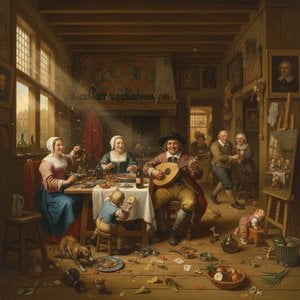
Franck’s oeuvre is a testament to the beauty of the human condition, ranging from the structured elegance of formal portraiture to the spontaneous charm of informal gatherings. He was a master of composition, capable of arranging figures in a way that felt both staged for posterity and naturally caught in a moment of repose. His works often explore the interplay between public identity and private emotion, a theme that resonates deeply within his most celebrated pieces.
Among his notable contributions to the art world are works that invite the viewer into specific, lived-in environments:
- Students in Uniform Relaxing in the Courtyard: A piece that exemplifies his ability to capture a sense of communal peace and the youthful energy of academic life.
- Portraiture of the Era: His ability to render the textures of fabric, the light on skin, and the weight of social status through careful brushwork.
In these works, Franck does more than merely record appearances; he creates a narrative. Whether it is the quiet dignity of a seated subject or the lively interaction of students in a courtyard, his paintings function as windows into the social fabric of the Netherlands during a period of significant transition. His technique, characterized by an acute attention to detail, ensures that every fold of a uniform and every shadow in a corner contributes to the overall storytelling of the canvas.
A Lasting Legacy in the Dutch Canon
The historical significance of Christoffel Frederik Franck lies in his role as a chronicler of his time. Though he worked in the shadow of much larger historical movements, his dedication to the "everyday" provided a vital visual record of Dutch life during the turn of the century. His ability to blend formality and informality within a single frame allowed him to capture the complexity of a society navigating the end of the 18th century and the dawn of the 19th.
Today, the enduring value of his work is preserved within some of the world's most prestigious institutions. The Rijksmuseum in Amsterdam, a sanctuary for the greatest achievements of Dutch art, holds his works within its permanent collection. Standing alongside the monumental legacies of Rembrandt van Rijn, Frans Hals, and Johannes Vermeer, Franck’s paintings serve as essential companion pieces that complete our understanding of the Dutch artistic tradition. His life's work remains a poignant reminder that art does not always need to depict the epic or the mythological to achieve immortality; sometimes, the most profound truths are found in the quiet, captured moments of everyday existence.