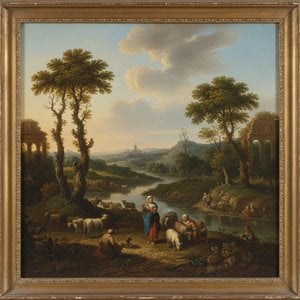
The Luminous Legacy of Barent Graat
In the heart of the Dutch Golden Age, a period defined by an explosion of cultural wealth and artistic mastery, the name Barent Graat resonates with the quiet elegance of a bygone era. Born in Amsterdam around 1628, Graat emerged from a city that was then the beating pulse of global commerce and creativity. While history often shines its brightest spotlight on titans like Rembrandt or Vermeer, Graat carved out a profound niche for himself, becoming a master of genre scenes, serene landscapes, and commanding equestrian portraits. His life, which spanned until 1709, was deeply woven into the fabric of Amsterdam’s social and artistic tapestry, reflecting the prosperity and the refined sensibilities of the seventeenth-century Netherlands.
The foundations of Graat’s artistry were laid in his early years through a lineage of talent. Though historical records offer only glimpses into his formative training, it is widely believed that he learned the craft from his uncle, Hans. This familial connection provided him with an intimate introduction to the nuances of pigment and light. His style was further refined by the influence of Hendrick Jacobsz. van Balen I, whose mastery of allegorical composition and vibrant color palettes undoubtedly left an indelible mark on Graat’s developing hand. Even without the transformative journey to Italy that many of his contemporaries sought, Graat achieved a remarkable proficiency in creating small-scale, Italianate landscapes. By emulating the delicate manner of Pieter van Laer, he brought a sense of Mediterranean warmth and classical grace to the northern European aesthetic.
A Mastery of Light and Narrative
To gaze upon a work by Barent Graat is to enter a world where every shadow tells a story. His technique was characterized by a meticulous devotion to detail and an exquisite use of chiarosc_uro—the dramatic interplay between light and dark that breathes life into form. He possessed a rare ability to capture the subtle flicker of emotion in a subject's gaze or the gentle movement of a landscape under shifting clouds. His brushwork, noted for its delicate precision, allowed him to render textures with such realism that one could almost feel the silk of a gown or the coarse hair of a farm animal.
Graat’s repertoire was as diverse as it was technically demanding. He was particularly celebrated for his skill in depicting animals, a talent that earned him the respect of fellow painters and led him to mentor the notable Johann Heinrich Roos. His ability to blend the pastoral with the profound is evident in several of his most enduring works:
- Pandora (1676): A masterpiece of psychological depth, where a seated female figure is enveloped by a dark, tree-rich landscape. The painting captures a moment of profound tension and curiosity as she interacts with a silver vessel, her expression caught between innocence and the weight of myth.
- Company in a Garden (1661): This work showcases his ability to construct complex, lively scenes within an idealized natural setting. Through the depiction of elegant figures, strolling dogs, and classical statuary, Graat invites the viewer into a serene, aristocratic retreat.
- Equestrian Portraits: These works demonstrate his capacity for capturing grandeur and dynamism, portraying the power and status of the Dutch elite through the majestic movement of horses and riders.
The Architect of an Artistic Academy
Beyond the canvas, Barent Graat was a pillar of the Amsterdam art community. His life was marked by a commitment to both the practice and the preservation of art. In 1664, he established himself in a beautiful home on the Leidsegracht, a residence that became more than just a dwelling; for fifteen years, it served as a vibrant art academy where he shared his knowledge with the next generation of painters. This role as an educator and a leader within the guild underscores his significance not just as a creator, but as a custodian of the Dutch tradition.
His professional reach extended into the very mechanics of the art market. In 1672, he was called upon to serve as an expert, evaluating collections to verify the authenticity of works—a testament to his profound technical knowledge and the trust placed in his discerning eye. Even in his later years, Graat remained active, contributing decorative grisailles and overmantel pieces for the prestigious regent families of Amsterdam. When he passed away in 1709 at the age of eighty-one, he left behind a legacy of beauty that bridged the gap between the rugged realism of early Dutch art and the refined elegance of the late seventeenth century, ensuring his place in the eternal pantheon of the Golden Age.