

A History Rooted in Earth: The Origins & Evolution of Graphite
A colored pencil (American English), coloured pencil (Commonwealth English), colour pencil (Indian English), map pencil, pencil crayon, or coloured/colouring lead (Canadian English, Newfoundland English) is a type of pencil constructed of a narrow, ...
The story of graphite is, at its heart, a tale of unassuming origins blossoming into profound artistic expression. Unlike pigments derived from vibrant minerals and exotic flora, graphite’s beginnings are humble – a naturally occurring form of carbon unearthed from the earth. Its earliest documented use wasn't in art as we know it, but rather for marking sheep on farms in 16th-century Borrowdale, England. This pure, readily available source quickly proved its utility, and soon, sticks of this “black lead” were being wrapped in twine or encased in wooden holders – the precursors to our modern pencils. However, it wasn’t merely a practical tool; even then, artists recognized something special in its ability to create subtle gradations of tone, a quality that set it apart from earlier drawing media like silverpoint and charcoal.
The Borrowdale mines yielded graphite of exceptional purity, but as this resource dwindled, the search for alternatives spurred innovation. Nicolas-Jacques Conté’s 1795 invention – mixing powdered graphite with clay and firing the resulting mixture – revolutionized pencil production, allowing for varying degrees of hardness and darkness. This breakthrough democratized access to a versatile medium, paving the way for its widespread adoption by artists across Europe.
Beyond Silverpoint: Graphite's Rise as an Artistic Medium
Before graphite’s ascendancy, silverpoint reigned supreme for detailed drawing. But silverpoint demanded specialized surfaces and yielded a delicate, often unforgiving line. Graphite offered a liberating alternative – a medium that embraced nuance and allowed for greater control over tonal values. Artists quickly discovered its capacity to render light and shadow with remarkable subtlety, moving beyond mere outline to create works of astonishing realism and emotional depth.
The 18th century witnessed graphite’s burgeoning popularity, particularly in portraiture and landscape studies. While initially used as a preparatory tool for paintings, it soon gained recognition as a legitimate art form in its own right. The portability and relative affordability of graphite pencils made them ideal for plein air sketching, fostering a new era of observational drawing. Artists like Thomas Gainsborough embraced the medium’s responsiveness, capturing fleeting moments with loose, expressive strokes.
The Language of Lines: Exploring Tonal Values and Chiaroscuro in Pencil
At its core, graphite drawing is about mastering the language of tonal values – the spectrum of light and dark that defines form and creates depth. Unlike color, which immediately draws the eye, graphite relies on subtle gradations to build volume and evoke a sense of three-dimensionality. This control over tone allows artists to manipulate perception, guiding the viewer’s gaze and creating a powerful emotional impact.
Chiaroscuro, derived from the Italian for “light-dark,” is perhaps the most potent tool in a graphite artist's arsenal. Popularized during the Renaissance and Baroque periods, chiaroscuro involves dramatic contrasts between light and shadow to heighten realism and create a sense of theatricality. Artists like Leonardo da Vinci, in his exquisite studies of horses, employed subtle shading to sculpt form with remarkable precision. Later masters such as Rembrandt van Rijn pushed this technique to its limits, using deep shadows to evoke mystery and psychological intensity – exemplified in his unfinished ‘Female Nude with Snake (Cleopatra)’.
Mastering Texture & Form: Techniques for Rendering Depth with Graphite
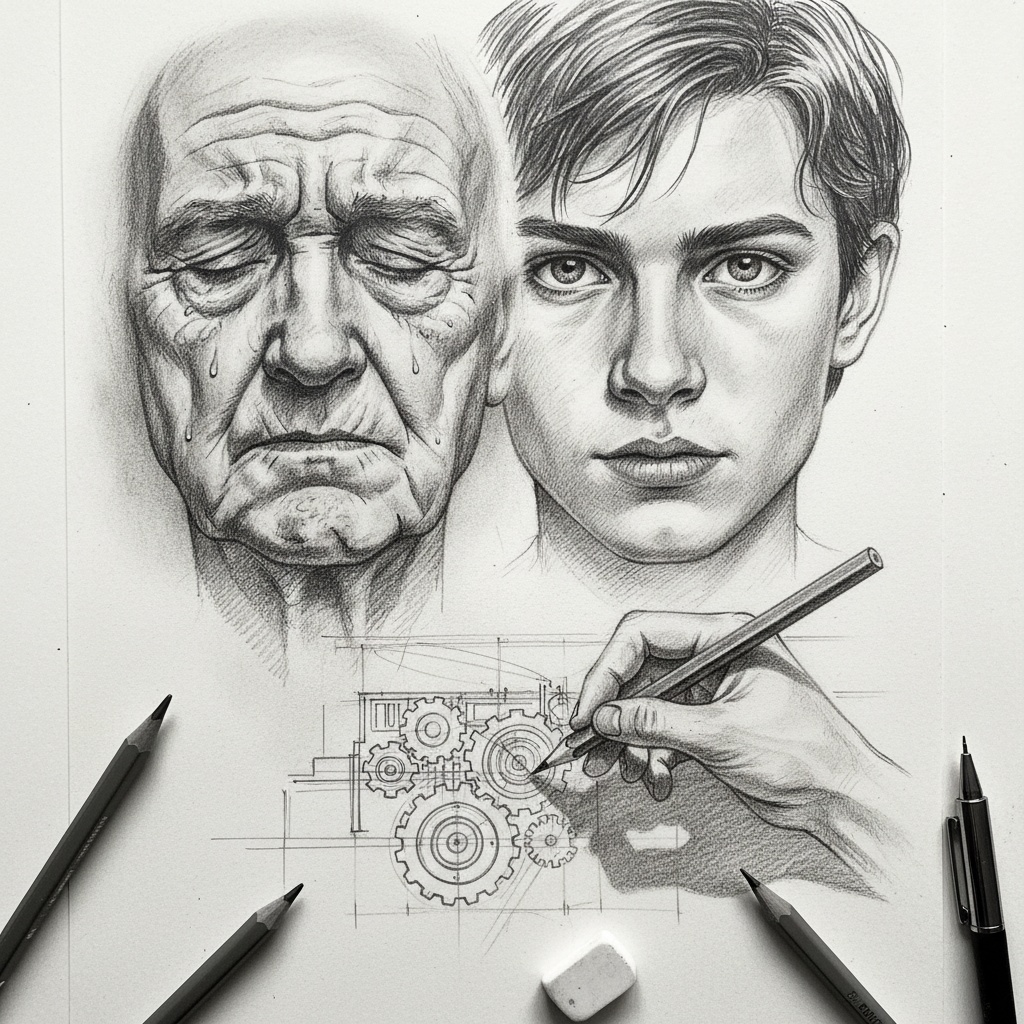
Achieving convincing depth in graphite drawing requires a nuanced understanding of texture and form. Artists employ a variety of techniques to create the illusion of three-dimensionality, from hatching and cross-hatching – building tone through parallel and intersecting lines – to blending and smudging. The choice of pencil hardness is crucial; harder pencils (H grades) produce delicate, silvery tones ideal for highlights and fine details, while softer pencils (B grades) yield rich, dark blacks perfect for shadows.
Blending
with a finger, stump, or tortillon softens transitions between values, creating smooth gradations. However, over-blending can result in a muddy appearance; careful control is essential. Similarly, erasing isn’t merely about correcting mistakes – it's a powerful tool for lifting tone and creating highlights. Artists often use kneaded erasers to selectively remove graphite, revealing the bright underlying paper and adding luminosity to their drawings.Emotional Resonance: How Graphite Captures Mood and Atmosphere
While technically demanding, graphite drawing is ultimately an expressive medium capable of conveying a wide range of emotions. The subtle gradations of tone allow artists to create atmosphere, evoke psychological states, and capture the nuances of human experience. Vincent van Gogh’s ‘Seated Female Nude,’ for example, isn't simply a study of anatomy; it’s a poignant exploration of vulnerability and introspection.
The very nature of graphite – its soft, velvety texture and muted tones – lends itself to introspective subjects. Unlike the bold vibrancy of oil paint or watercolor, graphite encourages a more contemplative approach. The artist is forced to rely on subtlety and nuance, creating works that reward close observation and invite emotional connection.
Graphite Today: Contemporary Artists & the Enduring Legacy
Despite its long history, graphite drawing remains remarkably relevant in contemporary art. Artists continue to push the boundaries of the medium, exploring new techniques and challenging traditional notions of representation. From hyperrealistic portraits to large-scale abstract compositions, graphite’s versatility knows no bounds.
The enduring appeal of graphite lies in its simplicity and directness. It requires minimal tools and materials, allowing artists to focus on fundamental skills – observation, composition, and tonal control. Whether you're a seasoned professional or a budding enthusiast, the possibilities with graphite are limitless. At ArtsDot.com, we celebrate this timeless medium by offering high-quality reproductions of masterpieces created with graphite, as well as custom portrait commissions that capture your unique vision. Explore our collection today and discover the captivating power of graphite for yourself.