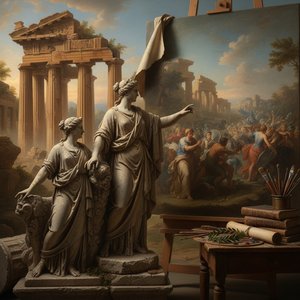
The Mathematical Origin: Brunelleschi and the Discovery of the Vanishing Point
 Filippo Brunelleschi
. Renaissance architect and engineer who pioneered linear perspective and designed Florence's dome.
Before the Renaissance, the depiction of space was often a matter of symbolic importance rather than physical accuracy. The size of a figure was frequently determined by their religious or social status rather than their distance from the viewer. This changed in Florence during the early fifteenth century when Filippo Brunelleschi began his experiments. Between 1415 and 1420, the architect sought a way to translate the three-dimensional world onto a two-dimensional plane with mathematical certainty. He demonstrated this through a clever experiment involving a painting of the Florence Baptistery, a hole, and a mirror, allowing observers to see how parallel lines appeared to meet at a single, distant point.
This discovery provided a logical framework that transformed the canvas from a flat surface into a window. By establishing a central vanishing point on the horizon, artists could finally dictate exactly how objects should recede. This was not merely a stylistic choice; it was a fundamental shift in how humanity perceived its place within a measurable, ordered universe. The mathematical precision of Brunelleschi allowed for a sense of order that replaced the stylized, flattened compositions of the medieval era.
Today, we see the legacy of this precision in the way we organize space in our own environments. Just as Brunelleschi used geometry to bring order to the Florentine streets, modern design relies on these same principles of perspective to create depth in interior spaces, ensuring that our visual world feels coherent and structured.
Architectural Order: Using Geometry to Construct Narrative Space
 Andrea Mantegna
. Italian Renaissance master of sculptural precision and illusionistic perspective, known for his monumental Triumphs of Caesar and frescoes.
Once the rules of perspective were established, artists began to use architecture as a tool to guide the viewer through a story. Rather than simply placing figures in a landscape, painters used receding columns, tiled floors, and arched doorways to create a stage for their subjects. This method allowed for a unified scene where every element contributed to a single, cohesive moment in time. Masaccio was among the first to apply these geometrical principles to his frescoes, creating a sense of weight and presence that had been previously unseen.
In the works of Andrea Mantegna, this technique reached a high level of sophistication. He used meticulous mathematical calculations to render the textures of polished marble and draped fabrics within the Gonzaga palace, making the painted architecture feel like a natural extension of the room itself. By using converging lines to draw the eye toward a specific focal point, the artist could control the viewer's attention, ensuring that the most important part of the narrative was always the most visually prominent.
This architectural precision is what gives a room a sense of purpose. When we look at a well-composed landscape or a structured interior, we are responding to the same geometric cues that Renaissance masters used to direct our gaze and establish a sense of hierarchy and importance.
The Human Dimension: Foreshortening and the Realism of the Body
The application of linear perspective was not limited to buildings and horizons; it fundamentally changed the way the human form was rendered. Through the technique of foreshortening, artists learned to depict limbs and torsos as they appeared when receding into the viewer's line of sight. This meant that an arm reaching toward the observer would appear shorter than it actually was, creating a startlingly realistic sense of volume and movement. This was a departure from the static, two-dimensional figures of earlier traditions.
This mastery of the body allowed for a new level of physical presence. When a figure is foreshortened, they no longer sit on the surface of the painting; they occupy the space within it. This creates a psychological connection between the subject and the viewer, as the figure seems to inhabit the same three-dimensional reality that we do. It is a technique that demands the viewer acknowledge the physical weight and anatomical truth of the human form.
We encounter this same principle in our modern visual language, from the way we photograph subjects to the way we perceive depth in a crowded room. The ability to recognize the true shape of an object, even when it is viewed from an unusual angle, is a direct inheritance from these early experiments in anatomical realism.
The Science of Solids: Piero della Francesca and the Mastery of Volume
While many artists used perspective to create a sense of depth, Piero della Francesca sought to understand the very geometry of existence. In his treatise De Prospectiva pingendi, written in the 1470s, he moved beyond the simple depiction of receding lines to explore the mathematical properties of three-dimensional solids. He was the first to accurately draw Platonic solids in perspective, treating light and shadow as mathematical variables that define the volume of an object.
His work is characterized by an extraordinary clarity and precision. In his depictions of battle scenes, the chaos of conflict is held within a rigorous geometric structure. He did not merely represent a battlefield; he constructed it. This approach ensured that every figure and every object was placed with absolute certainty, contributing to a sense of monumental stillness and permanence. His work represents the peak of the intersection between art and Euclidean geometry.
This pursuit of structural integrity is echoed in the way we value craftsmanship today. There is a profound satisfaction in seeing an object—whether a piece of furniture or a work of art—that possesses a clear, undeniable sense of weight and physical presence, a quality achieved through the careful balance of form and proportion.
The Softness of Air: Integrating Sfumato with Linear Precision
 Perspectiva para la Adoración
, Leonardo da Vinci
Linear perspective provides the skeleton of a painting, but it is the atmosphere that provides its soul. Leonardo da Vinci understood that while geometry could define the edges of a building, the eye perceives the world through layers of air and light. This led to his development of sfumato, a technique where colors and tones are blended so subtly that they appear to melt into one another, much like smoke. This prevented the harsh, artificial outlines that often accompanied strict mathematical perspective.
In his 1481 work Perspectiva para la Adoración, Leonardo demonstrates this delicate balance. He uses the rigorous lines of linear perspective to establish the architectural setting, but he softens the distant landscapes with atmospheric effects. As the eye moves toward the horizon, the details become less distinct and the colors more muted, mimicking the way light scatters through the atmosphere. This creates a sense of infinite depth that goes beyond mere geometry, touching upon the sensory experience of seeing.
This marriage of the mathematical and the atmospheric is what makes a scene feel truly lived-in. It is the difference between a technical drawing and a window into a real, breathing world, where the air itself has a texture and a weight.
The Illusion of Truth: Anamorphosis and the Boundaries of Perspective
 Ambassadors - the ambassadors (detail)
, Hans Holbein the Younger
The mastery of perspective also allowed artists to explore its limits, leading to the development of anamorphosis. This is a form of perspective distortion where an image appears highly distorted unless viewed from a very specific, oblique angle. A famous example is found in Hans Holbein the Younger’s The Ambassadors, where a distorted shape is revealed to be a skull only when the viewer stands to the side of the painting.
Anamorphosis serves as a reminder that our perception is often subjective and dependent on our position. It challenges the viewer to move, to change their perspective, and to look closer to find the hidden truth. It turns the act of looking into an active, intellectual engagement, where the "correct" view is not always the most obvious one. This technique plays with the very boundaries of what a flat surface can represent.
In an era of instant visual gratification, these subtle complexities remind us that true understanding often requires a change in viewpoint. It encourages a deeper, more deliberate way of seeing, much like the way we must carefully consider the nuances of a complex piece of art to appreciate its full meaning.